






Timing is the single biggest variable in your futures betting strategy. Pick the right window, and a 50/1 ticket cashes for a massive return. Pick the wrong one, and you lock up capital for nine months at odds that hold no value.
This guide covers how soccer futures markets work, the four timing windows that matter, and the entry signals that separate sharp bettors from the public.
What Is Futures Betting in Soccer
A futures bet is a long-term wager on an outcome that resolves weeks or months after you place it. The odds lock in at the moment of placement, so a Premier League title ticket struck in July at 50/1 pays at 50/1 even if that team becomes the favourite by March.
How Futures Markets Differ from Match Betting
Match betting is settled within 90 minutes. Your bankroll exposure is short, the bookmaker’s pricing is tight, and the variance per ticket is contained.
Future betting locks your stake for months. The two biggest differences are liquidity and overround. Match markets attract heavy volume and often operate at lower margins than futures markets, particularly at sharper sportsbooks and exchanges. Outright markets carry wider overrounds because the bookmaker is pricing 20 selections instead of three, and the ticket sits on the book for the full season.
Common Types of Soccer Futures
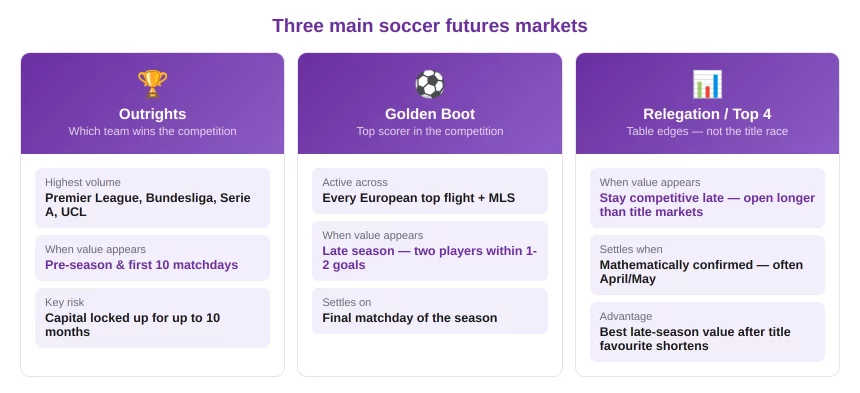
The most active soccer futures sports betting markets sit in three buckets:
- Outrights. An outright bet is a wager on which team wins a competition outright. Premier League futures betting markets attract the highest volume of any European league, with Bundesliga and Serie A close behind. Champions League futures betting markets also remain extremely popular, covering not only the outright winner, but also group winners and qualification for later knockout rounds.
- Top scorer (Golden Boot). Active across Major League Soccer futures betting and every European top flight, the Golden Boot market settles on the final matchday on whichever player finishes with the most goals.
- Relegation, top-four, and qualification markets. These resolve at the table’s edges and produce some of the best future bets late in the year. A relegation bet resolves when the bottom three clubs are mathematically confirmed — often not until April or May. Top-four and European qualification markets work the same way: they stay open and competitively priced far longer than title markets, where the favourite tends to shorten early and drain most of the value by December.
How Soccer Futures Markets Work
Three things determine where a futures price sits at any moment: how the book opened the line, how much margin sits inside the overround, and which inputs are moving the price right now.
Odds Formation and Market Movement
Bookmakers open futures using power ratings, ELO models, simulation tools, and last year’s table. Pricing then adjusts as results arrive, transfers close, and money flows in.
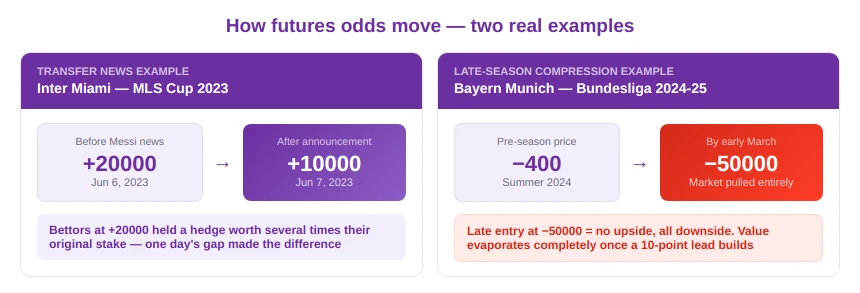
For example, on June 6, 2023, Inter Miami’s MLS Cup price sat at +20000. A day later, after news broke of Lionel Messi’s signing, those odds shifted to +10000 and continued to fall. Bettors who struck at +20000 held a hedging opportunity worth several times their original stake.
Bookmaker Margins and Value
Bookmaker margin (the overround) is the cost of doing business with the house. Industry margins on Premier League 1X2 markets average around 6%, with some books operating at 10% and the sharpest at 2%.
Outright futures markets are famously wide. Bookmakers routinely bake a massive overround into a 20-team title market, ensuring the house takes a heavy cut before a ball is even kicked. Because the margins are so stacked against the bettor, line-shopping across multiple books is the highest-impact optimisation you can make.
Serie A futures betting markets, for example, regularly carry higher overrounds than Premier League equivalents because lower betting volume gives bookmakers less reason to sharpen the line.
Factors That Influence Futures Odds
Pricing reacts to results, expected goals, transfer activity, injuries to key players, mid-season manager changes, and schedule difficulty. Each input feeds the bookmaker’s modelling and forecasting engines. Sharp money fronts the public reaction, which is why early markets carry the highest information asymmetry.
Key Timing Windows for Futures Betting
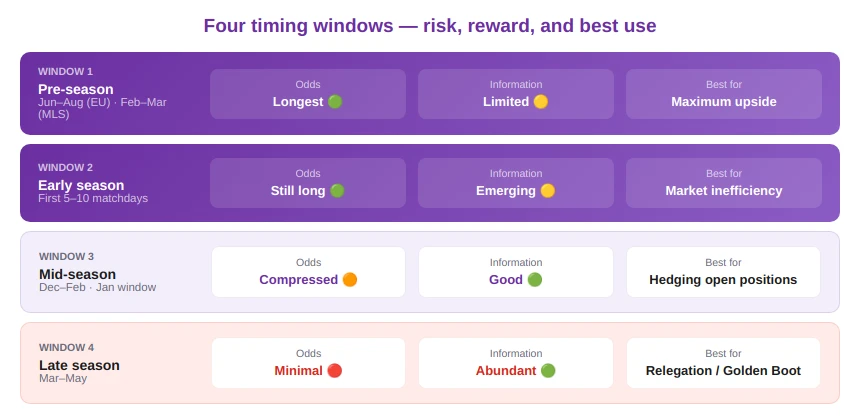
Four windows produce different risk-reward profiles. Optimal entry depends on whether you want long prices or a clearer information picture.
Pre-Season Opportunities
Pre-season runs from June through August for European leagues and from February through March for MLS. Books open prices before transfer windows resolve, so the probability distribution shifts as squads change.
Liverpool’s £116 million (around CA$214 million) signing of Florian Wirtz from Bayer Leverkusen on June 20, 2025, is a recent example. Anyone holding a Liverpool title ticket from the day after the previous season ended captured the full price compression that followed.
Early-Season Market Inefficiencies
The first five to 10 matchdays produce the second-best window. Books move favourites slowly and longshots even slower. Public bettors overreact to early results while bookmakers, wary of being wrong twice, drag their adjustments.
Leicester’s 2015-16 Premier League title run is the textbook case. The largest single payout in British bookmaker history (roughly CA$400,000 on a CA$200 stake) came from a ticket struck at 2,000/1 in October, eight matchdays in, with Leicester three points off the lead.
Mid-Season Adjustments and Value Spots
December through February is the hedging window, not the entry window. The January transfer window, mid-season managerial sackings, Champions League knockout draws, and fixture congestion reshuffle the probability distribution. If you opened a position in pre-season, this is the period to evaluate a partial hedge on an exchange or take a cash-out offer. New positions struck here face compressed odds and reduced upside.
Late-Season Risks and Limited Value
March through May offers limited value at the top of the table. Bayern Munich’s 2024-25 Bundesliga price ran all the way to -50000 by early March, with sportsbooks beginning to pull the market entirely.
Anyone who tries to bet on Ligue 1 futures after Christmas is usually looking at a PSG title market that has already priced out most of the value — the interest shifts entirely to second place and European qualification.
What survives in this window: relegation battles, top-four races, and Golden Boot markets where two players sit within one or two goals of each other. Drawdown risk on title favourites becomes asymmetric, with all the downside and almost no upside.
Factors That Determine the Best Entry Time
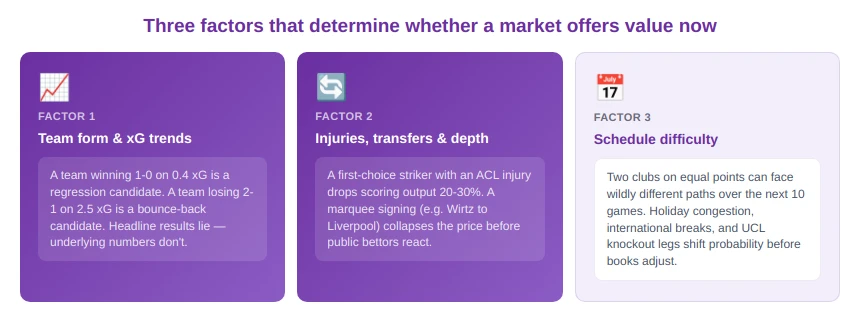
Calendar timing tells you when to look. These three inputs tell you whether the specific market in front of you offers value right now.
Team Form and Performance Trends
Form over the previous five to 10 matches, weighed against underlying analytics (xG differential, shot conversion regression, momentum indicators), gives a cleaner read than headline results. A team winning 1-0 on 0.4 expected goals is a regression candidate. A team losing 1-2 on 2.5 xG against is a bounce-back candidate.
Injuries, Transfers, and Squad Depth
A first-choice striker tearing his ACL in pre-season triggers a 20-30% drop in expected scoring output, forcing oddsmakers to instantly downgrade the team’s implied title probability. The reverse holds: a marquee signing late in the window collapses the price before public bettors react. Squad depth matters in proportion to fixture turnover, with Champions League and Europa League sides carrying heavier rotation loads.
Schedule Difficulty and Fixture Congestion
Run a fixture-difficulty rating across the next 10 matches. Two clubs on the same points total face wildly different paths over two months. Holiday congestion in the Premier League, the November international break, and European knockout legs introduce schedule volatility that opening markets do not fully price.
Pros and Cons of Betting Early vs Late
| Window | Odds | Information | Variance | Capital Lock-Up | Upside |
| Early | Longest | Limited | High | Up to 10 months | Maximum |
| Late | Compressed | Abundant | Low | Weeks | Limited |
Early entry compounds your edge when your forecasting is sound, because you capture both the longshot price and the option to hedge later. Late entry suits bettors who want lower variance and faster turnover at the cost of upside.
Strategies for Timing the Futures Market
These are the futures betting tips that separate disciplined long-term players from bettors who chase lines.
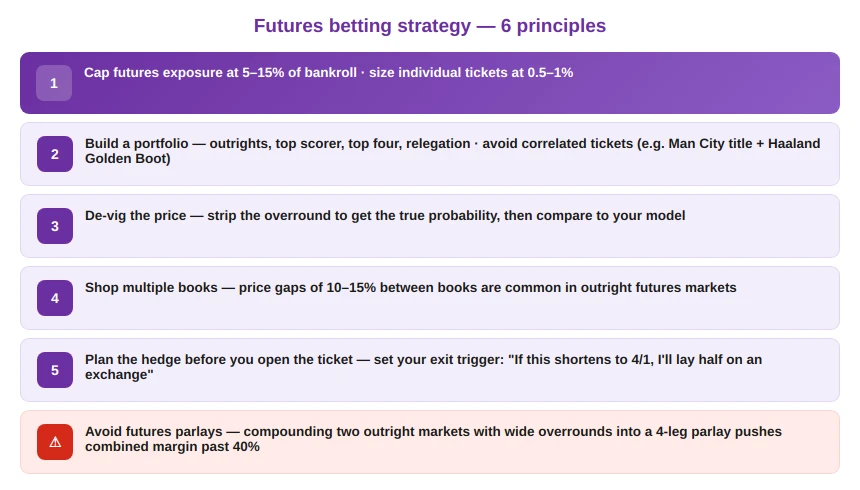
- Cap exposure. Allocate 5-15% of your bankroll to futures across a full season. Size individual tickets at 0.5-1%. Allocation discipline beats stock-picking.
- Build a futures portfolio. Diversification across outrights, top scorer, top four, and relegation reduces correlation. Avoid stacking correlated tickets (Manchester City title plus Erling Haaland Golden Boot wins or loses together).
- Use de-vigged pricing. Strip the overround from the book’s price to get a true probability, then compare to your model’s valuation. That’s your benchmarking discipline.
- Shop multiple books. Price gaps of 10-15% between books are common in outright futures markets.
- Plan your hedge. Set your exit trigger when you open the ticket: “If this shortens to 4/1, I’ll lay half on an exchange.”
- Use arbitrage selectively. Cross-book arbitrage on outrights ties up capital for months, and the efficiency gains rarely beat a tighter single-book entry.
- Be cautious with futures parlays. Compounding two outright markets — each carrying 115% overround — into a four-leg parlay pushes the combined margin past 40%. That’s entertainment money, not a positive-expected-value play.
Common Mistakes in Soccer Futures Betting
The quickest ways to drain a futures bankroll usually come from the same recurring mistakes:
- Betting your favourite team on emotion instead of on a number
- Ignoring overround and treating listed odds as fair probability
- Chasing 5,000/1 tickets with no analytical basis (Leicester was the exception, not the template)
- Putting heavy stakes in low-liquidity markets where exit options are limited
- Forgetting opportunity cost: a CA$200 ticket on a nine-month outright is dead capital
- Overreacting to a single September result and chasing the line move
The essence of how to bet on futures profitably is mostly about avoiding these traps before worrying about picks.
Responsible Gambling
Betting should be entertainment, not a way to make money. Gambling can be addictive—only bet what you can afford to lose, and never chase your losses. Set deposit, loss, and time limits before you play, and take regular breaks.
If gambling stops being fun or starts affecting your finances, relationships, or wellbeing, seek help immediately.
Support available across Canada:
- Responsible Gambling Council: responsiblegambling.org (national resource centre)
- British Columbia: Call 1-888-795-6111 (24/7)
- Alberta: Call 1-866-332-2322 (24/7)
- Quebec: Call 1-800-461-0140 (24/7, bilingual)
- Saskatchewan: Call 1-800-306-6789 (24/7)
- Manitoba: Call 1-800-463-1554 (24/7)
- Atlantic provinces: Call 1-800-461-1234 (NB), 1-888-429-8167 (NS), 1-855-255-4255 (PE), 1-888-899-4357 (NL)
- Additional support: Gambling Therapy (gamblingtherapy.org), Gamblers Anonymous (gamblersanonymous.org)
- 988 Suicide Crisis Helpline: Call or text 988
TonyBet provides responsible gambling tools in your account settings, including deposit limits, loss limits, time limits, cool-off periods, and self-exclusion. Use them.
Age restrictions: You must be 19 or older to gamble in British Columbia, Saskatchewan, and Atlantic provinces. You must be 18 or older in Alberta, Manitoba, and Quebec. Underage gambling is illegal.
For more information about responsible gambling practices and support resources, visit the Responsible Gambling section on TonyBet.

FAQ
When is the best time to place a soccer futures bet?
Are early futures bets more profitable than late ones?
How do odds change during a soccer season?
Can you cash out a futures bet before the season ends?


