





Two teams can play almost the same game, create the same chances, and still finish with completely different results because of their goalies. A goalie can slow a game down, frustrate shooters, and change the whole rhythm of the night.
In this article, we’ll break down why NHL goalie matchups matter so much, how they affect betting lines, and why some games stop following the numbers once the puck drops.
Why Goalie Matchups Matter More Than You Think
To understand why goalie matchups matter, you need to look at how they affect three things: who controls scoring chances, how the market reacts to changes in net, and where pricing still misses context.
The Goaltender as the Most Influential Position in Hockey
Every scoring chance ends at the goalie. No other player touches every critical moment like that. Skaters can control play for stretches, but the goalie decides whether those chances turn into goals.
In a goalie matchup, this shows up most in high-danger situations — shots from the slot, rebounds, and second attempts. If one goalie consistently handles those better, his team doesn’t need more chances to win. That’s why two sides can look equal on paper but produce different results.
How Goalie Changes Impact Betting Lines
Goalie changes affect betting lines because they change expected stability in the net. When teams confirm different starting goalies in the NHL, sportsbooks adjust odds to reflect that shift.
A clear pattern shows up with tandem systems. When a team rotates between a clear starter and a backup, the line typically moves one to two points toward the opponent the moment the backup is confirmed. The bigger the gap between the two goalies in recent performance, the sharper the move.
Why the Market Still Undervalues Goalie Impact
Even after market adjustments, goalie impact is not always priced correctly. A goalie matchup that NHL bettors evaluate too quickly is often judged only by save percentage, but that number misses a lot of context. One goalie may spend the night facing screens, rebounds, and dangerous slot chances, while the other mostly deals with clean shots from the perimeter.
As a result, the numbers can tell a misleading story. A goalie with weaker statistics may actually be performing better under much tougher conditions. Since basic stats rarely show the full picture, some matchups stay slightly mispriced, and that’s where deeper analysis becomes valuable.
How Goalie Matchups Shape NHL Odds
Books price the crease first, then build the rest around it. They open lines using projected lineups, particularly the starting goalie, and adjust once teams confirm who actually plays. That adjustment usually stays moderate, but it matters because it reflects expected stability in the net.
Timing plays a key role here. Early prices rely on projected NHL starting goalies, so confirmation can shift the number before the market fully settles. For example, when the Winnipeg Jets started Eric Comrie instead of Connor Hellebuyck against the Tampa Bay Lightning, the line moved toward Tampa before puck drop. The Jets went from -105 in the morning to +120 in the evening. The team didn’t change — the expected save level did. That’s how odds respond to goaltending.
Key Metrics for Evaluating Goalies
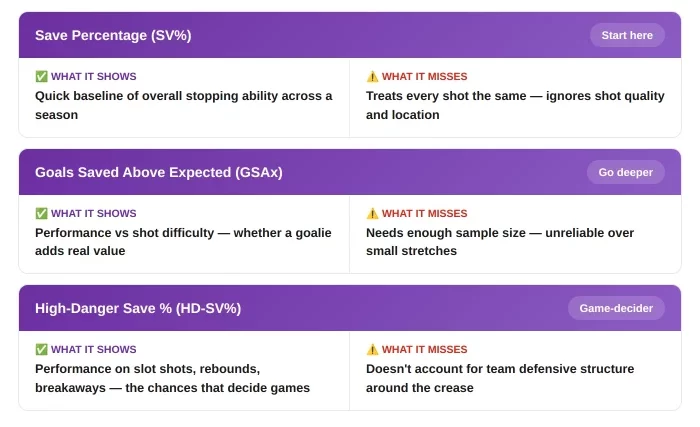
When you compare NHL starting goaltenders, relying on a single stat leaves gaps. To read a matchup properly, you need to separate three layers: results, shot quality, and current level. Each metric explains a different part of the overall picture.
Save Percentage and Its Limitations
Save percentage gives you a quick baseline, but it doesn’t show what a goalie actually deals with. It treats every shot the same, even though shot quality varies significantly.
A goalie behind the Carolina Hurricanes often faces cleaner attempts with less traffic, as the team allowed only 23.9 shots per game in the 2025-26 regular season, fewer than any other NHL side. In contrast, other teams expose their netminder to heavy screening, deflections, and pressure around the crease.
Those situations produce different outcomes, but the stat doesn’t separate them. Use the save percentage to start your evaluation, then look at where the shots come from.
Goals Saved Above Expected (GSAx)
GSAx moves the analysis forward by measuring performance against shot difficulty. It compares actual goals allowed to expected goals based on location and situation, which shows whether a goalie adds value.
For example, even when Igor Shesterkin of the New York Rangers faces repeated high-danger chances, he often posts positive GSAx (21.3 in the 2025-26 regular season) because his positioning and tracking limit clean finishes. That tells you he performs above expectation, not just within a strong system.
High-Danger Save Percentage
Once you understand overall performance, focus on the moments that decide games. High-danger save percentage isolates shots from the slot, rebounds, and breakaways — the situations where goals are most likely.
Goalies like Andrei Vasilevskiy stand out here. His .844 high-danger save percentage in the 2025-26 regular season was tied for seventh place in the league. He controls angles on breakaways and recovers quickly after initial saves, which reduces second chances. That recovery speed comes down to agility — the ability to reset laterally between saves is what separates goalies who give up soft rebounds from those who eliminate second chances entirely.
Recent Form and Rolling Performance
After evaluating long-term performance, shift your focus to current form. Season averages smooth out changes that matter in the short term.
Recent goalie starts help you spot those shifts. Heavy workloads can affect lateral movement and timing, while lighter usage can improve consistency and confidence.
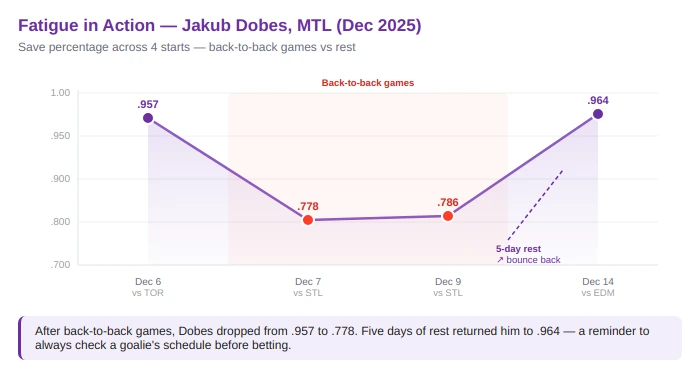
For instance, Montreal Canadiens goaltender Jakub Dobes posted a .957 save percentage against the Toronto Maple Leafs on December 6, 2025, which dropped to .778 the next day when they played the St. Louis Blues. On December 9, it stood at .786, and only after a five-day rest, did he bounce back with a .964 save percentage performance against the Edmonton Oilers.
Contextual Factors Bettors Often Miss
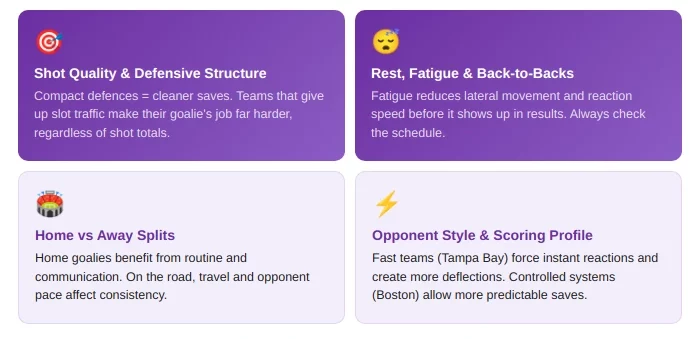
Metrics show how a goalie performs, but context explains why those numbers look the way they do. Shot quality, schedule, location, and opponent style all change how difficult a game becomes for the goalie.
Shot Quality and Defensive Structure
Defensive structure determines the type of shots a goalie faces. Teams that protect the middle limit attempts from the slot and reduce rebounds around the crease. That leads to cleaner, more predictable saves.
For example, in the 2024-25 regular season, the Los Angeles Kings played a very structured defensive system that limited dangerous chances around the net. The team ranked second in both shots allowed per game (25.5) and goals conceded (203). Because of that, LA Kings goalie Darcy Kuemper often posted more stable numbers than those playing behind weaker defensive coverage and even led the entire NHL with a .862 high-danger save percentage.
Teams that give up more traffic, rebounds, and second-chance opportunities near the crease force their goaltenders to deal with screens, deflections, and loose pucks in crowded areas. Even when the total number of shots looks similar, those situations usually create a much higher scoring risk.
Powerplay sequences produce some of the most dangerous looks a goalie faces — the defence is outnumbered, shooting lanes open up, and screens in the bluepaint become harder to manage.
Rest, Fatigue and Back-to-Back Games
Goaltending relies on timing and movement, and fatigue affects both. When goalies play on consecutive nights or handle a heavy schedule, their lateral movement and recovery speed tend to drop.
That’s why many bettors check searches like “the Oilers goalie tonight” before the puck drops. With the speed at which the Edmonton Oilers play, their goalie regularly deals with quick transitions, odd-man rushes, and breakaways. On short rest, even a slight delay in positioning or reaction time can turn those chances into goals.
Home vs Away Performance Splits
Performance can shift depending on location. At home, goalies benefit from routine, communication, and familiar surroundings. On the road, travel and opponent pace can affect consistency.
For instance, a Montreal goalie may show different results away from home, especially against stronger offensive teams. These differences don’t always appear in overall stats, but they become visible when you separate home and away performance.
Opponent Style and Scoring Profiles
Not every offence creates pressure in the same way. Some teams slow the game down and build patiently, while others attack with speed and force goalies to react almost instantly.
The Tampa Bay Lightning create a lot of movement through quick passing and dangerous positioning around the slot. Because of that, goalies facing Tampa Bay regularly deal with fast, unpredictable sequences in dangerous areas. The Lightning’s movement through the slot means opposing netminders see more second chances and deflections than against slower, more structured teams.
Meanwhile, the Boston Bruins usually play a more controlled system. Their structure limits unnecessary pressure and helps the Boston Bruins goalie group stay more consistent over long stretches of the season.
That’s why matchup analysis goes beyond simple stats. You also need to understand how a team creates chances and what kind of pressure a goalie will actually face during the game.
Identifying Value in Goalie Matchups
Value appears when the expected performance in net doesn’t match the actual conditions of the game. Start by checking what the line assumes about the starting goalie, then compare it to shot profile, recent workload, and opponent style.
Tandem systems highlight this clearly. The Minnesota Wild, for example, ran one of the most effective rotations in the regular season, with both Filip Gustavsson and Jesper Wallstedt posting strong results behind the same defensive structure. Because both goalies faced similar shot quality and workload, the gap between them stayed smaller than public perception suggested. When pricing assumes a larger difference than the underlying data supports, that’s where the mismatch comes from.
The goal here is to check whether the expected level in net aligns with how the team actually defends and what kind of chances the opponents create.
Goalie Matchups and Different Bet Types
Goalie performance affects outcomes in different ways depending on the type of result you’re looking at.
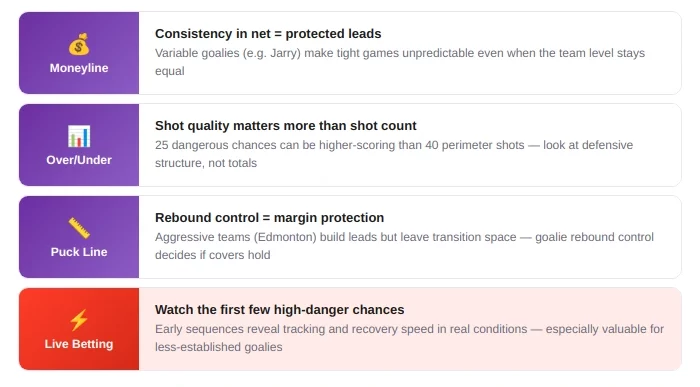
Impact on Moneyline Bets
Moneyline results depend on whether a team can protect small leads and manage late-game pressure. That comes down to consistency in the net.
Tristan Jarry provides a clear example of variability. Across different stretches, his results have shifted from above average to below average, even within the same season. When that happens, teams struggle to close out tight games because routine chances start turning into goals. In those matchups, the outcome becomes less stable, even if the overall team level stays similar.
Influence on Totals (Over/Under)
Over/under markets depend less on total shots and more on the quality of chances teams create. A game with 25 dangerous chances can become far more open than one with 40 harmless shots from distance.
That’s why defensive structure matters so much when evaluating totals. A Montreal goalie, for example, often faces pressure from rebounds, screens, and transition attacks when the Canadiens lose control around the slot. Against faster teams, those repeated high-danger chances usually push games toward higher scoring, even if the overall shot count stays average.
Relevance for Puck Line Betting
Puck line bets depend heavily on whether a team can protect a multi-goal lead. Scoring is important, but preventing momentum swings matters just as much.
That’s why the Edmonton goalie becomes such an important factor in Oilers puck line matchups. The team usually creates enough offence to build leads, but their aggressive style also leaves space for transition chances the other way. If the goalie controls rebounds and stays sharp during pressure stretches, Edmonton can comfortably cover the margin. If not, games often become much tighter than expected.
Live Betting Opportunities
Live play shows how a goalie performs in real conditions — movement, positioning, and rebound control become visible within the first few high-danger chances.
This is especially important with less-established options, such as Montreal Canadiens goalie Jakub Dobes, where long-term data remains limited. Early sequences often reveal whether the goalie tracks the puck cleanly or struggles with recovery. Those details affect scoring probability immediately, often before any long-term trend appears in the stats.
Common Mistakes When Evaluating Goalie Matchups
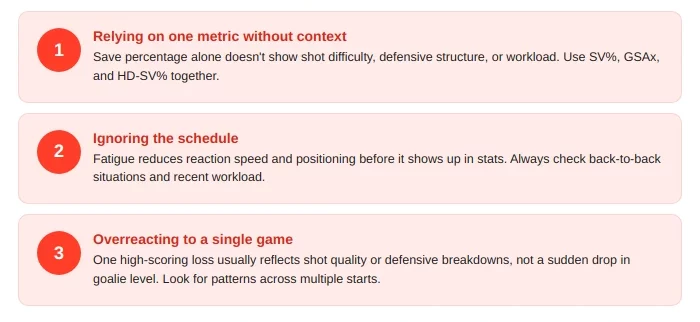
The most common mistake is relying on one metric without context. Save percentage alone doesn’t show shot difficulty, defensive structure, or workload.
Another mistake is ignoring how the schedule affects performance. Fatigue reduces reaction speed and positioning before it shows up in results.
Finally, many people overreact to single games. One high-scoring loss often reflects shot quality or defensive breakdowns rather than a sudden drop in level. To evaluate correctly, look for patterns over multiple games and connect performance to the type of chances a goalie faces.
Responsible Gambling
Betting should be entertainment, not a way to make money. Gambling can be addictive—only bet what you can afford to lose, and never chase your losses. Set deposit, loss, and time limits before you play, and take regular breaks.
If gambling stops being fun or starts affecting your finances, relationships, or wellbeing, seek help immediately.
Support available across Canada:
- Responsible Gambling Council: responsiblegambling.org (national resource centre)
- British Columbia: Call 1-888-795-6111 (24/7)
- Alberta: Call 1-866-332-2322 (24/7)
- Quebec: Call 1-800-461-0140 (24/7, bilingual)
- Saskatchewan: Call 1-800-306-6789 (24/7)
- Manitoba: Call 1-800-463-1554 (24/7)
- Atlantic provinces: Call 1-800-461-1234 (NB), 1-888-429-8167 (NS), 1-855-255-4255 (PE), 1-888-899-4357 (NL)
- Additional support: Gambling Therapy (gamblingtherapy.org), Gamblers Anonymous (gamblersanonymous.org)
- 988 Suicide Crisis Helpline: Call or text 988
TonyBet provides responsible gambling tools in your account settings, including deposit limits, loss limits, time limits, cool-off periods, and self-exclusion. Use them.
Age restrictions: You must be 19 or older to gamble in British Columbia, Saskatchewan, and Atlantic provinces. You must be 18 or older in Alberta, Manitoba, and Quebec. Underage gambling is illegal.
For more information about responsible gambling practices and support resources, visit the Responsible Gambling section on TonyBet.

FAQ
How important are goalie matchups in NHL games?
Which goalie stats matter most for analysis?
When are starting goalies usually confirmed?
Do backup goalies always create value?


