





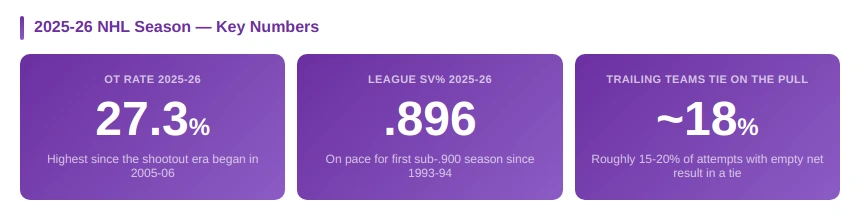
Live betting on hockey looks easy: react to swings and click. However, the moments that feel decisive on TV often do not match the moments that move the math. This guide separates real momentum shifts from cosmetic ones and shows how live markets price each. The 2025-26 season has produced a record overtime rate, the lowest league save percentage in three decades, and a wave of late-game collapses.
Live Betting in the NHL
Live NHL markets reopen after every whistle, with a constant stream of game-state inputs driving every reprice.
Differences Between Pre-Game and Live Markets
Pre-game NHL lines are built using team-level factors such as schedule, starting goalies, projected lineups, and recent form. NHL in-play betting odds, meanwhile, are priced off the current game state. Shot attempts, faceoff trends, special-teams sequences, and remaining time all feed into the model.
Live margins run wider than pre-game margins, meaning the same edge returns a smaller payout.
Understanding Momentum in Hockey
Momentum is the most overused word in hockey broadcasting and one of the most misread signals in live betting.
What “Momentum” Means in NHL Context
Hockey momentum is a sustained tilt in tempo, possession, and shot quality favouring one team for several minutes. It is felt through forecheck pressure, a clean breakout, longer offensive shifts, and broken plays at the other end. It is not the goal that just went in. Momentum is the run of play between events.
Why Momentum Is Hard to Quantify
Two minutes of pressure mean nothing unless they produce shots from dangerous areas or force a penalty. A 2025 Syracuse study by Griffiths and Moskow, using Sportlogiq data from 541,000 NHL events, found that optimal event sequences correspond to roughly a 15% increase in scoring probability. Momentum in sports is real, but the effect dissipates fast.
Key Indicators of Momentum Shifts
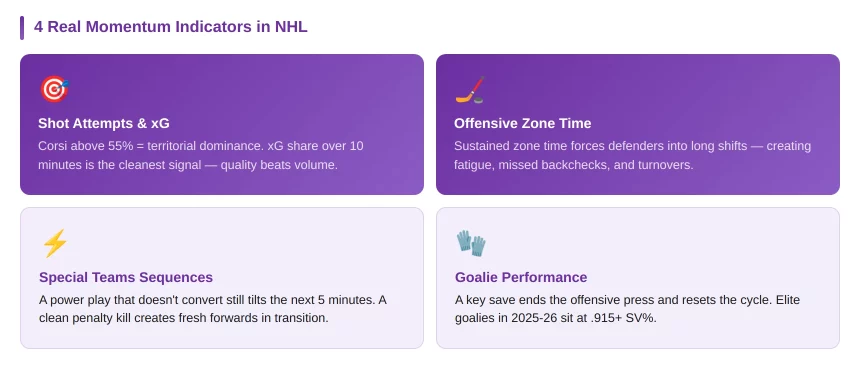
Four categories carry most of the signal: shot generation, possession location, special-teams sequences, and goalie performance.
Shot Attempts and Scoring Chances
Corsi (CF%) counts every shot attempt directed at the net, including misses and blocks. A number above 55% over a sustained stretch is the working threshold for territorial dominance.
Expected goals (xG) add important context by weighting each shot based on location, angle, and game situation, which is why a 1.2-to-0.4 xG advantage over 10 minutes beats a raw 12-to-4 edge in shots.
Offensive Zone Time and Possession
Sustained zone time means clean breakouts, effective cycling, and forcing defenders into long shifts, leading to fatigue, missed backchecks, and turnovers that create the next scoring chance.
Watch whether the trailing team is controlling the cycle and maintaining pressure, not just piling up shots.
Special Teams Impact (Power Plays & Penalty Kills)
A power play that does not convert can still tilt the next five minutes if it forces the kill unit into back-to-back long shifts. Edmonton’s league-leading 30.6% power play in 2025-26 marks the upper end of conversion, while the league average typically sits at 18-22%. A clean penalty kill produces a short burst of offence from fresh forwards and built-in transition.
Goalie Performance and Key Saves
A key save ends the offensive press, gives the defending team a faceoff in their own end, and resets the cycle.
The 2025-26 league save percentage has hovered around 89.6%, on pace for the first sub-.900 season since 1993-94. This year, elite goalies sit at .915 or higher, the new above-average ceiling.
How Live Markets React to Momentum
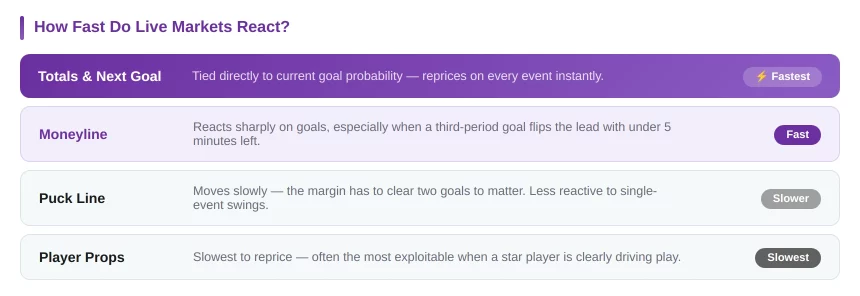
Sportsbooks reprice live NHL lines on every event, but not every market reacts at the same speed.
Odds Movement After Goals and Big Plays
Live moneylines move sharply on every goal, then recalibrate within seconds as the model reweights time remaining and score state. The shift is larger when the goal closes a deficit than when it extends a lead, and largest when a third-period goal flips the lead with under five minutes to play.
Markets That React the Fastest (Totals, Next Goal, Moneyline)
Live totals and next-goal markets update the quickest because they tie directly to current-state goal probabilities. The three-way regulation moneyline reacts second; the puck line moves more slowly because the margin has to clear two goals to matter. Player props are typically the slowest to reprice and often the most exploitable when a star is driving play.
Overreactions vs True Game Flow
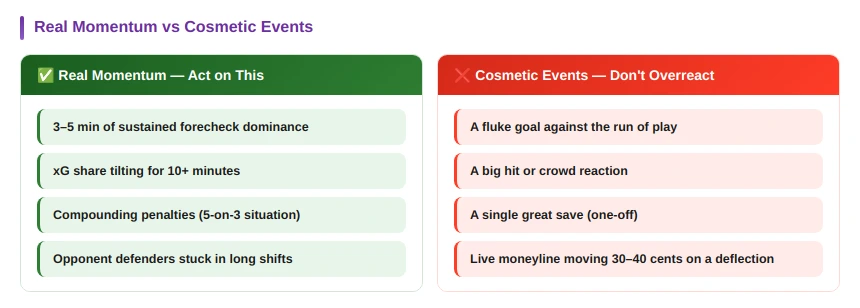
Hockey live odds frequently overreact to a goal scored against the run of play. The classic spot is a fluke deflection that does not reflect the 15 minutes of pressure before it. Bettors who track xG can find spots where game flow has not changed, even when the live moneyline has moved 30-40 cents.
When Momentum Truly Shifts in a Game
Not every swing matters; the shifts worth acting on last long enough to show up in the underlying numbers.
Sustained Pressure vs One-Off Events
A single big hit or great save does not shift momentum on its own. Sustained pressure does: three to five minutes of forecheck dominance, two or more high-danger chances, and a faceoff win deep in the offensive zone. That combination shows up in xG share and is the cleanest signal of a real shift.
Turning Points (Penalties, Breakaways, Big Saves)
Compounding penalties are the strongest turning point. A second penalty inside the first minute of a kill creates a 5-on-3 and the highest single-event scoring rate in hockey outside of an empty net.
Breakaways stopped on big saves also matter, because the goalie’s composure and the bench’s resilience visibly shift over the next two shifts.
Late-Game Momentum and Empty-Net Situations
Empty-net 6-on-5 creates the highest scoring rate of any game state. Empty-net goals made up roughly 16% of third-period scoring in 2023-24. Pull timing typically sits at 1:15 to 1:45 left when trailing by one, later than the 2:30 to 3:30 window most analytics-driven models prefer. Trailing teams tie on the pull in roughly 15-20% of attempts.
Overtime and Sudden-Death Dynamics
Through 425 games of 2025-26, 27.3% of NHL games went past regulation, the highest rate since the shootout era began in 2005-06.
3-on-3 produces substantially more goals per minute than 4-on-4. NHL live betting odds volatility in OT spikes because a single odd-man rush represents a larger share of remaining win probability than any regulation event.
Strategies for Reading Hockey Momentum
Any NHL live betting strategy worth following pairs momentum reading with a market read — knowing the shift means nothing if the odds have already moved.
Identifying Mismatch Between Score and Performance
The most exploitable spot is a team trailing on the scoreboard but leading in xG share and high-danger chances. Score-effects research confirms that trailing teams systematically outshoot leaders in the third period, and the gap widens as time runs down.
Recognising Undervalued Teams in Real Time
Look for teams that just won a long offensive-zone shift, killed a penalty cleanly, or got two consecutive saves on high-danger chances. The market may not move until the next goal, but the underlying probability has already shifted. Faceoff wins in the offensive zone late in a period are another quiet signal of building intensity.
Using Advanced Metrics (Corsi, xG)
Corsi gives you volume. Expected goals give you quality. Live xG is available on Natural Stat Trick and MoneyPuck during games, though most US sportsbook apps do not display it, so a second screen is needed. 10-minute rolling xG share is more useful than a single-period number because it captures whether momentum has carried through.
Balancing Momentum with Pre-Game Analysis
Momentum is short-lived. A team can dominate 10 minutes of play and still lose on a single shorthanded breakaway. Pre-game analysis (goalie matchup, schedule discipline, fatigue from back-to-backs) gives you the baseline; live momentum reading tells you when to act.
Common Misconceptions About Momentum
Three myths come up repeatedly:
- The team that just scored is more likely to score next. Score-effects research generally points the other way for late-game leads: the team scored against tends to push back, especially in the third, while the team holding the lead retreats into a more conservative system and concedes territorial pressure.
- Hot goalies stay hot. A 2021 University of Alberta study by Ding and colleagues, based on 48,431 playoff shots, found that recent strong save performance has a small negative effect on the next-shot save probability. Hot-goalie resilience in the playoffs is weakly supported.
- Big hits and crowd reactions create durable momentum. They do not. They produce short emotional spikes. Only structural momentum prices into hockey live odds.
Responsible Gambling
Betting should be entertainment, not a way to make money. Gambling can be addictive—only bet what you can afford to lose, and never chase your losses. Set deposit, loss, and time limits before you play, and take regular breaks.
If gambling stops being fun or starts affecting your finances, relationships, or wellbeing, seek help immediately.
Support available across Canada:
- Responsible Gambling Council: responsiblegambling.org (national resource centre)
- British Columbia: Call 1-888-795-6111 (24/7)
- Alberta: Call 1-866-332-2322 (24/7)
- Quebec: Call 1-800-461-0140 (24/7, bilingual)
- Saskatchewan: Call 1-800-306-6789 (24/7)
- Manitoba: Call 1-800-463-1554 (24/7)
- Atlantic provinces: Call 1-800-461-1234 (NB), 1-888-429-8167 (NS), 1-855-255-4255 (PE), 1-888-899-4357 (NL)
- Additional support: Gambling Therapy (gamblingtherapy.org), Gamblers Anonymous (gamblersanonymous.org)
- 988 Suicide Crisis Helpline: Call or text 988
TonyBet provides responsible gambling tools in your account settings, including deposit limits, loss limits, time limits, cool-off periods, and self-exclusion. Use them.
Age restrictions: You must be 19 or older to gamble in British Columbia, Saskatchewan, and Atlantic provinces. You must be 18 or older in Alberta, Manitoba, and Quebec. Underage gambling is illegal.
For more information about responsible gambling practices and support resources, visit the Responsible Gambling section on TonyBet.
FAQ
What is momentum in NHL live betting?
Do odds always reflect momentum accurately?
Which stats best indicate a momentum shift?
Is momentum more important in the playoffs or the regular season?


