






As of April 2026, the answer is no. The Toronto Maple Leafs are not built for a deep run this spring because they are already out of the race. Anyone asking whether Toronto will make the playoffs or if the Leafs are in the playoffs needs the same update: The team have been eliminated from postseason contention.
That does not make the question useless. It just changes the angle. Instead of treating Leafs playoffs talk as a live bracket question, 2026 makes more sense as a check on what went wrong, what still works, and whether this core has enough left to build a better version for next year.
Toronto Maple Leafs Overview and Current Position
The Maple Leafs finished the regular season 15th in the Eastern Conference with a 32-36-14 record, well outside the playoff picture. The East’s eight playoff spots went to Buffalo, Montreal, Tampa Bay, Carolina, Pittsburgh, Philadelphia, Ottawa, and Boston.
For readers checking how the Toronto Maple Leafs are doing, the answer is straightforward: their season is over. The final stretch of seven losses, including defeats to Washington and the Islanders, only confirmed what the standings had already made clear.
Maple Leafs Performance in the Season
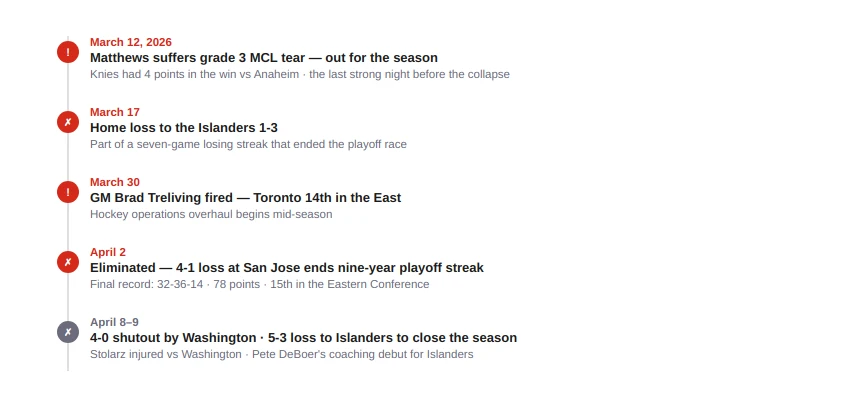
The turning point came in March and early April. Toronto lost Auston Matthews for the season after he suffered a grade 3 MCL tear and quad contusion on March 12, and the team never recovered from that hit to their ceiling. Already sitting below the Eastern cut line, they then continued to lose more ground until elimination became official.
The final Toronto Maple Leafs stats told the same story as their last seven results. The team finished without momentum, without a playoff position, and without any postseason form to carry forward.
Toronto’s Standing in the Atlantic Division
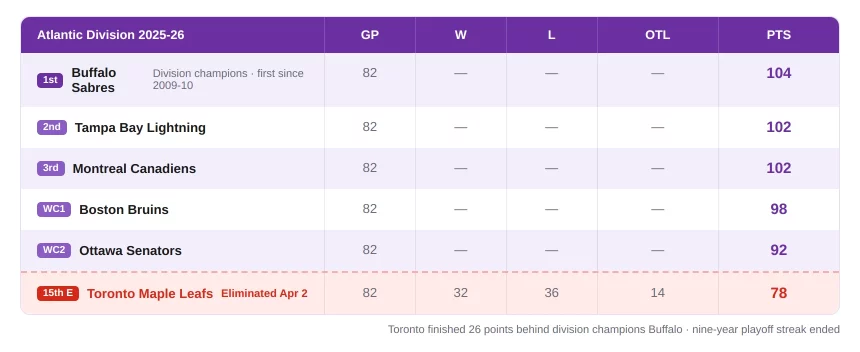
The Atlantic was not forgiving this year. Buffalo finished first, Tampa Bay second, and Montreal third, with Boston locking down a wild card. Toronto were nowhere in that bracket.
There was not much margin for error in the Atlantic. Florida stayed in the mix, Detroit kept hanging around the Eastern race, and Montreal pushed forward instead of fading out. Toronto did not get jumped by one rival. They got overtaken by too many teams at once.
Strengths That Could Power a Maple Leafs Playoff Run
There is still enough talent here to see why the deep-run question keeps coming back. Even in a lost year, Toronto have real top-end skill, recognisable scorers, and a few pieces that still translate to playoff hockey.
The problem is timing. Most of those strengths looked better on paper than they did over the full season, especially once injuries hit and the standings tightened.
Offensive Firepower in the Maple Leafs Lineup
A healthy Toronto forward group still has punch. Nylander, Tavares, Bertuzzi, Domi, and Knies give the club finishing ability, puck-carrying, and enough variety to keep the attack from becoming too easy to read. Even in March, projected Toronto lineups still featured Tavares, Nylander, Domi, Knies, and Calle Jarnkrok in meaningful spots.
That’s a big reason why interest around the Leafs’ playoff schedule picture stayed high for so long, and why every Leafs’ next game update kept drawing attention. On talent alone, this never looked like a weak offensive team.
Star Players Leading Toronto’s Attack
At full strength, Matthews drives everything. Mitch Marner used to be central to that identity too, but NHL.com’s 2025-26 season preview made clear that Toronto entered this year trying to replace the production he took with him to Vegas. That left Nylander and Tavares carrying even more of the scoring burden.
Power Play and Special Teams Advantages
Toronto’s special teams still flashed enough to matter. In the March 12 win over Anaheim, NHL.com described the Maple Leafs as shining on special teams, and Knies finished with four points before Matthews left hurt.
That kind of Toronto Maple Leafs game is the argument for optimism. When the power play clicks and the stars convert, they look dangerous. The trouble is that one strong special-teams night did not turn into a sustained late-season push.
Key Weaknesses That Could Hurt Toronto in the Playoffs
This is where the season turned. Toronto did not lose one clear strength; they piled up too many weak spots at once. The result was a team that could still threaten in talent but could not hold structure long enough to climb back into the race.
Defensive Consistency Concerns
The blue line never settled. Rielly remained the name people watch first, with Jake McCabe and Brandon Carlo asked to stabilise things, but injuries and lineup churn kept changing the look of the defence. By April 9, Toronto were dressing a patchwork group around Morgan Rielly, McCabe, Simon Benoit, Oliver Ekman-Larsson, and others.
Goaltending Stability for the Maple Leafs
The crease has been another area of instability. Woll was still active in April, while Anthony Stolarz suffered a lower-body injury against Washington on April 8. Earlier Toronto versions leaned on Ilya Samsonov; this version never found that settled No. 1 rhythm either.
That leaves the usual playoff concern in place: a deep run is hard without a hot goalie, and Toronto reached April with more uncertainty than certainty in net.
Depth Issues Across the Roster
Depth looked thin by the finish. Injuries pushed fringe names into bigger minutes, while the bottom six changed shape repeatedly. March and April lineups featured players like Steven Lorentz, Jacob Quillan, Luke Haymes, Easton Cowan, and Michael Pezzetta in spots that would feel risky in a serious postseason series.
That’s where names like David Kampf, Noah Acciari, Timothy Liljegren, Rasmus Sandin, Kasperi Kapanen, Jake Gardiner, and even older roster debates come back into the conversation. Different years, different supporting casts, same basic issue: the star layer got attention, while the lower lineup kept needing more.
Coaching Strategy and Management Decisions
Toronto’s 2026 story is not just about the ice. It is also about direction. Once the losses stacked up, the front office took the hit too.
Tactical Approach Behind the Maple Leafs System
Craig Berube remained the coach through the collapse, and MLSE’s team page continued to list him as head coach. He brought a heavier, more direct style than Toronto had under Sheldon Keefe, but the results never settled into anything strong enough to save the season.
The bigger issue is that systems only go so far when Matthews is out, the defence is rotating, and the standings pressure is rising every week.
Trade Deadline Moves and Front Office Strategy
The previous deadline logic made sense. Toronto added Scott Laughton and Brandon Carlo in March 2025 to address centre depth and defensive support. Those were practical fixes, not headline grabs.
Brad Treliving was fired on March 30 after Toronto sank to 14th in the East. That means Toronto Maple Leafs rumours are no longer just about players; they are about the shape of hockey operations too.
Competition in the Eastern Conference Playoff Race
The East was too crowded for a flawed team to drift. In addition to the eight teams that eventually qualified, the Islanders and Red Wings were still fighting around the edges in early April.
Toronto simply ran out of runway in the East. For readers checking how many teams make the NHL playoffs, the league takes 16 teams overall: the top three in each division plus two wild cards in each conference. The Leafs were not close enough to grab one of those places.
Atlantic Division Rivals Challenging Toronto
The Atlantic Division was a three-team gauntlet down the stretch of 2025-26: entering games on April 9, Buffalo sat first (104 points), Tampa Bay second (102), and Montreal third (102), with Boston (98) holding the top wild card and Ottawa (92) the second. Toronto, by contrast, were officially eliminated on April 2, 2026, after a 4-1 loss at San Jose, ending their nine-year playoff streak.
The collapse was punctuated by a March 17 home loss to the Islanders (1-3), a humiliating 4-0 shutout by Washington on April 8, and a 5-3 defeat to the Islanders on April 9 in Pete DeBoer’s coaching debut.
Toronto finished the season with 78 points, sitting at the bottom of the Atlantic and 28 points behind division champions Buffalo, who clinched their first division title since 2009-10.
Potential First Round Matchups for the Maple Leafs
Right now, there is no answer to who the Leafs play in the playoffs because they’re out. On the Atlantic side, the opening round pits Buffalo against Boston and Montreal against Tampa Bay.
Lessons From Previous Maple Leafs Playoff Runs
This is the part Toronto cannot dodge. The current disappointment lands harder because it follows years of similar questions. The franchise history adds weight too. The last time the Leafs won the Cup was in 1967.
Recurring Playoff Struggles for Toronto
NHL.com noted last spring that Toronto’s core playoff scorers from 2017-24 were Marner, Matthews, Nylander, Rielly, and Tavares, but none averaged a point per game over that span. That is a useful snapshot of why the team kept looking dangerous without ever feeling fully convincing.
What Needs to Change for a Deeper Run
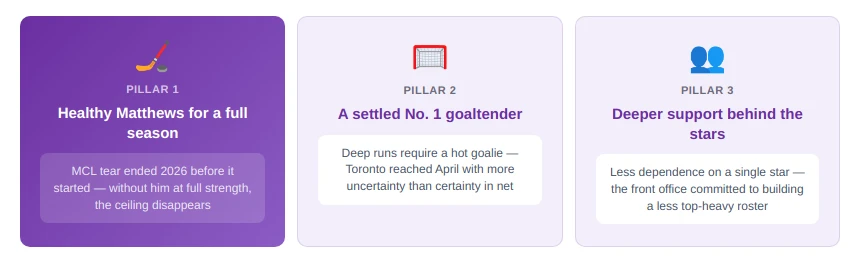
Toronto need a healthier top line, steadier goaltending, and more reliable support behind the stars. They also need the next version of the roster to look less top-heavy when the games get tighter.
Can the Maple Leafs Realistically Make a Deep Playoff Run?
Not this year. Toronto did not qualify, finishing 32-36-14 and closing the regular season on a seven-game losing streak.
The more useful answer is that the core is still good enough to make people ask the question again next season. But it is not good enough to escape the same questions forever.
Factors That Could Push Toronto Far in the Postseason
In a better season, the argument would be easy to make: Matthews at full health, Nylander finishing, Tavares producing, Knies growing, Rielly driving from the back end, and Woll catching form in goal. That is still the skeleton of a serious team. The issue is that 2026 never gave Toronto that full version for long enough.
Scenarios That Could End the Run Early
This year showed the blueprint for failure: one major injury, unstable goaltending, thin depth, and too much pressure on a few stars. That combination already ended the run before the playoffs even started.
Responsible Gambling
Betting should be entertainment, not a way to make money. Gambling can be addictive—only bet what you can afford to lose, and never chase your losses. Set deposit, loss, and time limits before you play, and take regular breaks.
If gambling stops being fun or starts affecting your finances, relationships, or wellbeing, seek help immediately.
Support available across Canada:
- Responsible Gambling Council: responsiblegambling.org (national resource centre)
- British Columbia: Call 1-888-795-6111 (24/7)
- Alberta: Call 1-866-332-2322 (24/7)
- Quebec: Call 1-800-461-0140 (24/7, bilingual)
- Saskatchewan: Call 1-800-306-6789 (24/7)
- Manitoba: Call 1-800-463-1554 (24/7)
- Atlantic provinces: Call 1-800-461-1234 (NB), 1-888-429-8167 (NS), 1-855-255-4255 (PE), 1-888-899-4357 (NL)
- Additional support: Gambling Therapy (gamblingtherapy.org), Gamblers Anonymous (gamblersanonymous.org)
- 988 Suicide Crisis Helpline: Call or text 988
TonyBet provides responsible gambling tools in your account settings, including deposit limits, loss limits, time limits, cool-off periods, and self-exclusion. Use them.
Age restrictions: You must be 19 or older to gamble in British Columbia, Saskatchewan, and Atlantic provinces. You must be 18 or older in Alberta, Manitoba, and Quebec. Underage gambling is illegal.
For more information about responsible gambling practices and support resources, visit the Responsible Gambling section on TonyBet.

FAQ
Do the Toronto Maple Leafs have a realistic chance of making the playoffs?
Who are the most important players for the Maple Leafs in the postseason?
What are the biggest weaknesses of the Maple Leafs heading into the playoffs?
How far could the Toronto Maple Leafs realistically go in the NHL playoffs?


