






The 2025-26 Vancouver Canucks were not one of the NHL’s most explosive teams, but their games still kept showing up in totals discussions. They played with enough pace and attacking intent to keep the score moving, while too little defensive control kept many matchups open.
The season around the club also kept shifting. Jim Rutherford and Patrik Allvin oversaw major lineup changes, injuries kept disrupting the group, and Vancouver rarely looked fully settled from one stretch to the next. For bettors, that made the Canucks more interesting as a game-flow team than as a team to judge by record alone.
Vancouver Canucks Season Overview and Betting Trends
The overall numbers tell a clear story. Vancouver finished 25-49-8, placed eighth in the Pacific Division, scored 210 goals, and allowed 314, the highest total in the league. That left the Canucks with one of the loosest game profiles in the NHL and made Vancouver Canucks stats far more useful for totals betting than the standings table on its own.
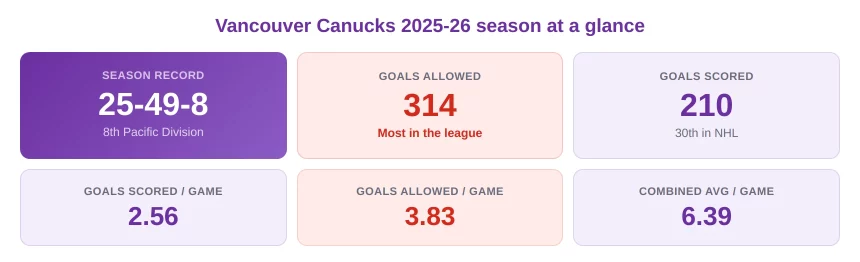
From a betting angle, the more useful detail was how those games were built. Vancouver averaged 2.56 goals per game and 3.83 against, with a 21.8% power play and a 71.5% penalty kill. That profile points to a team that added enough offence to stay involved while leaving opponents clear openings at the other end.
Canucks Results and Scoring Patterns This Season
The Canucks produced several 2026 results that fit the season’s broader pattern. On April 1, Vancouver beat Colorado 8-6 behind the Canucks’ Brock Boeser hat trick. Three days later, the club lost 7-4 to Utah, with Clayton Keller scoring three times for the visitors. Those were not random one-off scorelines dropped into a quiet season; they matched a year in which Vancouver struggled to keep games under control once the pace rose.
Trends in Vancouver Games
The pattern also held across divisional games. Matchups with Edmonton, Vegas, Anaheim, Seattle, and Calgary were harder for Vancouver to slow down because those games exposed the gap between the Canucks’ attacking push and their defensive structure. Once the game opened up, Vancouver rarely had the personnel or form to bring it back to a low-event pace.
That made totals more useful than simple side betting in many spots. The team’s broad analytics profile pointed in the same direction: weak goals-against numbers, a poor penalty kill, and inconsistent goaltending created a stronger case for looking at totals than for backing the club outright.
The Canucks’ Offensive Playing Style
Vancouver’s offence was not strong enough to save the season, but it still kept games open. The Canucks played with pace, attacked through transition, and created enough rush chances to stay involved in high-scoring matchups. The April 1 win over Colorado was the clearest example of that style at work.
Fast-Paced Attacking Approach in Vancouver’s System
Vancouver did not become a slow, defence-first team once the season got away from them. The Canucks still looked for quick exits and speed through the neutral zone, which kept games open at Rogers Arena in British Columbia.
That style showed up clearly in the 8-6 win over Colorado on April 1, when the game kept moving end to end before Vancouver pulled away late.
Key Offensive Players Driving Scoring Chances
Looking at the Vancouver Canucks’ best players, the attack still leaned on familiar names. Elias Pettersson, Brock Boeser, Conor Garland, and Quinn Hughes all shaped the way Vancouver created chances, whether through finishing, support play, or puck movement from the blue line.
| Player stat profile | GP | G | A | P |
| Elias Pettersson stats | 74 | 15 | 36 | 51 |
| Brock Boeser stats | 75 | 22 | 26 | 48 |
| Conor Garland stats | 50 | 7 | 19 | 26 |
| Quinn Hughes stats | 26 | 2 | 21 | 23 |
Those Vancouver Canucks’ player stats help explain why the team could still generate offence even in a poor season.
Transition Hockey and Rush Opportunities
Transition remained one of the clearest attacking features through all the Vancouver Canucks roster changes. The team still created chances when the game loosened in the neutral zone, and that’s part of the reason the club’s totals profile stayed active even after the Vancouver Canucks roster shifted toward younger pieces.
That approach showed up in the same high-scoring games that defined their season. Vancouver were more likely to create off rushes and quick attacks than through long stretches of controlled offensive-zone play, so once the pace rose, the total became easier to push upward.
Defensive Issues That Lead to High-Scoring Games
The clearest over signal came from Vancouver’s defence. The Canucks allowed more goals than any team in the league, and that pushed totals up quickly once their offence added any pressure.
Injuries and lineup changes made that worse. The defensive structure rarely looked settled, which left Vancouver vulnerable in both tough matchups and ordinary ones.
Goals Allowed and Defensive Breakdowns
The club’s defensive problems were broad rather than narrow. Vancouver gave up too many goals off the rush, too many clean looks in dangerous areas, and too many stretches where one mistake quickly became three. The 7-4 loss to Utah showed that clearly: Vancouver still scored four, but the defensive side collapsed often enough that the game went over with room to spare.
That same pattern helps explain why the names on the blue line kept drawing attention. Hronek, Soucy, and Juulsen were asked to stabilise games that were repeatedly getting loose.
Goaltending Challenges for the Canucks
Any look at the Vancouver Canucks goalie situation starts with Thatcher Demko. In January 2026, it was reported that Demko would miss the rest of the season because of hip surgery after posting an 8-10-1 record, a 2.90 goals-against average, and a .895 save percentage. Those Thatcher Demko stats were not disastrous in isolation, but they did not give Vancouver the steady backbone needed to calm totals down.
The contract side also stayed relevant. Spotrac listed the current Thatcher Demko contract at a $5 million cap hit for 2025-26, while also noting his three-year extension signed in the offseason. For betting purposes, though, the larger point was availability: Vancouver spent too much of the year without reliable, healthy No. 1 goaltending.
Impact of Injuries on the Defensive Structure
Injuries shaped the defensive story all season. NHL reporting in January quoted Allvin backing the coaching staff and pointing toward health issues while the team kept losing, which helps explain why Vancouver never found much continuity in its defensive pairings or support structure.
That instability affected more than the blue line. It changed the whole support picture around the crease, influenced which forwards had to defend more conservatively, and made the gap wider between Vancouver’s attacking instincts and their ability to protect the slot.
Special Teams and Their Effect on Game Totals
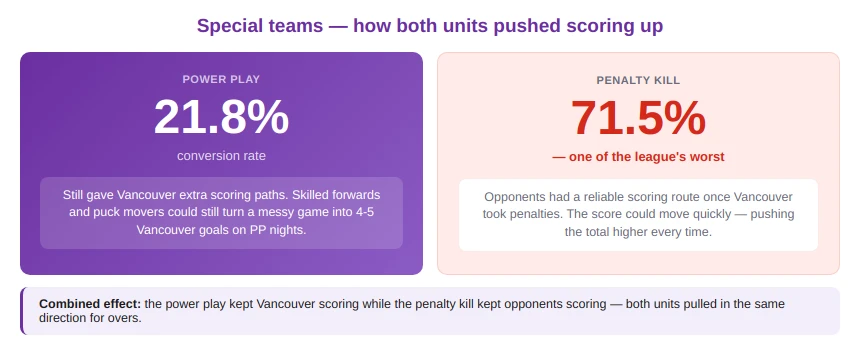
Vancouver’s 21.8% power play and 71.5% penalty kill pushed scoring from both directions. That split helps explain why this team still landed in overs despite their low standing in the table.
Power Play Opportunities in Canucks Games
Vancouver’s 21.8% power play kept them competitive in games where the 5-on-5 balance was shaky. That unit added another path to offence and made it harder for unders to survive once a game picked up penalties or momentum swings.
That’s one reason the Canucks still carried an offensive threat through different roster phases. Even as the team changed around them, skilled forwards and puck movers could still turn a messy game into one with four or five Vancouver goals.
Penalty Kill Struggles and Opponent Scoring
The penalty kill was a bigger problem. Vancouver sat at 71.5%, which gave opponents a clear scoring route even without full 5-on-5 control.
That also changed the game flow. Once the Canucks took penalties, the score could move quickly and push the total higher.
Roster Changes and Their Impact on Playing Style
Few teams changed shape as sharply as Vancouver. The season brought a blockbuster trade, injury-driven lineup changes, and a larger role for younger Vancouver Canucks players, so the team never really carried one fixed identity from October to April.
That also explains why names like Horvat, Miller, and Mikheyev still come up in wider conversations around the club. Vancouver’s current style came out of several waves of reshaping rather than one clean rebuild step.
Trade Deadline Moves Affecting Team Balance
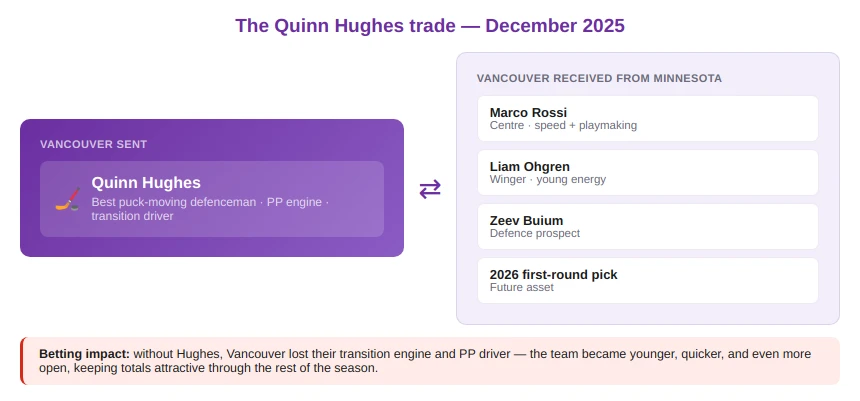
The biggest move came in December 2025, when Vancouver sent Quinn Hughes to Minnesota for Marco Rossi, Liam Ohgren, Zeev Buium, and a 2026 first-round pick. That deal removed the team’s best puck-moving defenceman and brought younger talent into the lineup.
It also changed the way Vancouver played. Without Hughes, the Canucks had to adjust both their transition game and their defensive support, which made the team even less predictable.
Young Players and Depth Forwards Adding Energy
The younger layer helped raise the tempo. Rossi, Ohgren, and Buium became the clearest examples of the Vancouver Canucks new players changing the team’s profile, and they joined a wider depth picture that also included names like Blueger, Sasson, and Karlsson in the broader roster conversation.
That youth injected speed and energy, but it did not solve the team’s defensive issues. Instead, it made Vancouver look younger, quicker, and more open, which is part of why totals remained attractive even while the club stayed near the bottom of the standings in British Columbia.
Why Vancouver Games Often Go Over the Total
By the end of the season, the full picture was clear: 210 goals for, 314 against, a 21.8% power play, and a 71.5% penalty kill. Vancouver combined weak defending, uncertain goaltending, and enough offensive push to keep scoring active at both ends.
High Event Hockey and Shot Volume
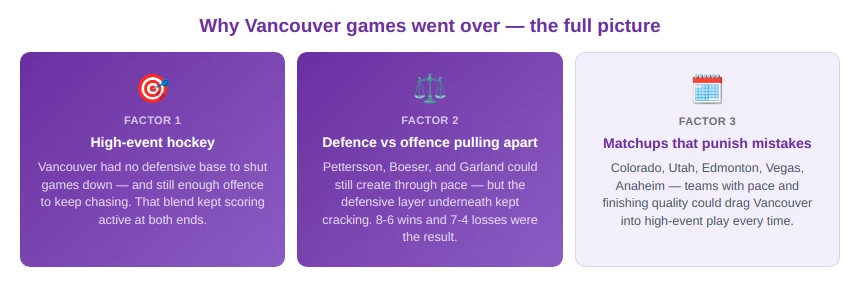
High-event hockey was the season’s defining theme. Vancouver did not have the defensive base to shut games down consistently, and it still had enough offence to keep chasing or trading chances. That blend kept the score moving.
Defensive Risk vs Offensive Pressure
The Canucks’ attack and defence pulled in opposite directions all year. The offence could still create through Pettersson, Boeser, Garland, and transition play, but the defensive layer underneath that pressure kept cracking. On some nights that led to wins like 8-6, on others it produced losses like 7-4.
Matchups That Produce High-Scoring Results
The strongest over spots usually came against teams with pace, skill, or enough finishing quality to punish mistakes. Colorado did it in the 8-6 game, Utah did it in the 7-4 game, and divisional opponents such as Edmonton, Vegas, and Anaheim were the kind of teams that could drag Vancouver into that style as well.
Responsible Gambling
Betting should be entertainment, not a way to make money. Gambling can be addictive—only bet what you can afford to lose, and never chase your losses. Set deposit, loss, and time limits before you play, and take regular breaks.
If gambling stops being fun or starts affecting your finances, relationships, or wellbeing, seek help immediately.
Support available across Canada:
- Responsible Gambling Council: responsiblegambling.org (national resource centre)
- British Columbia: Call 1-888-795-6111 (24/7)
- Alberta: Call 1-866-332-2322 (24/7)
- Quebec: Call 1-800-461-0140 (24/7, bilingual)
- Saskatchewan: Call 1-800-306-6789 (24/7)
- Manitoba: Call 1-800-463-1554 (24/7)
- Atlantic provinces: Call 1-800-461-1234 (NB), 1-888-429-8167 (NS), 1-855-255-4255 (PE), 1-888-899-4357 (NL)
- Additional support: Gambling Therapy (gamblingtherapy.org), Gamblers Anonymous (gamblersanonymous.org)
- 988 Suicide Crisis Helpline: Call or text 988
TonyBet provides responsible gambling tools in your account settings, including deposit limits, loss limits, time limits, cool-off periods, and self-exclusion. Use them.
Age restrictions: You must be 19 or older to gamble in British Columbia, Saskatchewan, and Atlantic provinces. You must be 18 or older in Alberta, Manitoba, and Quebec. Underage gambling is illegal.
For more information about responsible gambling practices and support resources, visit the Responsible Gambling section on TonyBet.

FAQ
Why do Vancouver Canucks games often go over the total?
Are the Canucks a high-scoring NHL team?
How does Vancouver’s defence affect game totals?
What factors should bettors consider when betting on Canucks?


