



The 2026 FIFA World Cup concluded on Sunday, July 19, with Spain crowned world champions after a 1-0 extra-time victory over Argentina. La Roja controlled much of the final game but needed a late goal from Ferrán Torres to lift the trophy at the New York New Jersey Stadium.
As with every major tournament, some players exceeded expectations while others fell short. Here, we focus on those who shone brightest as we select our Best XI of the tournament. We have opted for a 4-3-3 formation.
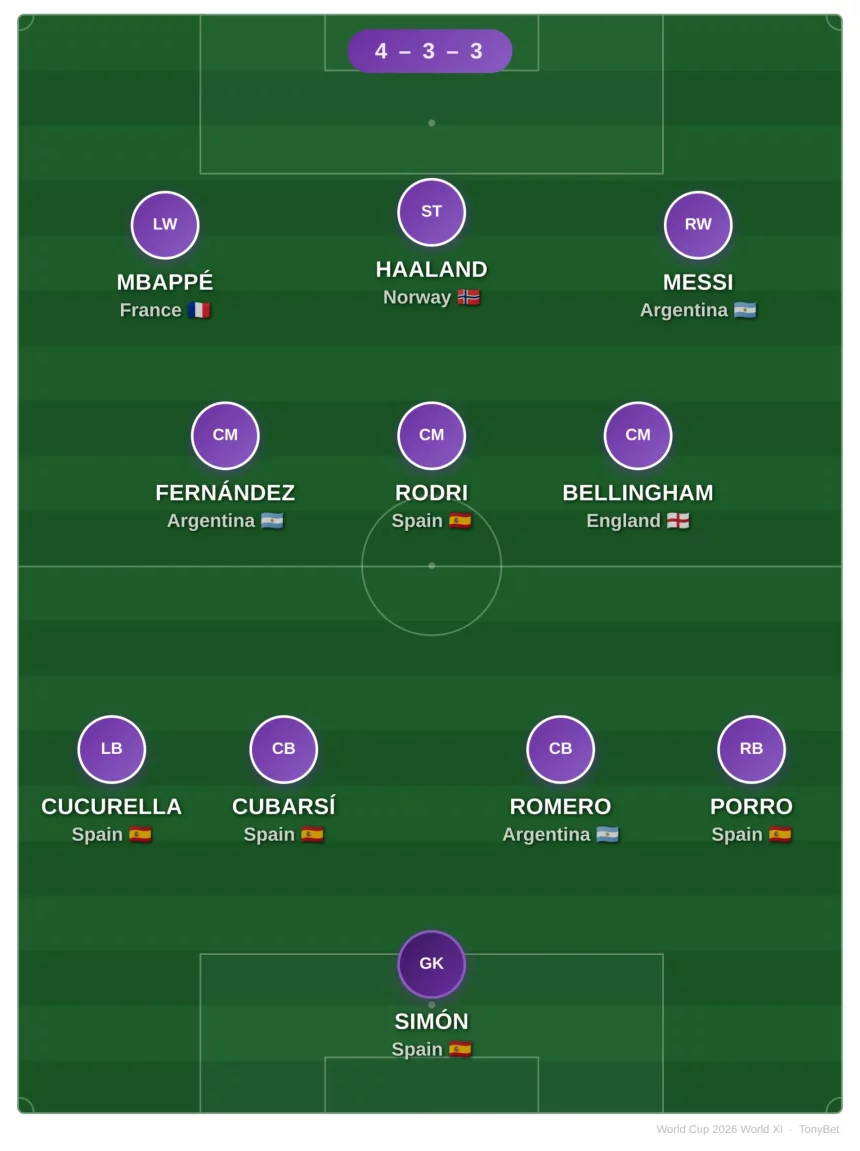
Unai Simón
There were questions ahead of the World Cup about whether the Athletic Club goalkeeper should remain Spain’s first-choice keeper, with Barcelona’s Joan Garcia and Arsenal’s David Raya also in contention.
However, Simón erased all those concerns with an impressive display, earning the Golden Glove Award as the tournament’s best goalkeeper. He conceded just one goal, in Spain’s 2-1 quarterfinals win over Belgium, and finished the tournament with seven clean sheets. He was the backbone of an elite defensive line.
Pedro Porro
Before the tournament, one of the biggest debates in Spain was whether Porro or Marcos Llorente would start at right-back. However, the Spurs defender settled the discussion with a series of outstanding performances, starting every knockout-stage match and finding the back of the net against Austria and France.
Porro’s partnership with Lamine Yamal on the right wing was a key part of Spain’s attack throughout the World Cup.
Cristian Romero
The only non-Spanish defender in our Best XI, Romero showed why he’s one of the best centre-backs in the world when fit. He earned the nod ahead of several other potential candidates due to his decisive aerial ability.
He scored two key goals in the knockout stages against Cape Verde and Egypt — both times when Argentina seemingly didn’t have answers to turn complicated games around.
Pau Cubarsí
The FC Barcelona defender was named the Young Player of the Tournament, and deservedly so. He played a key role in a Spanish defensive line that finished undefeated and conceded just one goal in eight matches.
The 19-year-old player looked mature beyond his years and was a key presence at the back for Luis de la Fuente’s men while establishing an excellent partnership with veteran defender Aymeric Laporte.
Marc Cucurella
Few defenders are as dangerous as the former Chelsea left-back, and he made his presence felt as a reliable two-way presence at the back for Spain. Cucurella didn’t score a single goal in the tournament, but he contributed with two assists while also playing every single minute of this title-winning run.
As if that wasn’t enough, he kept opposing wingers in check throughout the World Cup, and his display in the semifinal against France was one of the best individual performances of a defender throughout the tournament. He shut down reigning Ballon d’Or winner Ousmane Dembele completely.
Rodri
Spain wouldn’t have won the World Cup without the Manchester City midfielder patrolling the middle of the park as he did. Rodri was excellent at reading the game and did all the dirty work that allowed the likes of Pedri, Fabian Ruiz, and Dani Olmo to thrive as creative outlets.
Rodri was rewarded for his impressive consistency with the Golden Ball, which named him the best player of the 2026 FIFA World Cup.
Enzo Fernandez
Fernandez’s tournament ended on a sour note after he was sent off in the final following a harsh challenge in extra time, but that moment shouldn’t overshadow an outstanding World Cup.
He cemented his place as one of the best box-to-box central midfielders in the world with stellar displays. Fernandez stood out in Argentina’s midfield that also featured Leandro Paredes, Alexis Mac Allister, and Rodrigo De Paul. He scored two goals — the late winner against Egypt in the Round of 16 and the equaliser against England in the semifinal.
It remains to be seen whether Fernandez will play at Chelsea in the 2026-27 season, but this World Cup proved he can handle any role in midfield at the highest level.
Lionel Messi
In what was likely his last World Cup, Messi once again delivered an unforgettable tournament.
The Argentine captain was dominant and scored five goals across his first two matches. Although his production slowed later in the competition, Messi still scored or assisted in every game except the final, finishing with eight goals, four assists, and 25 chances created across his eight appearances.
At one stage, he became the World Cup’s all-time leading scorer, but he was ultimately surpassed by Kylian Mbappé, who won the Golden Boot with 10 goals.
If this was the last we’ve seen of Messi at the World Cup, he’ll finish the tournament with 21 goals scored across six tournaments, one title, two second-place finishes, and a legacy that will endure for generations.
Jude Bellingham
Harry Kane gets much of the praise for being England’s key player, but let’s be honest. The Three Lions wouldn’t have finished third without Bellingham’s contributions.
The star playmaker finished as the third-top scorer at the 2026 FIFA World Cup behind Mbappé (10) and Messi (eight), but his contributions went beyond goals.
Bellingham stepped up right when England needed him most, scoring twice in the Round of 16 and the quarterfinal, becoming the first midfielder to do so in back-to-back games since Diego Armando Maradona in Mexico in 1986.
Bellingham cemented his place as a World Cup legend in England’s history with his magnificent midfield performance.
Kylian Mbappe
Mbappe couldn’t lead France to a third consecutive World Cup final or a second straight title, an achievement that hasn’t been matched since Brazil accomplished it in Sweden 1958 and Chile 1962 under the leadership of Pelé.
However, he finished the World Cup as the top scorer for the second consecutive tournament, becoming the first player in tournament history to achieve that feat.
His 22 goals — and specifically, his brace in the third-place match against England — allowed him to become the all-time leading scorer in World Cup history, ahead of Lionel Messi (21). Don’t expect that record to be in danger any time soon, as Mbappe has at least two or three more World Cups in him during the prime years of his career.
Erling Haaland
The biggest question for this Best XI was whether to close it out with Haaland or Kane. Haaland scored seven goals in five matches for Norway, netting braces against Iraq, Senegal, and Brazil while also scoring the game-winner against Ivory Coast. As for Kane, he netted six goals and played a massive role in England’s third-place run.
However, the Manchester City star was more decisive and posted a better goal-per-minute ratio than Kane (66.4 to 108.8). He announced himself on soccer’s biggest stage as a key player for a Norway team that reached the quarterfinals in their best-ever World Cup finish.
That gives him the edge over Kane, who didn’t play a big role in the semifinal loss to Argentina and later stayed on the bench for the third-place match against France. Haaland announced himself on the World Cup stage with an outstanding debut tournament.


