


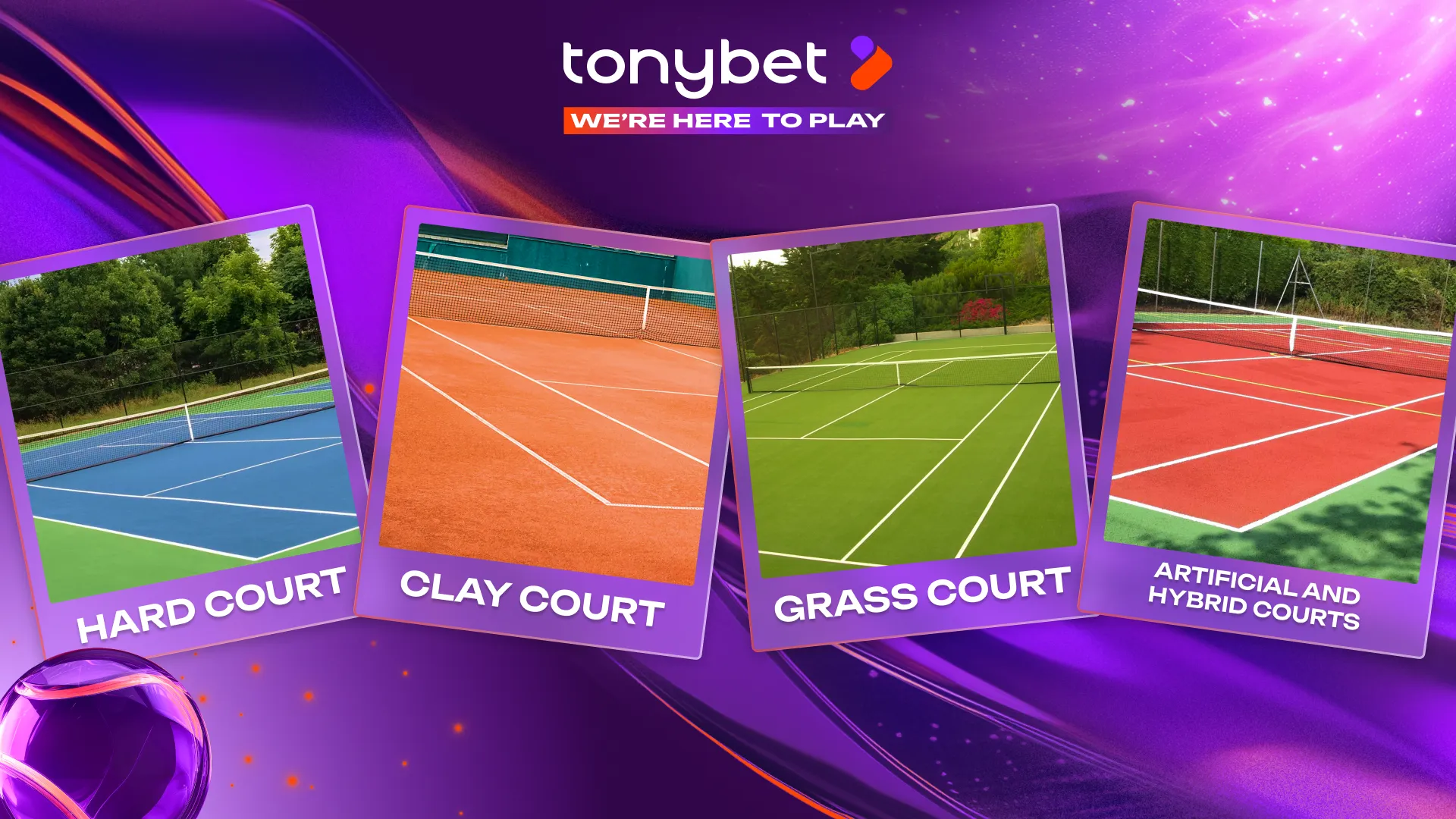



When betting on tennis, you should never assess a player’s attributes in isolation. Performance is always tied to the surface they are playing on. The surface dictates how points unfold, how the ball behaves, and which playing styles gain an advantage.
A player who dominates on clay can struggle on grass. Rafael Nadal is a textbook example. His record at Roland Garros stands at 112-4 (96.6% win rate), compared to 58-12 (82.9% win rate) at Wimbledon — two different court surfaces producing very different outcomes.
In this article, we break down the main court types and explain how each one influences play style, match dynamics, and ultimately how you should read tennis betting odds.
Understanding Tennis Court Surfaces
If you’re wondering what tennis courts are made of, the answer depends on the surface type and tournament specifications. Courts are built in layers, starting with a subbase, followed by asphalt or concrete, and finished with a surface coating that defines how the court plays.
The tennis court material determines how fast the ball travels, how high it bounces, and how players move. While tennis court dimensions, size, and lines remain fixed, playing conditions vary significantly from one surface to another. 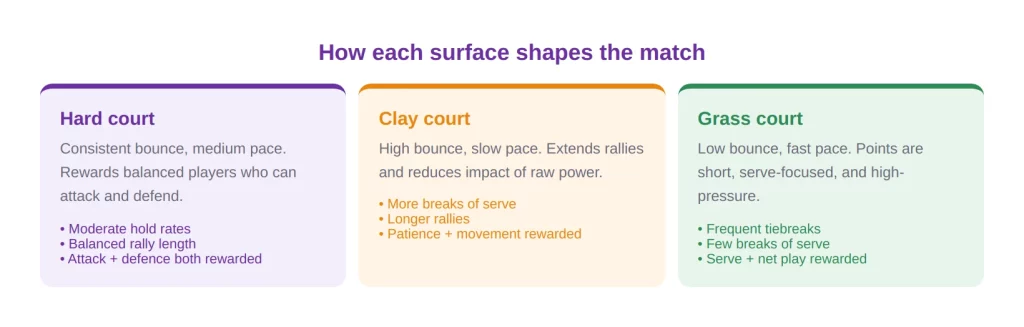
What Are Hard Courts?
Hard courts are constructed using acrylic coatings applied over an asphalt or concrete base. The Australian Open surface (GreenSet) and the US Open surface (Laykold) are both hard courts, yet they play differently due to variations in coating texture, cushioning, and court preparation.
Hard-court tennis produces a consistent bounce and a medium pace. This balance allows both aggressive baseliners and counterpunchers, such as Novak Djokovic, to succeed. His dominance in hard-court tournaments comes from his ability to absorb pace, extend rallies, and control points from the baseline, a style that fits these conditions perfectly.
What Are Clay Courts?
A clay court is made from crushed brick or stone layered over compacted ground. It slows the ball and produces a high bounce, extending rallies and reducing the impact of raw power.
Rafael Nadal, who retired in 2024, built one of the most dominant records in sports history at Roland Garros, winning the title 14 times. His heavy topspin, movement, and defensive recovery allowed him to control long rallies and wear opponents down.
Clay courts also produce more breaks of serve than other surfaces. Matches regularly feature multiple breakpoints, which reduces the advantage of big servers and increases the importance of consistency.
What Are Grass Courts?
A grass tennis court is the fastest of the traditional surfaces. The ball stays low and moves quickly, making points shorter and more serve-focused.
At Wimbledon, players like Roger Federer (eight titles) and Pete Sampras (seven titles) thrived by combining strong serving with net play and effective use of slice. Grass rewards players who take control early in the point, leading to more aces and frequent tiebreaks.
Other Surface Variations
Other surfaces include carpet courts and synthetic grass tennis courts. Indoor carpet courts, once common on the ATP Tour, are among the fastest surfaces and heavily favour serve-dominant players.
These surfaces appear less frequently today but still feature in indoor and lower-tier ATP, WTA, and ITF events. Because points are shorter, they increase match variance and make outcomes more sensitive to small momentum swings.
How Court Conditions Affect Play Style
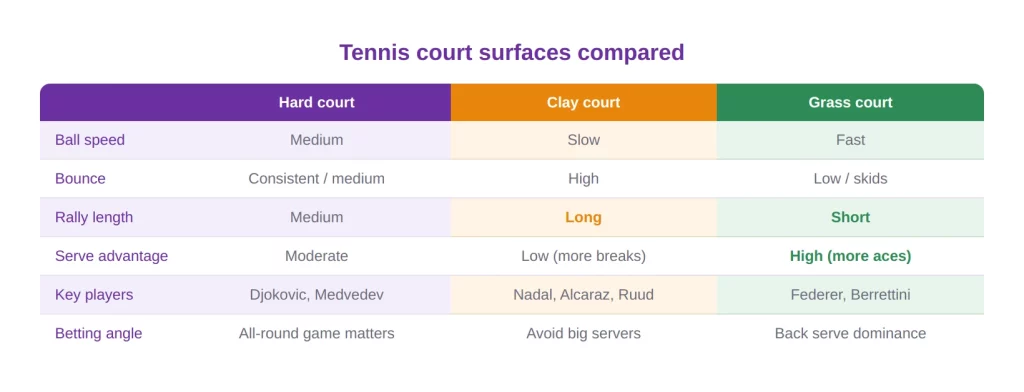
Court conditions directly shape how matches are played. Ball speed, bounce, and movement all vary across surfaces, influencing rally length, shot selection, and which players’ styles gain the upper hand.
Ball Speed and Bounce on Hard Courts
Hard courts create a predictable bounce and moderate rally length. Players who combine strong returns with controlled aggression perform well here.
Daniil Medvedev is a prime example. His success on hard courts comes from his ability to absorb pace and redirect the ball, forcing opponents into longer rallies while maintaining control of the point. His return game is one of the strongest on the ATP Tour, ranking among the top 25 players in return points won on hard courts.
Clay Court Characteristics and Player Advantages
Clay extends rallies and rewards patience. The surface slows the ball and produces a higher bounce, making it harder to hit clean winners and leading to longer exchanges.
At the Madrid Open, which is played at altitude, clay behaves differently. The ball travels faster through the air, creating quicker, more aggressive conditions than at Roland Garros.
This difference is evident in players like Carlos Alcaraz, who has won titles in Madrid (2022 and 2023), where points are shorter and more attacking, while also adapting his game to succeed at Roland Garros (2024 and 2025), where rallies are longer and more physically demanding. His height, combined with his movement and shot variety, allows him to generate power and adjust effectively across both conditions.
Grass Court Characteristics and Player Advantages
Grass reduces reaction time and compresses matches into short, high-pressure moments. At Wimbledon, matches tend to feature more tiebreaks and fewer breaks of serve compared to clay events, reflecting the faster pace and lower bounce of the surface.
This is why players such as Matteo Berrettini become more dangerous on grass. During his run to the Wimbledon final in 2021, he was one of the top players in aces and relied heavily on his serve to dominate points and hold consistently, showing how serve-dominant players can dictate entire sets on grass courts.
Key Factors Bettors Should Consider
To read tennis betting odds accurately, you need to go beyond the surface alone. Player performance on different surfaces, match conditions, and environmental factors all influence how points are played and how matches are decided.
How Surface Influences Match Outcomes
Surface directly changes how points are won:
- Grass: High hold rates, frequent tiebreaks
- Clay: More breaks of serve, longer rallies
- Hard: Balanced between attack and defence
You can see these patterns reflected in ATP match statistics, including serve hold rates, break frequency, and tiebreak occurrence. Grass-court matches produce fewer breaks and more tiebreaks, while clay matches feature longer rallies and higher break rates. This directly shapes how tennis betting odds are priced.
Player Performance Trends by Surface
Surface-specific performance usually outweighs player rankings:
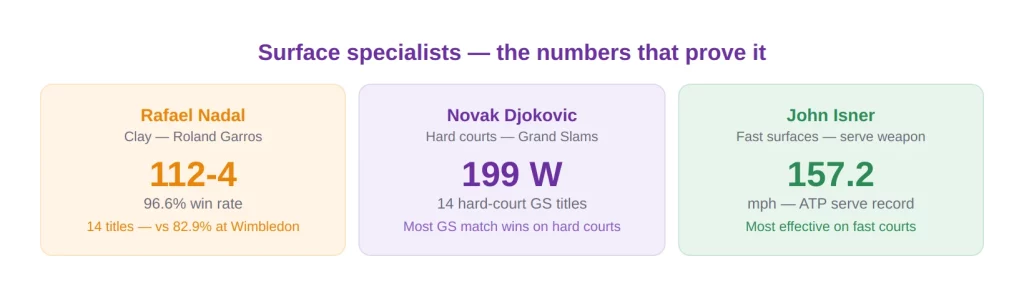
- Rafael Nadal was dominant on clay, widely known as the “King of Clay.”
- Novak Djokovic has achieved his greatest success on hard courts and holds the record for the most match wins in Grand Slam tournaments on this surface (199 matches, 14 titles, as of March 2026).
- John Isner is most effective on fast surfaces, where his serve gives him a significant advantage. He also holds the official ATP record for the fastest serve in a tour-level match (Davis Cup 2016), clocking in at 157.2 mph.
Players with serve-heavy games rely on quick points, while defensive baseliners perform better on slower courts. Analysts commonly use Surface-adjusted Elo ratings to capture these differences.
Weather and Court Surface Considerations
Conditions can change how a surface plays within a single tournament:
- Humidity slows the ball and increases rally length
- Altitude speeds up play
- High temperatures make hard courts faster
- Moisture affects grass bounce and clay consistency
Sport court construction elements, such as traction, drainage, and paint texture, also influence performance, especially after rain delays or heavy usage.
Historical Data and Betting Patterns
Even on identical surfaces, not all tournaments behave the same. For example, recent ATP match data shows that the Australian Open produces a higher ace rate and faster playing conditions than the US Open, highlighting how two hard-court events can play differently.
Historical patterns have shown:
- Wimbledon produces more tiebreak-heavy matches
- Roland Garros produces longer matches and more breaks
- Indoor events increase serve dominance
Recognising these patterns helps identify value when markets rely too heavily on rankings alone.
Comparing Betting Odds Across Surfaces
When comparing betting odds across surfaces, the key is knowing what to look for. Each surface rewards a different style of play, and bettors who understand these patterns can spot value that rankings and odds alone might miss.
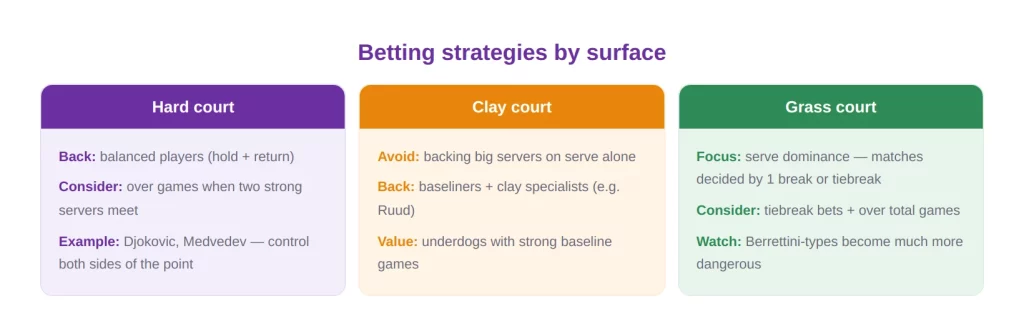
Hard Court Betting Strategies
On hard courts, bettors should look for players who can do both: hold serve and apply pressure on return. This surface rewards balance, so players with a strong all-around game tend to be more reliable. Players like Novak Djokovic and Daniil Medvedev consistently perform well in these conditions because they control both sides of the point.
Matches between two strong servers are also worth considering. These often feature fewer breaks and can push total games higher, making over markets and tiebreak bets more appealing.
Clay Court Betting Strategies
On clay, bettors should avoid backing big servers based solely on serve. The slower conditions reduce the impact of power and expose players who struggle with movement or long rallies.
Instead, look for players who can sustain rallies and defend consistently. Clay specialists like Casper Ruud often outperform expectations, while underdogs with strong baseline games can offer value against more aggressive opponents.
Grass Court Betting Strategies
On grass, bettors should focus on serve dominance. Matches are often decided by a single break or a tiebreak, so players with strong serves, such as Berrettini or Nick Kyrgios, become significantly more dangerous.
This also affects betting markets. Instead of only backing match winners, bettors should consider options like tiebreak bets or over total games, as tighter sets and fewer breaks are more common on grass courts.
Common Misconceptions About Court Conditions
The first common misconception is that all hard courts play the same. In reality, differences in surface coatings, ball types, and weather conditions create measurable variations between tournaments.
Another mistake is relying purely on rankings. A lower-ranked player with strong surface-specific performance can outperform a higher-ranked opponent under the right conditions.
Technical factors such as court construction, surface composition, and materials directly influence speed and bounce, yet they are rarely considered in betting decisions.
Responsible Gambling
Betting should be entertainment, not a way to make money. Gambling can be addictive—only bet what you can afford to lose, and never chase your losses. Set deposit, loss, and time limits before you play, and take regular breaks.
If gambling stops being fun or starts affecting your finances, relationships, or wellbeing, seek help immediately.
Support available across Canada:
- Responsible Gambling Council: responsiblegambling.org (national resource centre)
- British Columbia: Call 1-888-795-6111 (24/7)
- Alberta: Call 1-866-332-2322 (24/7)
- Quebec: Call 1-800-461-0140 (24/7, bilingual)
- Saskatchewan: Call 1-800-306-6789 (24/7)
- Manitoba: Call 1-800-463-1554 (24/7)
- Atlantic provinces: Call 1-800-461-1234 (NB), 1-888-429-8167 (NS), 1-855-255-4255 (PE), 1-888-899-4357 (NL)
- Additional support: Gambling Therapy (gamblingtherapy.org), Gamblers Anonymous (gamblersanonymous.org)
- 988 Suicide Crisis Helpline: Call or text 988
TonyBet provides responsible gambling tools in your account settings, including deposit limits, loss limits, time limits, cool-off periods, and self-exclusion. Use them.
Age restrictions: You must be 19 or older to gamble in British Columbia, Saskatchewan, and Atlantic provinces. You must be 18 or older in Alberta, Manitoba, and Quebec. Underage gambling is illegal.
For more information about responsible gambling practices and support resources, visit the Responsible Gambling section on TonyBet.

FAQs
What is the fastest tennis court surface?
Which surface favours baseline players?
How do court conditions influence betting odds?
Are some players significantly better on one surface than others?


