


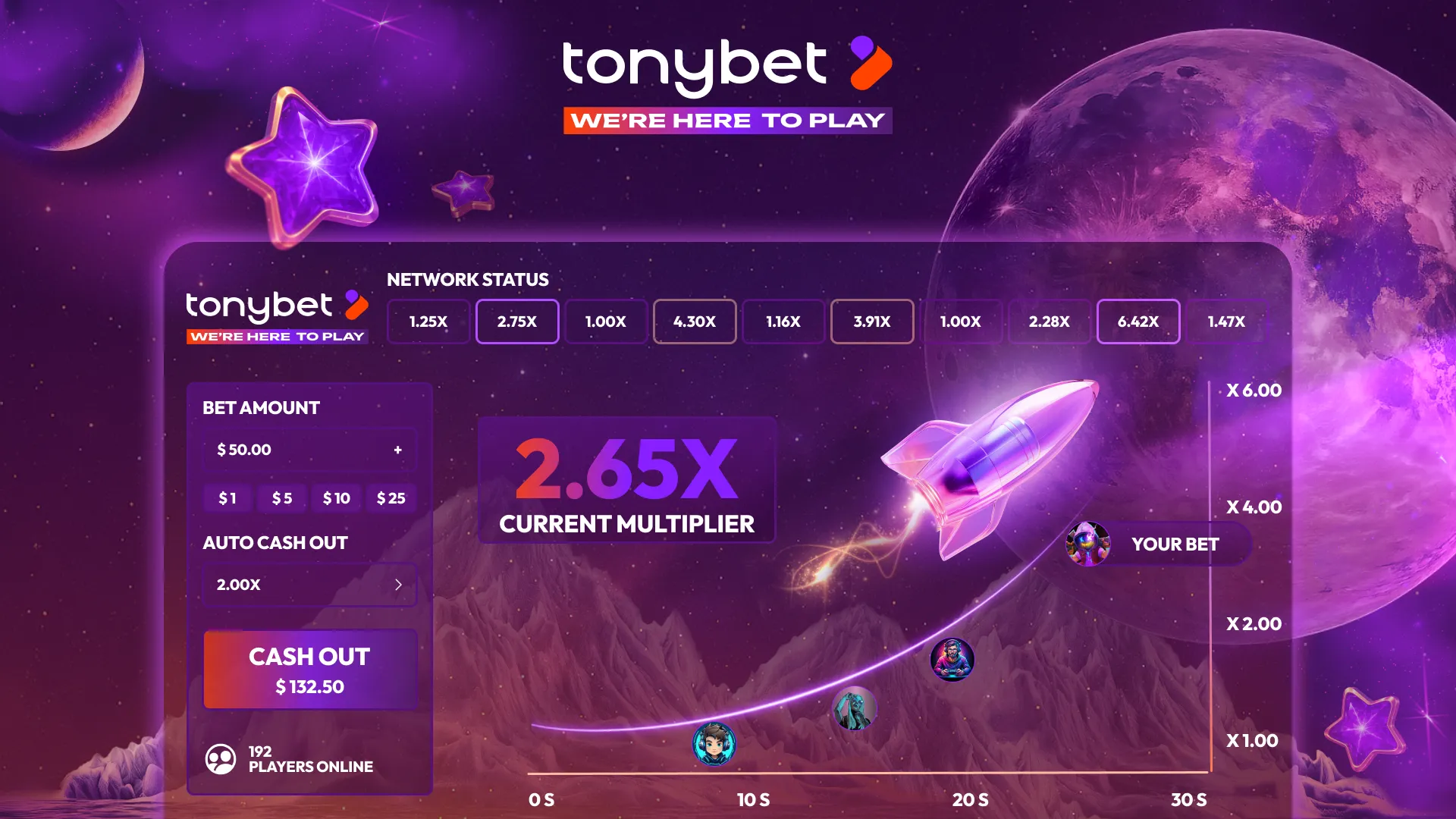



A crash game is the simplest bet in the modern casino. You place a wager, a multiplier climbs from 1.00x, and you tap cash out before it crashes. Wait too long, and you lose the stake. That’s the whole game, and it has pulled in numbers that dwarf slots: Spribe’s Aviator now reports more than 77 million monthly players and over 400,000 bets a minute.
What Are Crash Games?
Strip away the rocket or plane animation, and a crash game is just one rising number you bet against.
Core Mechanics: Multiplier and Cash-Out
Every round works the same way: you bet before it starts, the multiplier ticks up from 1.00x, and you decide when to pull your money out. Cash out at 2.00x on a $10 stake and you collect $20; miss it and the round is gone. Rounds last between seconds and about half a minute, so crash gambling rewards fast decision-making.
How Crash Games Differ From Traditional Casino Games
A slot has paylines and symbols; a crash casino game has none of that. Your only move is timing the exit; a random number generator fixes the result before the animation starts.
How Crash Games Work
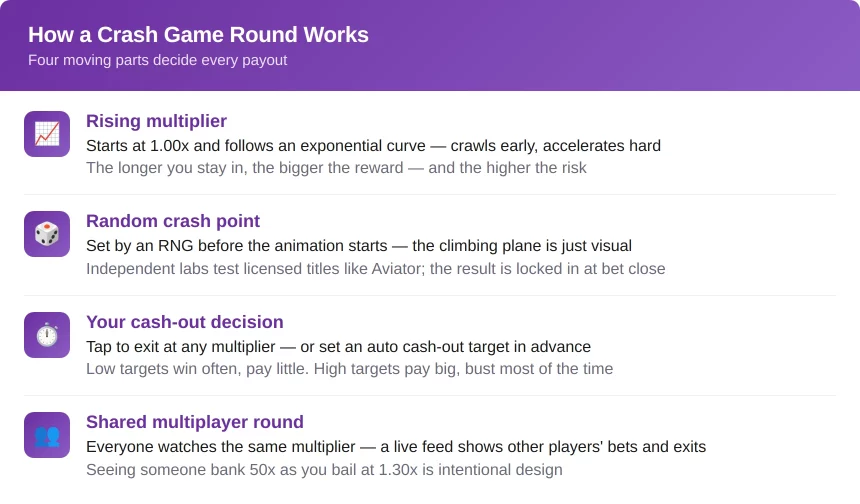
The screen looks simple, but four moving parts decide every payout: the rising curve, the random crash point, your exit, and the shared round.
The Rising Multiplier Concept
The multiplier follows an exponential curve, crawling early then accelerating hard. The longer you stay in, the bigger the reward, but your odds of reaching it fall sharply. In a crash multiplier game, the math keeps high multipliers rare by design.
Random Crash Point and RNG Systems
Each round’s crash point comes from a random number generator, the same type of algorithm used in online slots. In licensed titles like the Aviator crash game from Spribe, that generator is tested by independent labs. The climbing plane is only an animation; the crash point was set the moment betting closed.
Cash-Out Timing and Risk vs Reward
Most games add an auto cash-out target, so you collect at, say, 1.80x automatically. In any crash betting game, the trade-off is blunt: low targets win often and pay little, while high targets pay big and bust most of the time.
Multiplayer and Shared Outcomes
The social side is the real hook. Everyone in a round watches the same multiplier and the same crash at once, while a live feed shows other players’ bets and cash-outs. You might see someone bank 50x as you bail at 1.30x. That visible near-win is built in on purpose.
Key Features Driving Popularity
Four things explain why this category keeps growing while classic slots flatten out.
Fast-Paced Gameplay and Short Rounds
Speed is the draw. A typical Aviator round lasts only seconds, so you can fire off dozens of bets. Spribe says its move to Amazon Web Services lets it handle four times more bets per minute after a four-hour migration. Low latency is crucial because a laggy cash-out in a synchronised game kills both trust and adrenaline fast.
Simplicity and Low Entry Barrier
You can learn a crash game in one sentence. There is no paytable, no bonus rules, and no symbols to match. Spribe has argued in industry coverage that this plainness is why Gen Z players take to crash games so quickly. A C$0.10 minimum bet on many sites keeps the barrier on the ground.
Social and Interactive Elements
Live chat, win feeds, and leaderboards turn a solo bet into a group event. Pragmatic Play’s Spaceman adds a 50% cash-out button that banks half your stake mid-round. These hooks are why a crash gambling game holds attention longer than a static reel.
High RTP and Perceived Transparency
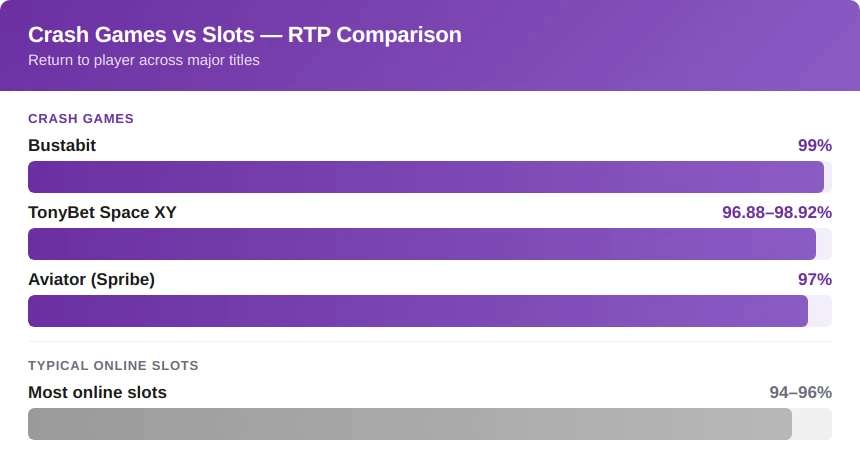
Return to player on the big crash titles rivals the best slots: Aviator and SpinRa advertise 97%, while Tonybet Space XY sits between 96.88% and 98.92% depending on the chosen strategy. Most online slots land between 94% and 96%, so a 97% crash game casino title is at the higher end. Pair that with provably fair math, and players feel real transparency.
The Role of Crypto in Crash Game Growth
Crash games did not start at licensed casinos. They began on Bitcoin forums, and that origin still shapes how they work.
Origins in Crypto Casinos
The first crash game, MoneyPot, launched in July 2014, was sold in 2015, and rebranded as Bustabit, the title most people credit as the original. The crash crypto game format spread fast through Bitcoin-only sites that suited a technical, proof-minded crowd.
Provably Fair Technology Explained
Provably fair lets you check, after a round, that the casino did not rig the result.
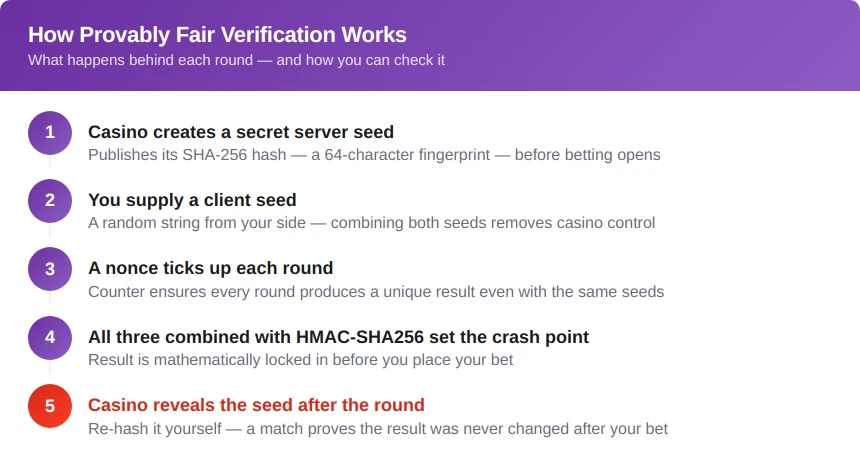
It does not improve your odds; it proves the number was not changed after your bet.
Instant Transactions and Accessibility
Crypto deposits and withdrawals clear far faster than bank transfers. A crypto wallet with standard encryption moves funds in minutes. That speed is why online crash gambling grew up on blockchain first and reached fiat casinos later.
Why Crash Games Are Trending Right Now
The surge makes sense once you look at who gambles now and how they prefer to play.
Appeal to Younger Digital Audiences
TransUnion’s 2025 US betting research found betting rose to 30% of consumers in Q2 2025, up from 25% a year earlier, led by Gen Z and Millennials at 34% and 42%. Operators want short-session, mobile-first products that fit the crash-game format well.
Mobile-First and Stream-Friendly Format
Crash games are built in HTML5, so they render the same on phone and desktop. The builds are light, made for older phones and weak 3G connections. The compact layout films well: the multiplier, the chat, and a player’s reaction fit on one screen.
Influencer and Streaming Exposure
Streamers handed crash games a megaphone. Gambling content on Twitch climbed to 62.6 million hours watched in October 2023, more than double the 28.2 million that January. Aviator rides near the top, and one big multiplier clip can send thousands hunting for the best crypto crash game to copy it.
Shift Toward Skill-Perception Gambling Formats
A slot asks you to press spin; a crash game asks you to make a call under pressure, and that sense of agency is why crash game betting keeps people coming back. Choosing when to cash out manages your risk, but it does not bend the underlying probability.
Risk and Psychology Behind Crash Games
The same features that make crash games fun also make them risky, and the psychology behind that pull is well documented.
The “One More Second” Effect
These games run on the near-miss. Watching the multiplier sail past your planned exit and crash a tick later lights up the brain: a 2009 fMRI study led by Luke Clark in the journal Neuron found near-misses fire the same circuits as real wins, strongest when the player feels in control. That “one more second” pull is wiring, not weak discipline.
High Volatility and Loss Potential
Crash games are high-volatility by construction: the spread skews toward low numbers, so most rounds end early and chasing 10x loses far more often than it wins. Bustabit, with its 1% house edge, busts about one round in 100 below 1.00x, and high variance drains bankrolls fast.
Illusion of Control vs Random Outcomes
The cash-out button is a textbook trigger for the illusion of control, a bias the psychologist Ellen Langer identified in 1975. Her work showed that people expect better odds when they feel involved, even in pure chance. Your timing feels like skill, yet the crash point was set before you touched the screen.
Emotional Decision-Making in Fast Rounds
Speed is the real risk multiplier. Fast games are tied to greater harm because quick rounds leave no gap to think; the UK Gambling Commission notes in its National Strategic Assessment that high-frequency gambling is more likely linked to harm and loss-chasing. Underneath it all is the variable-ratio reward schedule, a concept demonstrated by B.F. Skinner, which produces the most stubborn behaviour, the same mechanism that fuels impulsive crash play.
Common Misconceptions About Crash Games
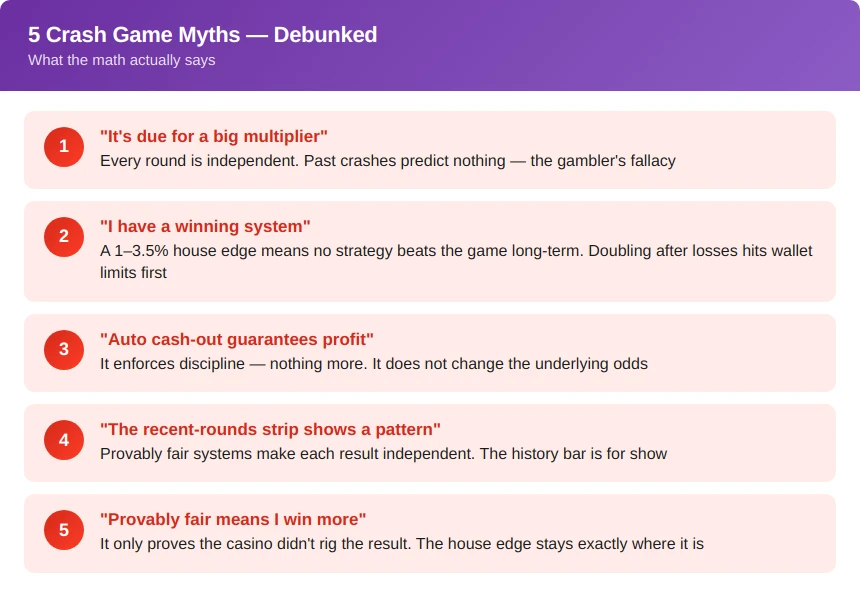
Several myths continue to surround crash games. Here’s what the math says:
Responsible Gambling
Betting should be entertainment, not a way to make money. Gambling can be addictive—only bet what you can afford to lose, and never chase your losses. Set deposit, loss, and time limits before you play, and take regular breaks.
If gambling stops being fun or starts affecting your finances, relationships, or wellbeing, seek help immediately.
Support available across Canada:
- Responsible Gambling Council: responsiblegambling.org (national resource centre)
- British Columbia: Call 1-888-795-6111 (24/7)
- Alberta: Call 1-866-332-2322 (24/7)
- Quebec: Call 1-800-461-0140 (24/7, bilingual)
- Saskatchewan: Call 1-800-306-6789 (24/7)
- Manitoba: Call 1-800-463-1554 (24/7)
- Atlantic provinces: Call 1-800-461-1234 (NB), 1-888-429-8167 (NS), 1-855-255-4255 (PE), 1-888-899-4357 (NL)
- Additional support: Gambling Therapy (gamblingtherapy.org), Gamblers Anonymous (gamblersanonymous.org)
- 988 Suicide Crisis Helpline: Call or text 988
TonyBet provides responsible gambling tools in your account settings, including deposit limits, loss limits, time limits, cool-off periods, and self-exclusion. Use them.
Age restrictions: You must be 19 or older to gamble in British Columbia, Saskatchewan, and Atlantic provinces. You must be 18 or older in Alberta, Manitoba, and Quebec. Underage gambling is illegal.
For more information about responsible gambling practices and support resources, visit the Responsible Gambling section on TonyBet.

FAQ
What are crash games in online casinos?
Why are crash games so popular right now?
Are crash games based on luck or skill?
How do payouts work in crash games?


