






Slot tournaments turn a normally solo session into a leaderboard race against other players. The format has existed in Las Vegas casinos for decades, and most online operators now run daily and weekly events with cash prize pools. The real question is whether competing for those pools makes mathematical sense, or whether the buy-in offers anything beyond the thrill. This guide covers the formats, the math, and the trade-offs.
What Are Slot Tournaments
A slot tournament is a time-limited contest where players compete on the same slot title or set of titles and are ranked on a leaderboard based on their score. The top finishers split a prize pool. Outcomes still depend on RNG results, but the competition layer adds structure on top of the spins.
Basic Format
Every player starts on equal terms with the same starting credits or spin allowance and a leaderboard that updates in real time. The top positions when the timer expires take the cash. Land-based slots tournaments at MGM Resorts run heats where the lowest score is dropped, with the best three of four advancing to a bracket Grand Finale.
How Tournament Slots Differ From Regular Play
In a dedicated land-based slot tournament, the machine sits in tournament mode and accepts no cash bets, so the entry fee is your only real-money exposure. Regular slot play works differently: every spin costs and pays your real bankroll, with no leaderboard score to chase. That difference is why slot machine tournament strategy focuses on speed, points, and ranking rather than bankroll preservation.
How Do Slot Tournaments Work?
The slot tournament rules vary by venue, but four mechanics repeat across nearly every format.
Time-Limited Rounds and Scoring Systems
Most rounds last 20-60 minutes. Scoring uses one of three approaches: total accumulated credits, highest single win, or total wins above the player’s stake. If that sounds hectic and too RNG-based, at some casinos, scoring comes down to betting volume rather than winning spins. You earn points based on the total amount wagered to climb the leaderboard. So, if you’re wondering how to win a slot tournament in a volume-based format, the answer is simple: the more you spin, the more rewards you can reap.
Use of Free Credits and Unlimited Spins
Some casinos hand you a fixed tournament credit balance and let you spin until the credits or the timer run out. Others give you 200-300 free spins on a designated slot. A fixed credit pool rewards speed; a fixed spin count rewards bet sizing.
Prize Pools and Payout Structures
Standard small fields usually pay out the top three spots, while larger tournament fields spread prizes across the top 10-20%. In a free slot tournament or online slot tournament promo such as Pragmatic Play’s Drops & Wins, the distribution is often much steeper: first place can reach a 100,000x multiplier on your stake, while lower leaderboard payouts may sit closer to 5x.
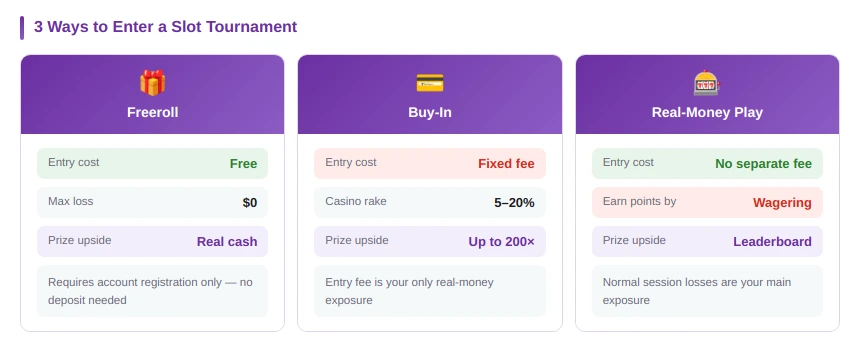
Entry Types (Free vs Paid Tournaments)
Three entry routes dominate. Freerolls cost nothing, while buy-in tournaments charge a fixed fee that contributes to the prize pool, with a casino rake of 5-20%. Real-money play tournaments charge no separate entry but require wagering on qualifying games to earn leaderboard points. Across many popular casinos, free daily slot tournaments typically fall into the freeroll or real-money qualification category.
Types of Slot Tournaments
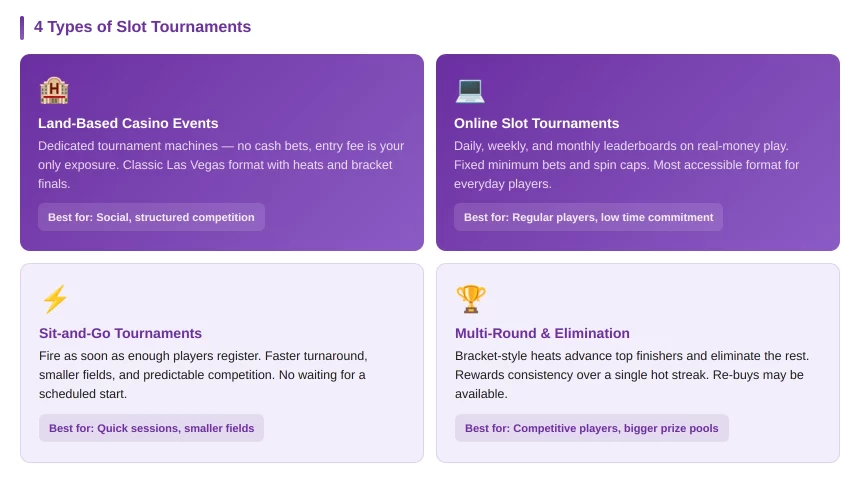
Different formats serve different player types, and the volatility profile of each affects which slot you should pick.
Land-Based Casino Events
Las Vegas operators built the original template. Major casino groups run land-based slot tournament series where players qualify through participating properties and may be invited to a larger finale event. During the tournament round, machines are usually set to tournament mode and do not accept cash bets, so your main real-money exposure is the entry or qualification cost. From a slot tournament strategy perspective, the focus shifts from managing a normal bankroll to maximising points within a fixed time or spin limit.
Online Slot Tournaments
Online versions dominate the everyday calendar with daily, weekly, and monthly leaderboards on real-money play. Some regulated online operators run weekly leaderboard events with fixed minimum bets and spin caps, offering a predictable format for players who prefer scheduled competition over daily volume.
Sit-and-Go vs Scheduled Events
Scheduled events have fixed start and end times. Sit-and-go tournaments fire as soon as a target number of entrants register. Scheduled events attract larger fields and bigger prize pools; sit-and-gos offer faster turnaround and smaller, predictable competition.
Multi-Round and Elimination Formats
Bracket-style events split players into heats, advancing the top finishers and eliminating the rest. The progression structure rewards consistency, not a single hot streak. Some buy-in events allow re-buys, which add liquidity to the prize pool but dilute equity for original entrants.
Advantages of Slot Tournaments
Slot tournaments offer concrete benefits over flat session play, even setting aside the question of profitability.
Low Financial Risk in Some Formats
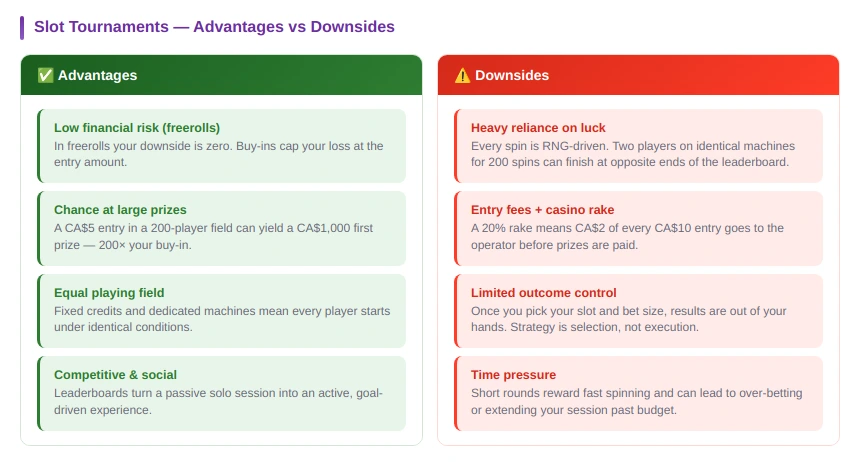
In a freeroll, your downside is zero. In a land-based dedicated-machine event, the entry fee is the only real-money exposure. Buy-in formats cap your loss at the entry amount.
Chance to Win Large Prizes
The prize pool aggregates many small entries into a few large payouts. A CA$5 buy-in in a 200-player field with a CA$1,000 first prize gives the winner 200 times their entry, with a reward distribution skewed toward the top placings.
Competitive and Social Experience
Leaderboards turn a passive activity into an active one. Most online platforms display live rankings, and several land-based events run on a single tournament floor where you watch other players in real time.
Equal Playing Field for Participants
In fixed-credit and dedicated-machine formats, every entrant plays the same slot under the same rules with the same starting conditions. There is no meaningful skill edge and no positional advantage. The competition reduces to who gets the better random distribution of outcomes during the timer.
Downsides and Risks to Consider
The same features that make slot tournaments appealing also create predictable problems.
Heavy Reliance on Luck
Slot outcomes come from a random number generator. The randomness is mathematically independent: no spin sequence is more likely than any other in the underlying probability space. Two players on identical machines for 200 spins each can finish in opposite leaderboard positions purely on variance.
Limited Control Over Outcomes
Once you choose the slot and your bet size, the outcome is out of your hands. Strategy reduces to selection: which tournament to enter, which qualifying slot to play, and how to allocate your spin budget.
Entry Fees and Hidden Costs
Paid tournaments include a casino rake on top of the prize pool. A CA$10 entry that funnels CA$8 into the prize pool and CA$2 to the operator gives you a 20% negative expectation before the underlying slot RTP takes its cut.
Time Pressure and Fast Gameplay
Short rounds reward fast spinning. The pace creates room for over-betting, missed paytable details, and the pull to keep playing past your session budget once the timer ends.
Are Slot Tournaments Actually Worth It?
The answer depends on what you want from the session and how the tournament is structured.
Value for Casual Players
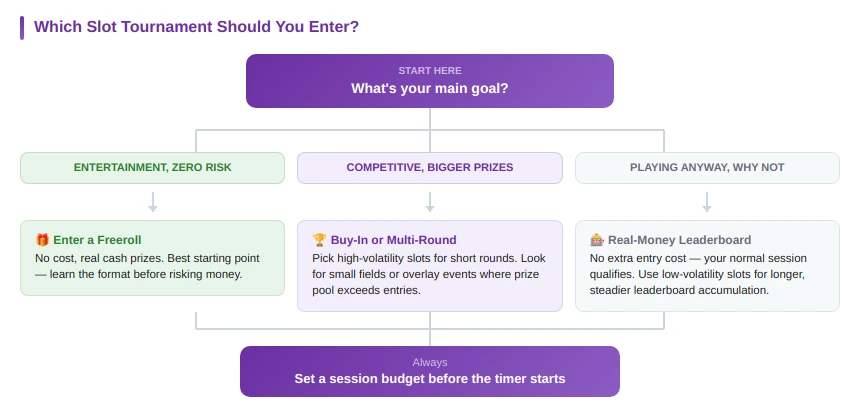
For a casual player, a free or low-cost slot tournament gives more entertainment per dollar than a flat session. The leaderboard provides a goal, the structure caps the loss, and the upside is real even when the probability of finishing in the top 10 stays low.
Value for Competitive Players
For a player chasing an edge, slot tournaments are a poor primary venue. The exception is overlay events, where the operator guarantees a prize pool larger than the entries collected.
Comparing Expected Value vs Regular Slots
A regular slot session loses you the house edge on every spin. A tournament adds a probabilistic share of the prize pool to that math. When the prize pool divided by entries exceeds the entry fee plus expected losses from qualifying play, the tournament beats regular slots in EV.
Entertainment vs Profit Perspective
Treating a slot tournament as entertainment is the rational frame for nearly every player. Treating it as a profit grind requires identifying overlay events, small fields with large prize pools, or freerolls. The bankroll variance stays enormous because the prize distribution is heavily top-loaded.
Common Misconceptions About Slot Tournaments
Three myths come up often:
- High-RTP slots are not automatically better for tournaments. RTP carries over, but it does not meaningfully change tournament EV. Volatility matters more, however. High-volatility slots suit short sprints, while low-volatility slots fit longer leaderboards.
- Repetition does not teach you how to beat the RNG. Practice helps with format awareness, bet sizing, and slot selection, but outcomes remain random. So, how do you practice for a slot tournament? Free play/demo mode is useful for learning paytables, bonus frequency, and win caps.
- Paid tournaments are not scams by default. Like casino games, they usually have negative expectations, but transparent events disclose the rake and prize structure before entry.
Responsible Gambling
Betting should be entertainment, not a way to make money. Gambling can be addictive—only bet what you can afford to lose, and never chase your losses. Set deposit, loss, and time limits before you play, and take regular breaks.
If gambling stops being fun or starts affecting your finances, relationships, or wellbeing, seek help immediately.
Support available across Canada:
- Responsible Gambling Council: responsiblegambling.org (national resource centre)
- British Columbia: Call 1-888-795-6111 (24/7)
- Alberta: Call 1-866-332-2322 (24/7)
- Quebec: Call 1-800-461-0140 (24/7, bilingual)
- Saskatchewan: Call 1-800-306-6789 (24/7)
- Manitoba: Call 1-800-463-1554 (24/7)
- Atlantic provinces: Call 1-800-461-1234 (NB), 1-888-429-8167 (NS), 1-855-255-4255 (PE), 1-888-899-4357 (NL)
- Additional support: Gambling Therapy (gamblingtherapy.org), Gamblers Anonymous (gamblersanonymous.org)
- 988 Suicide Crisis Helpline: Call or text 988
TonyBet provides responsible gambling tools in your account settings, including deposit limits, loss limits, time limits, cool-off periods, and self-exclusion. Use them.
Age restrictions: You must be 19 or older to gamble in British Columbia, Saskatchewan, and Atlantic provinces. You must be 18 or older in Alberta, Manitoba, and Quebec. Underage gambling is illegal.
For more information about responsible gambling practices and support resources, visit the Responsible Gambling section on TonyBet.

FAQ
What is a slot tournament, and how does it work?
Do slot tournaments require real money to enter?
Are slot tournaments based on skill or luck?
Can you consistently profit from slot tournaments?


