





Canada’s Gambling Landscape Is Not the Same Everywhere
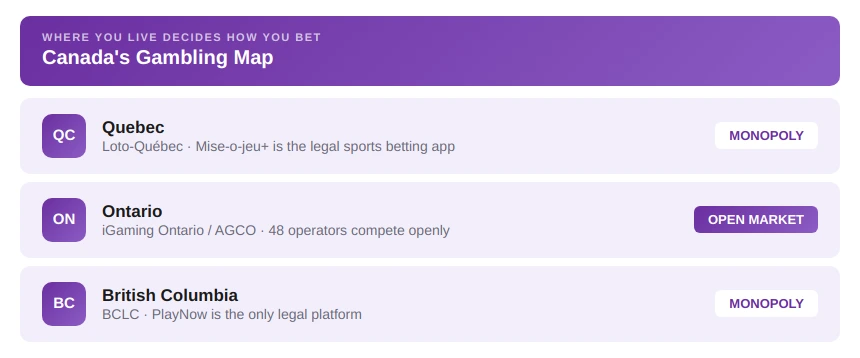
If you’re a Canadian who bets, where you live shapes everything. The gambling laws in Canada sit within the federal Criminal Code, but each province controls how gambling is actually run. That gap is why someone in Toronto has access to more than 80 licensed online gaming sites, a Vancouverite is technically limited to one government platform, and a Montrealer’s only legal sports betting app belongs to the provincial Crown corp.
Provincial Control and Regulation
Section 207 of the Criminal Code lets each province conduct and manage lottery schemes, which covers everything from slots to online casinos. Bill C-218, in force from August 27, 2021, added single-event sports betting to that list after decades during which only multi-leg parlays were legal. Sports betting regulations Canada-wide changed overnight when that restriction was lifted.
Why Betting Habits Differ Across Regions
Product access drives habit more than anything else. When 48 competing operators fight for your attention with live in-play markets, you bet more and differently than when one government platform is your only option. Demographics also matter: Ontario’s population skews younger and more urban, and research on sports bettors show a higher engagement in betting among younger individuals.
How Gambling Works in Quebec, Ontario, and British Columbia
Each province operates gambling under its own model, shaping which products are available and who can offer them.
Quebec’s Lottery and Casino Tradition
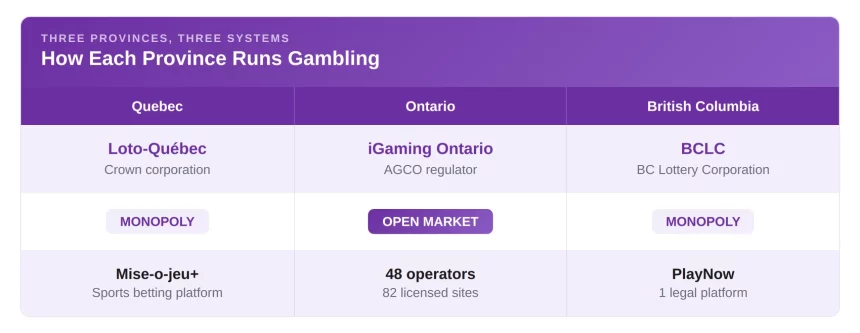
Quebec runs gambling through Loto-Québec, a Crown corporation founded in 1969. The monopoly covers lotteries, VLTs, four casinos, and Espacejeux, Loto-Québec’s online gaming transactional website.
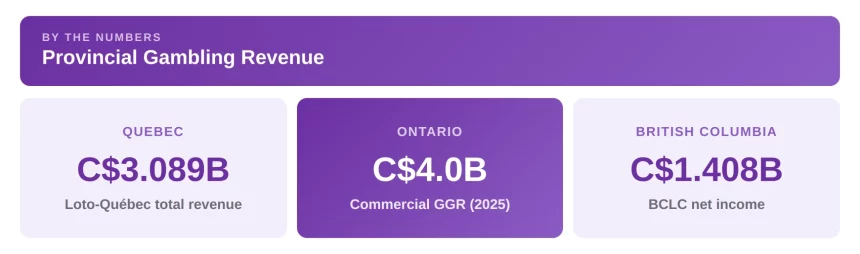
The Casino de Montréal draws roughly seven million visitors a year across 3,000-plus slots and 100-plus tables. Loto-Québec’s most recent annual results show total revenues of C$3.089 billion and net income of C$1.526 billion.
Sports bettors in Quebec have one legal option: Mise-o-jeu+, offering single-game bets, live betting, and cashout. No private operator holds a licence. Quebec gambling laws route all legal online play through this Crown corporation model.
Ontario’s Competitive Online Betting Market
Ontario took a different path. In April 2022, the province launched iGaming Ontario under the AGCO, allowing private operators to compete openly. By early 2026, 48 operators were running 82 gaming sites. The gambling laws in Ontario permit those sites to offer casino games, poker, and sports betting. The commercial sector generated approximately C$4.0 billion in gross gaming revenue in the 2025 calendar year, delivering roughly C$807 million in provincial tax.
British Columbia’s Government-Run Approach
BC sits closest to the traditional monopoly model. The BC Lottery Corporation (BCLC), established in 1985, runs all gambling through PlayNow, North America’s first legal online casino (2010). The BC gambling laws do not permit private operators to enter the market.
In September 2024, BCLC replaced its 33-year-old Sports Action retail product with a QR-code-based ProLine and recorded net income of C$1.408 billion in its most recent financial year, down C$140 million year over year, partly due to offshore competition.
Betting Preferences by Province
What people bet on reflects the products available to them. Lottery leads in Quebec, sports betting drives Ontario, and BC balances both.
Why Lottery Products Remain Popular in Quebec
Quebec’s lottery segment produced C$995.6 million in the 2025-26 fiscal year, covering Lotto Max, Lotto 6/49, Quebec 49, and scratch tickets. Part of that enduring popularity is structural: Espacejeux is the only legal online gambling platform, and Loto-Québec now offers more than 2,000 online games.
The Rise of Sports Betting and Parlays in Ontario
The numbers from Ontario’s regulated iGaming market tell a clear story. Sports bettors wagered C$9.3 billion in the 2024-25 fiscal year, producing C$724 million in sports betting revenue. Same-game parlays have emerged as the fastest-growing product, estimated to account for roughly 40% of all Canadian sportsbook wagers.
The best sports betting apps available to Ontario residents now include a wide range of licensed international operators competing on odds, features, and promotions.
Casino and Sportsbook Trends in British Columbia
BC has more land-based casinos than any other province, with roughly over 30 facilities under BCLC’s framework. Online, however, the picture is less encouraging.
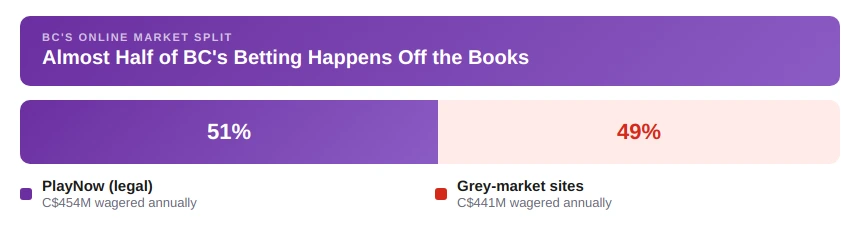
In 2025, BC Finance Minister Brenda Bailey told the provincial legislature that BCLC captures only 51% of BC’s online gambling market, with C$441 million wagered annually through grey-market sites versus roughly C$454 million via PlayNow.
How Regulation Shapes Player Behaviour
The regulatory model each province sets determines how many operators compete, how competitive the odds are, and how aggressively brands can advertise.
Access to Operators and Betting Options
The experience gap between provinces is real. An Ontario player can pick from dozens of licensed sites and place a live in-game bet within seconds. The online gambling laws in each jurisdiction determine which sites are legal and how much competition exists to improve them.
Advertising, Promotions, and Market Competition
Ontario’s open market created an advertising wave that spills across provincial borders. National sports broadcasts carry ads for Ontario-licensed operators that Quebec and BC viewers can’t legally use. In Ontario itself, the AGCO bans operators from advertising bonuses to the general public and enforces geofencing compliance to keep licensed sites within provincial boundaries.
Comparing Popular Betting Products
Lottery, casino games, and sports betting carry different risk profiles and serve different bettor needs.
Lottery Games vs Sports Betting
Lottery and sports betting serve different impulses. A Lotto-Québec scratch ticket or 6/49 draw requires no knowledge of any sport: you buy it, you wait, you win, or you don’t. Sports betting, especially live parlays, demands that you watch, read odds, and make quick decisions. The Lotto 6/49 itself acknowledged this competitive pressure when it relaunched in September 2022 with the Gold Ball Draw.
Traditional Casino Play vs Live Betting
A slot session at the Casino de Montréal or on PlayNow offers self-contained entertainment with fixed odds. Live betting asks you to read a match in real time and act before the market moves.
What These Differences Mean for Canadian Bettors
Provincial differences affect which platforms are legal, what protections apply, and how competitive the market is where you live.
Choosing Products Based on Risk and Entertainment Value
Where you live sets the ceiling on your legal options. Ontario players have the widest licensed selection, along with the most marketing pressure that comes with it. Quebec and BC players have fewer choices, but regulated products on those platforms, whether lottery or casino games, carry protections like deposit limits and self-exclusion that grey-market sites are under no obligation to provide. The laws against gambling in each province set the floor; what you do within that floor is your call.
Understanding Provincial Rules Before Playing
If you’re wondering whether online gambling is legal in Quebec, the answer is yes — through Espacejeux and Loto-Québec’s platforms. Accessing offshore sites isn’t a criminal matter for individual players, but those sites aren’t licensed.
In Ontario, any of the 48 licensed operators represents a fully legal option. In BC, PlayNow is the only legal online route.
Responsible Gambling
Betting should be entertainment, not a way to make money. Gambling can be addictive—only bet what you can afford to lose, and never chase your losses. Set deposit, loss, and time limits before you play, and take regular breaks.
If gambling stops being fun or starts affecting your finances, relationships, or wellbeing, seek help immediately.
Support available across Canada:
- Responsible Gambling Council: responsiblegambling.org (national resource centre)
- British Columbia: Call 1-888-795-6111 (24/7)
- Alberta: Call 1-866-332-2322 (24/7)
- Quebec: Call 1-800-461-0140 (24/7, bilingual)
- Saskatchewan: Call 1-800-306-6789 (24/7)
- Manitoba: Call 1-800-463-1554 (24/7)
- Atlantic provinces: Call 1-800-461-1234 (NB), 1-888-429-8167 (NS), 1-855-255-4255 (PE), 1-888-899-4357 (NL)
- Additional support: Gambling Therapy (gamblingtherapy.org), Gamblers Anonymous (gamblersanonymous.org)
- 988 Suicide Crisis Helpline: Call or text 988
TonyBet provides responsible gambling tools in your account settings, including deposit limits, loss limits, time limits, cool-off periods, and self-exclusion. Use them.
Age restrictions: You must be 19 or older to gamble in British Columbia, Saskatchewan, and Atlantic provinces. You must be 18 or older in Alberta, Manitoba, and Quebec. Underage gambling is illegal.
For more information about responsible gambling practices and support resources, visit the Responsible Gambling section on TonyBet.

FAQ
Why do betting habits vary across Canadian provinces?
Is online gambling regulated differently in Quebec, Ontario, and BC?
Why is sports betting more visible in Ontario?
Which province has the widest range of betting options?


