


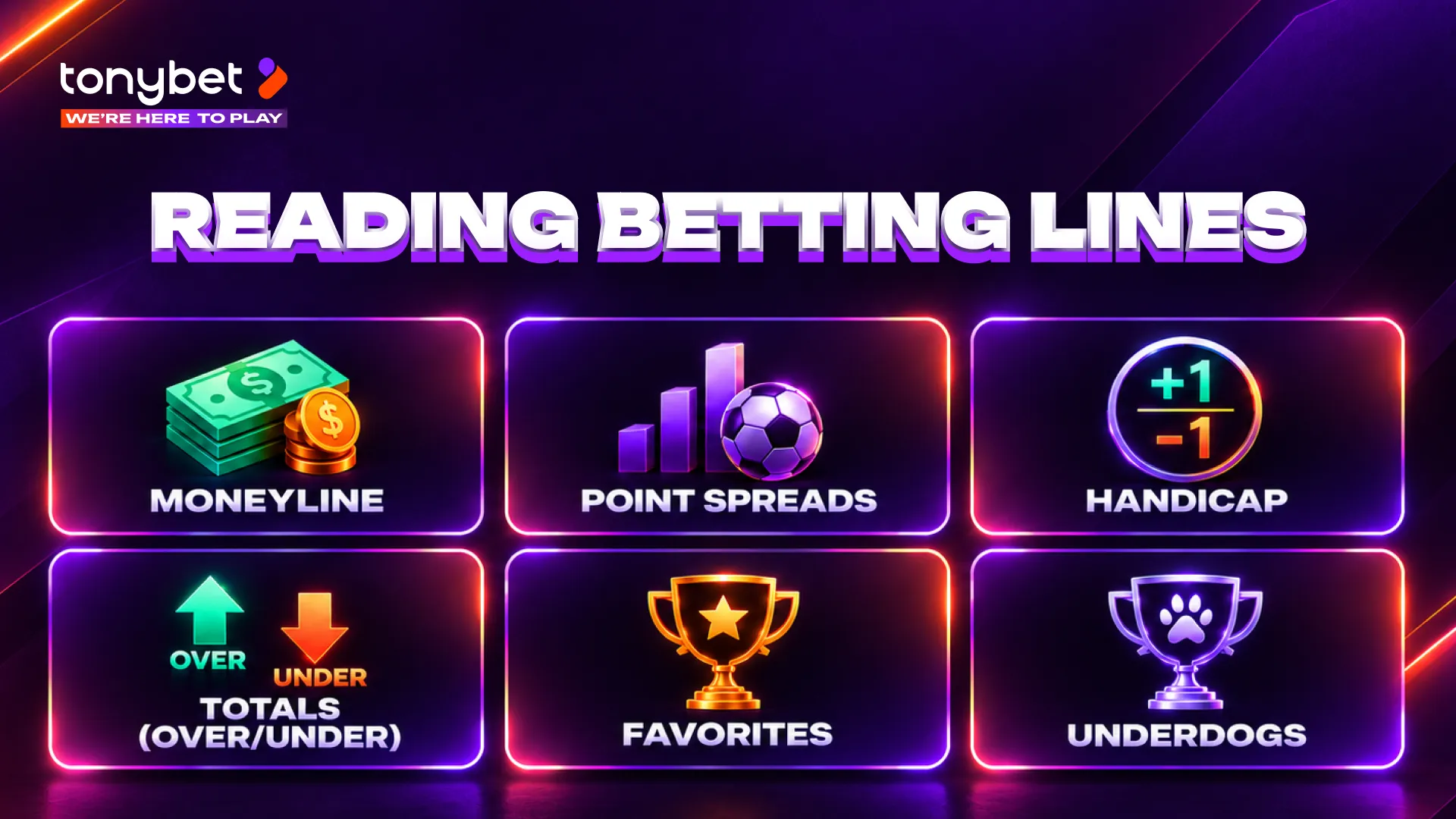


A sportsbook page can look busy at first: teams, numbers, plus signs, minus signs, totals, and prices all sitting beside each other. Those numbers are betting lines, and this guide explains betting lines in plain English, shows how to read betting lines, how odds turn into possible returns, and why the same match can have moneyline, spread, total, and live markets at the same time. It also explains favourites, underdogs, implied probability, line movement, common betting terms, and mistakes beginners should avoid.
What Is a Betting Line?
A betting line is the price and conditions attached to a bet. It tells the bettor what market is available, what outcome must occur, and what the potential return could be if the wager wins.
How do betting lines work? A bookmaker or sportsbook sets a price by looking at team strength, form, injuries, betting demand, and its own market model. The bettor then chooses an outcome, enters a stake, and accepts the price shown on the bet slip.
A line is not a promise that something will happen. It is a market price. That’s why two sportsbooks may show slightly different odds for the same match, even when they are offering the same market.
How to Read Odds in Different Formats
If you want to learn how to read betting odds, start with the three main odds formats: decimal, fractional, and American. They show the same idea in different ways: how much the bet may return and what chance the market gives that result.
| Format | Example | What it means with C$100 |
| Decimal | 2.50 | C$250 total return, including C$150 profit |
| Fractional | 3/2 | C$150 profit, plus the C$100 stake back |
| American | +150 | C$150 profit from a C$100 stake |
Decimal odds are often the easiest for beginners because the total return is the stake multiplied by the odds. A C$100 bet at 2.50 returns C$250 if it wins. The profit is C$150 because the original stake is part of the return.
Understanding Moneyline Betting
Moneyline betting is the simplest way to read a betting line. The bettor only picks who will win the match, fight, race, or event. There is no spread to cover and no total score to reach.
A betting moneyline price of 1.80 means a C$100 stake would return C$180 if the pick wins. That return includes the C$100 stake and C$80 profit.
Moneyline markets are easy to understand, but it is still important to consider the price. This was reflected when Plymouth Argyle faced Liverpool in the 2024/25 FA Cup. An archived odds list had Liverpool at 1.05 and Plymouth at 13.00 before the match. A C$100 bet on Liverpool would have returned only C$105 if Liverpool won, while the same stake on Plymouth would have returned C$1,300. Plymouth then won 1-0, which shows why a short favourite is not risk-free and a big underdog price still needs careful thought.
How Point Spreads and Handicap Bets Work
A point spread helps level the playing field between a strong team and an opponent at a disadvantage.
So, how do point spreads work? Let’s say, for example, you place a bet where the line is -6.5. This means the better team has to win by seven points or more for your bet to win. An underdog listed at +6.5 can win the match outright or lose by six points or fewer, and the spread bet still wins. The spread is about the final margin, not just the match winner.
A handicap bet works the same way, meaning it gives one side a head start or disadvantage on the betting line. The handicap can involve points, goals, runs, or games, depending on the sport. While a point spread is the term mostly used in the United States, a handicap is more common in other countries.
Totals (Over/Under) Explained
Over/under betting is about the combined score, not the winner. The sportsbook sets a total, and the bettor chooses whether the final score will finish above or below that number.
A soccer total of 2.5 goals means over 2.5 wins if the match has three or more goals. Under 2.5 wins if the match has zero, one, or two goals.
Over/under odds may be close on both sides, but they do not have to be identical. A common price like 1.90 means a C$100 stake would return C$190 if the bet wins.
Half-point lines, such as 2.5 or 48.5, also avoid a push because the result cannot land exactly on the line.
What Favourites, Underdogs, and Implied Probability Mean
A favourite is the side the market expects to win more often. An underdog is the side priced as less likely to win. Betting on favourites can feel safer because the stronger side is expected to win, but the odds may be low.
Favourite betting still requires checking the price. A team at 1.20 may win, but a C$100 stake only returns C$120. That is C$20 profit, which may not be worth the risk for every bettor.
Betting against favourites is part of underdog betting. In underdog sports betting, the possible return is higher because the outcome is less expected. A C$100 stake at 3.50 returns C$350 if the underdog wins.
Implied probability turns odds into a percentage. For decimal odds, the simple formula is:
Implied probability = 1 ÷ decimal odds × 100
That means 2.00 odds carry a 50% implied probability. Odds of 1.50 imply about 66.7%, while odds of 3.00 imply about 33.3%. Converting odds to implied probability is not the same as identifying a guaranteed real-world chance because the sportsbook’s margin is built into the market.
How Betting Lines Change Before a Match
Betting lines can change before a match because new information changes the market. Injury news, team selection, weather, travel issues, public betting volume, and sharper money can all move the price.
A sportsbook may start with an opening number based on its projection. As more bets come in, the line may move toward market consensus. That movement can become a useful benchmark, but it should not be treated as proof that one side will win.
Liquidity also matters. A major soccer match may take a lot of betting money before the price moves far. A smaller market may have lower liquidity, so the odds can move faster after fewer bets.
Volatility means the line is moving more sharply than usual. Live betting lines can be even more volatile because the algorithm and traders may react to goals, cards, injuries, time left, and betting pressure while the match is still active. Even then, variance can still produce results that do not match the market’s expectation.
Common Symbols and Terms Every Beginner Should Know
Beginners do not need to learn every betting term at once. These are the ones that matter most when reading a basic line:
- Minus sign (-): Often indicates the favourite on a spread or American odds line.
- Plus sign (+): Often indicates the underdog on a spread or American odds line.
- Push: This can happen when the final result lands exactly on a whole-number line. The stake is usually returned, depending on the sportsbook’s rules.
- Parlay: A bet that combines more than one pick. Every leg must win for the parlay to pay.
- Accumulator: Another name for a parlay, used more often in UK-style betting.
- Hedge: A second bet placed to reduce risk on an earlier bet.
- Arbitrage: A pricing gap where a bettor tries to cover all outcomes across different books. It can still carry practical risks, such as odds changing before every bet is accepted.
- Margin: The built-in edge in the odds. A market with margin added will usually have implied probabilities that total more than 100%.
The Biggest Mistakes New Bettors Make When Reading Lines
New bettors often read the team name before checking the price. That can lead to backing a favourite at odds that are too short, even when the team is likely to win.
Another mistake is mixing up return and profit. A C$100 bet at 2.00 returns C$200, but the profit is C$100. That difference matters when tracking results.
Some beginners also follow a projection without asking what price would make the bet worthwhile. A prediction may point to one side, but the odds may already be too low.
Underdogs can create another trap. Bigger odds do not mean better value on their own. An underdog still needs a real reason to outperform the market.
Parlays and accumulators also catch many beginners. A four-leg parlay may look attractive because the payout is larger, but one losing leg can ruin the whole slip.
A Simple Checklist Before You Place a Bet
Use this short checklist before placing any bet:
- Review the market first: moneyline, spread, total, prop, parlay, or live market.
- Confirm the odds format: decimal, fractional, or American.
- Convert the price into implied probability.
- Separate possible return from real profit.
- Compare the same line across more than one sportsbook where possible.
- Check whether the line has moved since opening.
- Read the settlement rule for pushes, voids, extra time, and abandoned matches.
- Set the stake before emotions get involved.
- Avoid chasing losses with a bigger next bet.
- Save the result so you can track profit, loss, and betting habits over time.
Key Takeaways: Reading Betting Lines With Confidence
A betting line is a price, not a promise. It shows the market, the odds, the condition of the bet, and the possible payout.
The easiest starting point is moneyline betting because the bettor only picks the winner. Point spreads and handicap bets introduce a margin. Totals focus on the combined score.
Implied probability helps turn odds into a percentage, but sportsbook margin means the number is not a perfect real-world forecast.
Line movement can be useful as a benchmark, especially when it follows injury news, team news, or strong market consensus. No projection removes variance.
Even a good bet can lose, and a lucky run can fade through regression to the mean. Reading betting lines well means understanding the numbers before placing the stake.
Responsible Gambling
Betting should be entertainment, not a way to make money. Gambling can be addictive—only bet what you can afford to lose, and never chase your losses. Set deposit, loss, and time limits before you play, and take regular breaks.
If gambling stops being fun or starts affecting your finances, relationships, or wellbeing, seek help immediately.
Support available across Canada:
- Responsible Gambling Council: responsiblegambling.org (national resource centre)
- British Columbia: Call 1-888-795-6111 (24/7)
- Alberta: Call 1-866-332-2322 (24/7)
- Quebec: Call 1-800-461-0140 (24/7, bilingual)
- Saskatchewan: Call 1-800-306-6789 (24/7)
- Manitoba: Call 1-800-463-1554 (24/7)
- Atlantic provinces: Call 1-800-461-1234 (NB), 1-888-429-8167 (NS), 1-855-255-4255 (PE), 1-888-899-4357 (NL)
- Additional support: Gambling Therapy (gamblingtherapy.org), Gamblers Anonymous (gamblersanonymous.org)
- 988 Suicide Crisis Helpline: Call or text 988
TonyBet provides responsible gambling tools in your account settings, including deposit limits, loss limits, time limits, cool-off periods, and self-exclusion. Use them.
Age restrictions: You must be 19 or older to gamble in British Columbia, Saskatchewan, and Atlantic provinces. You must be 18 or older in Alberta, Manitoba, and Quebec. Underage gambling is illegal.
For more information about responsible gambling practices and support resources, visit the Responsible Gambling section on TonyBet.
FAQ
What does a betting line tell you?
What is the difference between moneyline, spread, and totals?
Why do betting lines change before a game?
Which betting line is easiest for beginners to understand?


