





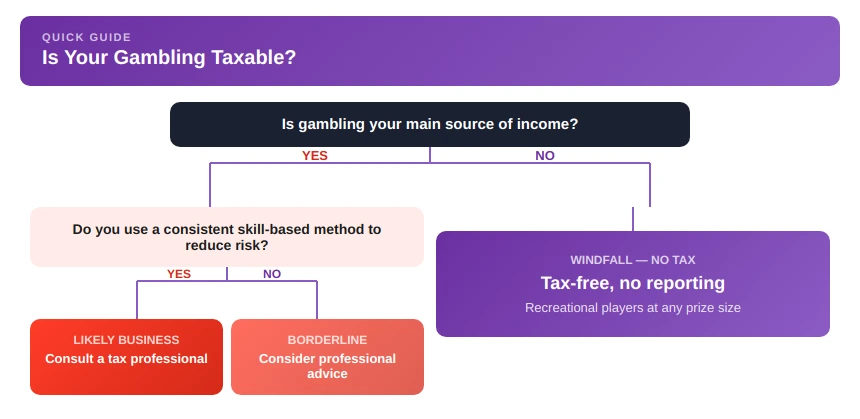
You hit a C$4,000 win on a TonyBet slot, cash a Maple Leafs parlay, or scratch a winning lottery ticket. Does the Canada Revenue Agency (CRA) take a cut? For almost every Canadian player, the answer is no. The CRA treats recreational winnings as a windfall, not income, and windfalls aren’t taxed in Canada.
This guide explains the CRA’s position, the distinction between recreational and professional gambling, the role of the T5 tax slip, and the records you should keep.
This article is for general information only and does not constitute tax or legal advice. Your tax obligations depend on your individual circumstances. Consult a qualified Canadian tax professional or the CRA if you need advice.
Are Gambling Winnings Taxable in Canada?
Recreational winnings are tax-free, from a C$20 scratch card to a seven-figure jackpot, because the CRA taxes income from a source and luck is not one.
The General CRA Position on Gambling Income
The CRA’s guidance on amounts that are not reported or taxed says you do not report lottery winnings of any amount, unless the prize counts as income from employment, a business, or property. The legislation behind this is the source rule in section 3 of the Income Tax Act, which taxes only money traceable to a source. A casual win does not qualify. The CRA sets out the same logic in Income Tax Folio S3-F9-C1.
Why Most Recreational Players Do Not Pay Tax on Winnings
A windfall has clear hallmarks: no enforceable right to the money, nothing earned through a trade, no reason to expect it again. Casino winnings are not taxable in Canada for recreational players, and lottery winnings are not taxed in Canada at any prize size.
These windfalls sit on the short list of non-taxable income in Canada: money won by chance carries no tax regardless of the amount. The same exemption is why you cannot deduct gambling losses.
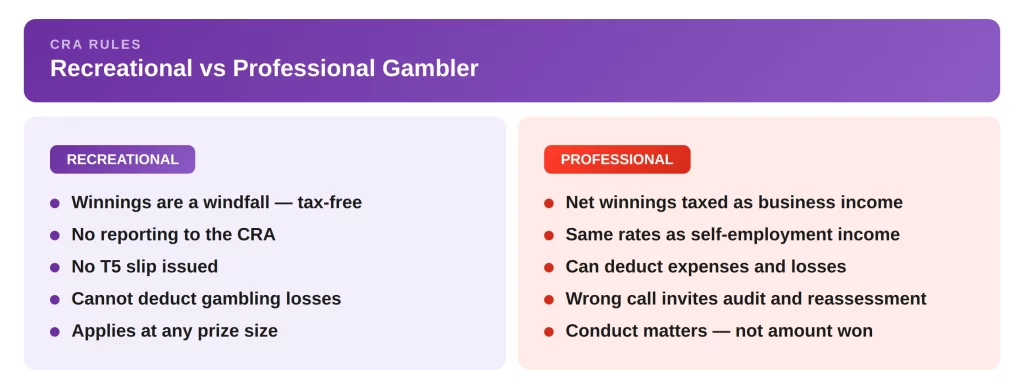
Recreational vs Professional Gambling
Everything turns on one question: are you gambling for fun, or running a business? The distinction is based on how you play, not how much you win.
How the CRA Distinguishes Between the Two
The CRA and the courts apply a source-of-income test from the Supreme Court’s ruling in Stewart v. Canada. A pastime is a personal endeavour with no tax. A business is run in a commercial manner to profit, and gambling carries a built-in personal element, so it is a business only in limited circumstances.
Factors That May Indicate Professional Gambling Activity
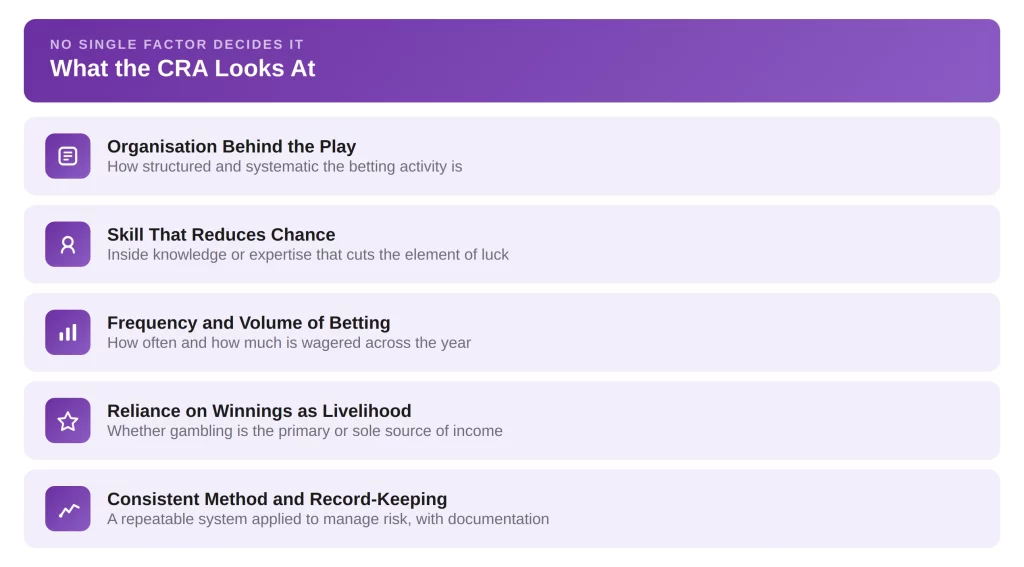
The CRA’s folio outlines several factors it considers, with no single factor being determinative: the organisation behind the play, inside knowledge that reduces chance, whether you play for pleasure or a livelihood, and the frequency and volume of betting.
Courts also consider risk management, record-keeping, and whether you rely on gambling winnings for your livelihood. Skill is particularly important because it can reduce the influence of chance, so a poker grinder draws more scrutiny than a lottery player.
Court Cases and the Importance of Intent
Poker winnings are not taxable in Canada for recreational players, and Canadian jurisprudence shows how difficult it can be for the CRA to prove that gambling constitutes a business.
In Leblanc v. The Queen, two brothers wagered close to C$50 million on sports lotteries from 1996 to 1999, betting up to C$300,000 a week with 15 “helpers”, yet the Tax Court ruled their C$5 million-plus profit tax-free because they were still based primarily on chance rather than a systematic business operation.
A contrasting example is Luprypa v. The Queen, a sober pool player taxed for hustling drunk patrons, where skill drove the profit.
In Cohen v. The Queen, a lawyer who quit to play poker was denied C$121,000 in losses for lack of a real system. Meanwhile, World Series of Poker champion Jonathan Duhamel kept multimillion-dollar winnings tax-free, with outside income and no risk system.
The CRA then won against three players in Fournier-Giguère v. Canada, where the Federal Court of Appeal upheld tax on net winnings of C$5,241,025, C$3,219,074, and C$1,450,000, because poker was each man’s livelihood and sole income. In June 2026, the Supreme Court dismissed a further appeal, leaving the decision intact: poker as a living is a business; the same game for fun is not.
When Gambling Income Can Become Taxable
Winnings become taxable in two cases: when gambling is part of a business you already run, or when you turn the activity itself into a business.
Operating in a Business-Like Manner
This takes structure, not just volume: a method that cuts risk, applied consistently, plus reliance on it as your main income. The Federal Court of Appeal taxed the three poker players for exactly that. A weekend bettor on TonyBet with a day job does not clear the bar.
Record-Keeping, Skill, and Consistency
Three threads run through every case the CRA wins: skill that cuts chance, a consistent method, and dependence on the income. A professional adjusts stakes to protect their bankroll, avoids bad matchups, and keeps detailed documentation. A recreational player keeps none of that. The more your play reads like a managed operation with a ledger, the closer it sits to a taxable business.
Tax Implications for Professional Gamblers
A professional reports net winnings as business income, taxed at the same rates as any self-employment. The trade-off cuts both ways: a professional deducts reasonable expenses and losses, which a recreational player cannot. This is a real tax liability, and a wrong call invites an audit and a reassessment.
Understanding T5 Slips and Gambling-Related Confusion
A big win does not trigger a tax slip the way a US casino does. In Canada, winnings produce no slip at all.
What a T5 Slip Is Used For
A T5 slip, the Statement of Investment Income, reports investment earnings paid to you in the year. So what is a T5 slip in practice? It covers interest from a savings account or GIC, dividends, royalties, and similar income. A payer issues this T5 tax slip once that income hits the C$50 threshold.
Why Gambling Winnings Usually Do Not Generate T5 Slips
Gambling winnings are not investment income, so they never land on a T5. They are not interest, not a dividend, and not a return on capital. A jackpot is a windfall, not a payment on an investment. Canadian operators, TonyBet included, issue no slips for winnings and apply no withholding to your payout.
Situations Where Investment Income May Be Reported Instead
A slip enters only after you are paid. Deposit a C$100,000 win, and the interest it earns is taxable, reported on a T5 past C$50. The CRA is explicit that income earned on winnings is taxable even when the winnings are not. The prize is tax-free; what you do with it follows the normal rules for interest and dividends.
Common Misconceptions About Gambling Taxes in Canada
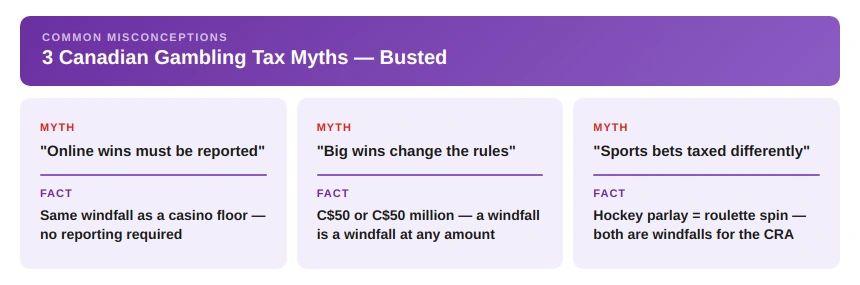
Three myths about gambling taxes in Canada refuse to die.
Do Online Casino Wins Have to Be Reported?
No. A recreational win on a licensed Ontario site or an offshore platform is treated the same, and neither has to be reported. A slot win online is the same windfall as one in a Niagara Falls casino. Foreign-platform balances above C$100,000 trigger a separate form, the T1135, a different matter from tax on the winnings.
Does the Size of a Win Change the Tax Rules?
The size changes nothing. A windfall is a windfall whether it is C$50 or C$50 million, which is how the Leblanc brothers kept more than C$5 million tax-free. No dollar threshold turns a recreational win taxable. That answers a common question about what amount of gambling income is not taxable in Canada: all of it, for a recreational player.
Are Sports Betting and Casino Winnings Treated Differently?
No. A winning hockey bet and a winning roulette spin are both windfalls for a recreational player. On whether sports betting is taxable in Ontario, the answer is no for recreational bettors, even after Ontario launched its regulated iGaming market on April 4, 2022. The province raises revenue by taxing operators, not players, and the line is identical in every province, with no separate Canada casino tax and no Canada gambling tax on players.
What Canadian Players Should Do for Tax Compliance
Tax-free winnings still reward a little bookkeeping, and a few cases call for an accountant.
Keeping Records of Deposits and Withdrawals
Keep a simple record of deposits, withdrawals, wins, and losses across the sites you use. That documentation could come in handy if the CRA questions a large or frequent betting pattern, and it becomes essential if your play starts to look like a business. A basic ledger of dates, amounts, and platforms supports your compliance.
Knowing When Professional Advice May Be Needed
Talk to an accountant when gambling looks like your main income, when you win in the United States, or when you invest a large prize. A tax professional will assess whether your activity crosses into business territory and handle any declaration or reassessment. If the CRA begins an audit or enforcement action, representation earns its cost, since these disputes are fact-driven and frequently winnable.
Responsible Gambling
Betting should be entertainment, not a way to make money. Gambling can be addictive—only bet what you can afford to lose, and never chase your losses. Set deposit, loss, and time limits before you play, and take regular breaks.
If gambling stops being fun or starts affecting your finances, relationships, or wellbeing, seek help immediately.
Support available across Canada:
- Responsible Gambling Council: responsiblegambling.org (national resource centre)
- British Columbia: Call 1-888-795-6111 (24/7)
- Alberta: Call 1-866-332-2322 (24/7)
- Quebec: Call 1-800-461-0140 (24/7, bilingual)
- Saskatchewan: Call 1-800-306-6789 (24/7)
- Manitoba: Call 1-800-463-1554 (24/7)
- Atlantic provinces: Call 1-800-461-1234 (NB), 1-888-429-8167 (NS), 1-855-255-4255 (PE), 1-888-899-4357 (NL)
- Additional support: Gambling Therapy (gamblingtherapy.org), Gamblers Anonymous (gamblersanonymous.org)
- 988 Suicide Crisis Helpline: Call or text 988
TonyBet provides responsible gambling tools in your account settings, including deposit limits, loss limits, time limits, cool-off periods, and self-exclusion. Use them.
Age restrictions: You must be 19 or older to gamble in British Columbia, Saskatchewan, and Atlantic provinces. You must be 18 or older in Alberta, Manitoba, and Quebec. Underage gambling is illegal.
For more information about responsible gambling practices and support resources, visit the Responsible Gambling section on TonyBet.