






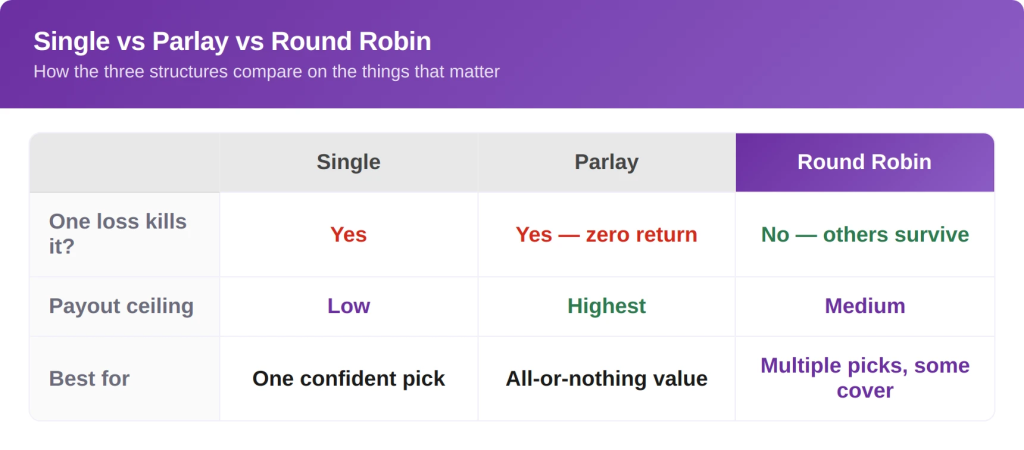
A single bet gives you one pick, one return, and one shot. A parlay chains multiple picks onto one ticket for a bigger payout, but one wrong leg kills the whole thing. Round robin betting sits somewhere in between. This guide covers how round robin bets work, what they cost in practice, and when they make sense.
What Is a Round Robin Bet?
In tournament scheduling, round robin means every participant faces every other exactly once — a round robin game with no byes and no shortcuts. In betting, the structure works the same way. A round robin bet takes three or more selections and auto-generates a series of smaller parlays from them. You choose the picks and the parlay size; the sportsbook builds every combination automatically.
How Round Robin Betting Works
With round robin betting, your stake applies to each individual parlay, not to the round robin as a whole. Choose three teams and parlay them “by 2s,” and you get three separate two-leg parlays. At C$10 per parlay, your total cost is C$30. Two of your three picks need to win before you see any return.
Understanding Combinations and Permutations
The number of parlays generated follows the combinations formula:
C(n,r) = n! / [r!(n−r)!]
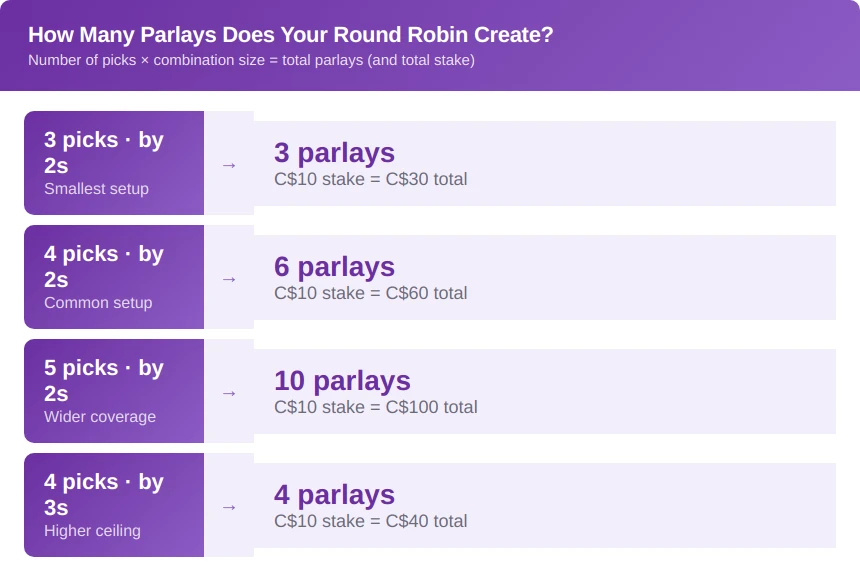
where n is your total picks and r is the size of each parlay. Four picks by 2s give C(4,2) = 6 parlays. Six picks by 2s give 15.
Most sportsbooks handle this through an algorithm automatically — enter your picks and parlay size, and every combination generates instantly. The number of combinations grows quickly, which is why budget allocation is important before confirming the bet.
Round Robin vs Parlays
The choice between a round robin and a parlay comes down to how much variance you can absorb. Both use the same picks; the structure determines what a single wrong selection costs you.
Key Differences in Risk and Reward
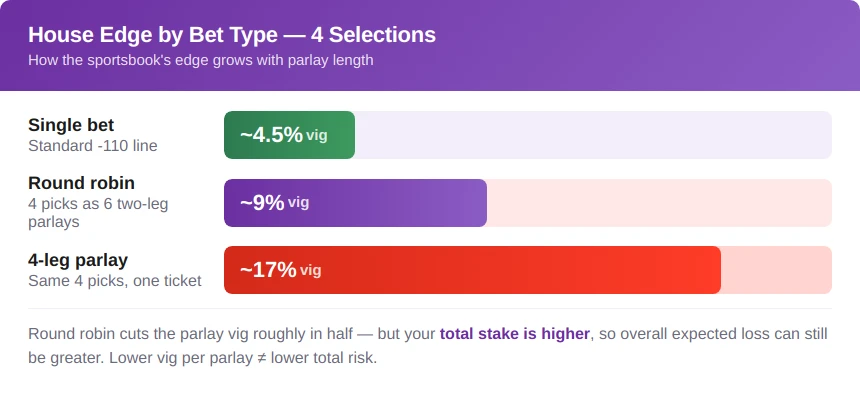
A standard -110 single bet carries a house edge of roughly 4.5%. That hold compounds with each leg you add. A five-leg parlay pushes the sportsbook’s expected hold to approximately 20.8%. A round robin parlay splits the same picks across shorter combinations, which lowers the per-parlay vig.
Four legs as a single parlay carry roughly 17% vig; those same four picks spread across six two-leg parlays drop closer to 9%. The catch: you stake more money in total, so your overall expected loss can still be higher.
Why Round Robins Provide More Flexibility
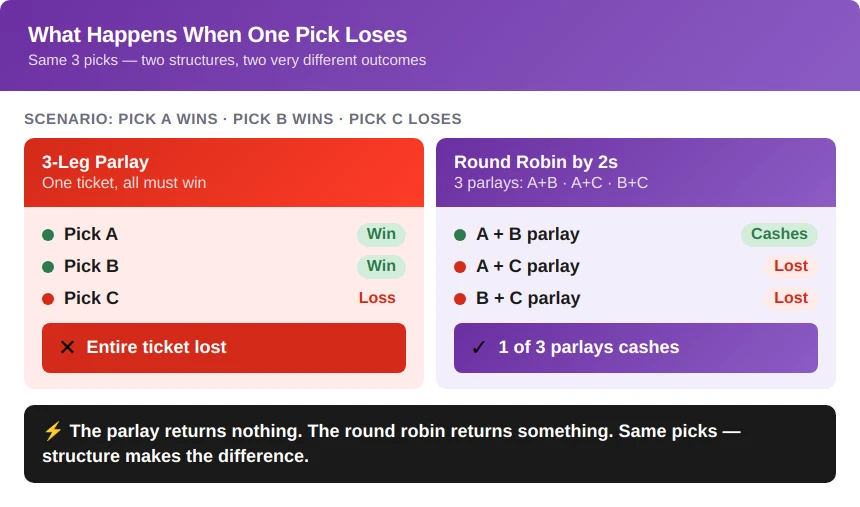
A standard parlay returns nothing if any leg loses. Round robin bets survive a missed pick. Two of three wins are enough to cash at least one combination. That partial-win coverage is the reason bettors reach for round robins rather than a single all-or-nothing ticket.
Types of Round Robin Bets
Most sportsbooks let you build round robin bets by 2s, by 3s, or both at once. The combination size changes the number of parlays generated, the total cost, and how much protection you get against a bad pick.
Two-Team Combinations
This is the most common configuration. Three picks by 2s produce 3 parlays. Four picks by 2s produce 6. Five picks by 2s produce 10. Two-team combinations offer the lowest variance, the widest coverage, and the lowest ceiling per parlay.
Three-Team Combinations
Four picks by 3s produce 4 parlays. Five picks by 3s produce 10. Each combination pays more, but a single losing pick removes that leg from multiple parlays and hits your return harder than a two-team setup would.
Choosing the Right Structure
The sequencing of your combination sizes — starting with 2s before layering in 3s — determines both total cost and potential return before a pick is confirmed. A 5-team round robin shows how fast the numbers scale. Covering by 2s alone generates 10 parlays at C$100 total on C$10 stakes. Adding by 3s brings the total to 20 parlays and C$200.
The name comes from round robin scheduling in sports tournaments, where every participant faces every other exactly once. In a double round robin, each matchup happens twice. In betting, a double round robin means running two separate combination sizes across the same pick pool; for example, five teams covered by both 2s and 3s simultaneously.
Advantages of Round Robin Betting
The core appeal is coverage. You keep action alive across multiple combinations even when one pick fails, allowing for gradual accumulation of returns across tickets rather than one all-or-nothing result.
Winning Without a Perfect Card
Round robin betting explained simply: any parlay that does not include the losing pick still stands. That built-in diversification across multiple tickets is what separates a round robin from both singles and standard parlays. A three-leg parlay with one loser returns nothing. A three-pick round robin by 2s with one loser still cashes the one parlay that excluded that pick. The ticket is not dead because a single selection failed.
Reducing the Impact of One Losing Pick
Consider four selections by 2s at C$10 per parlay, for a total stake of C$60. If three of the four selections win, the three parlays that do not include the losing pick still cash. At odds of roughly +264, those three winning parlays would return approximately C$109.20. A straight four-leg parlay on the same picks returns zero the moment any leg misses.
Drawbacks of Round Robin Betting
The protection a round robin offers comes at a price. Two costs stand out: a higher total outlay and a lower ceiling when everything lands.
Higher Total Stake Requirements
Stake × combinations = total cost. A 5-team round robin by 2s at C$10 per parlay costs C$100 before a result lands. Adding three-team combinations to those same five selections doubles the number of wagers and increases the total exposure to C$200. The full matrix needs to be budgeted before confirming the bet.
Lower Maximum Payouts Than Parlays
When every pick wins, a traditional parlay will always produce the highest payout. For example, a four-pick NHL parlay cited by HowToBet.ca would have paid C$1,380 on a C$100 stake. The same four selections structured as a round robin would have returned C$516.92.
The round robin trades ceiling for variance mitigation, not for better expected value. Round robin bets reduce the chance of a total wipeout; they do not reduce the sportsbook’s edge.
When Round Robin Bets Make Sense
Not every card calls for a round robin. The structure works best in specific situations where you have genuine confidence in multiple independent picks and want coverage without going all-in on one ticket.
Betting Multiple Strong Selections
A round robin betting strategy lets you leverage confidence in multiple independent picks without the binary risk of a single parlay — but only when every selection can stand on its own merit. Adding a weak selection to build more combinations is the same mistake as padding any other parlay. Each leg needs a genuine reason to be there.
Picks with low correlation to each other — different sports, leagues, or game contexts — also perform more independently, which is what the round robin structure relies on.
Managing Risk in Multi-Pick Betting
Treating a round robin as a portfolio of small parlays rather than one large bet changes how you approach selection quality — each leg needs to justify its place individually.
Sportsbooks earn a disproportionate share of revenue from multi-leg bets. In New Jersey in a single month in 2024, parlays carried a 24.2% hold compared to 4.4% on every other bet type. A Rutgers Center for Gambling Studies analysis of 138 million New Jersey bets found standard parlays lost 91.5% of the time; round robins lost 82.2%. Round robins perform better by that measure, but both products still favour the house.
Common Mistakes With Round Robin Bets
Most mistakes with round robin bets come from misreading what the structure is actually doing. Two mistakes come up again and again, and both are easy to avoid once you understand the mechanics.
Misunderstanding Total Cost
The most common error: treating the per-parlay stake as the full outlay. A five-pick round robin by 2s creates 10 parlays. At C$10 per parlay, the total cost is C$100, not C$10. Always calculate the number of combinations first.
Expecting Parlay-Level Returns
Round robins hedge exposure across multiple smaller tickets. That hedging has a cost: the ceiling is lower. Bettors who build round robins expecting parlay-sized returns on a partial win are measuring against the wrong benchmark.
Responsible Gambling
Betting should be entertainment, not a way to make money. Gambling can be addictive—only bet what you can afford to lose, and never chase your losses. Set deposit, loss, and time limits before you play, and take regular breaks.
If gambling stops being fun or starts affecting your finances, relationships, or wellbeing, seek help immediately.
Support available across Canada:
- Responsible Gambling Council: responsiblegambling.org (national resource centre)
- British Columbia: Call 1-888-795-6111 (24/7)
- Alberta: Call 1-866-332-2322 (24/7)
- Quebec: Call 1-800-461-0140 (24/7, bilingual)
- Saskatchewan: Call 1-800-306-6789 (24/7)
- Manitoba: Call 1-800-463-1554 (24/7)
- Atlantic provinces: Call 1-800-461-1234 (NB), 1-888-429-8167 (NS), 1-855-255-4255 (PE), 1-888-899-4357 (NL)
- Additional support: Gambling Therapy (gamblingtherapy.org), Gamblers Anonymous (gamblersanonymous.org)
- 988 Suicide Crisis Helpline: Call or text 988
TonyBet provides responsible gambling tools in your account settings, including deposit limits, loss limits, time limits, cool-off periods, and self-exclusion. Use them.
Age restrictions: You must be 19 or older to gamble in British Columbia, Saskatchewan, and Atlantic provinces. You must be 18 or older in Alberta, Manitoba, and Quebec. Underage gambling is illegal.
For more information about responsible gambling practices and support resources, visit the Responsible Gambling section on TonyBet.

FAQ
What is a round robin bet?
How is a round robin different from a parlay?
Can I make money if one selection loses?
Are round robin bets good for beginners?


