






Every season brings new names, but not all of them make an immediate impact. Some young NHL players need time. Others step in and change how their team play within a few games. That difference is where things get interesting. Not just for fans, but for anyone trying to understand results, trends, and shifts in performance.
Markets no longer wait for a full season of evidence before adjusting. They react to usage, production, and momentum, though not always at the right time. So instead of asking, “Who are the best prospects?”, the better question is: “Which players are actually changing what happens on the ice, and how quickly are those shifts occurring?”
Young Players’ Influence on NHL Betting Markets
Young players don’t influence games simply because they’re talented. Their real impact begins once coaches trust them. Ice time, line placement, and special teams decide everything. A prospect playing 10–12 minutes won’t change much. Put that same player on a scoring line, however, and suddenly he’s part of every offensive sequence.
The Growing Impact of Rookies and Prospects
Teams now rely on young hockey players much earlier than before.
Why? Because younger players bring something many veteran-heavy teams lack:
- speed through the neutral zone
- quick decision-making
- confidence to attack instead of recycling plays
You’ll often notice this in games where a rookie line suddenly pushes the pace. Even if they don’t score, they create pressure, force turnovers, and keep the puck in the offensive zone longer. That kind of impact doesn’t always show in points right away, but it alters the flow of the game.
Once a player proves he can handle that pace, coaches increase his minutes. That’s when influence starts to grow.
How Breakout Performances Shift Expectations
Breakout seasons rarely come out of nowhere. Usually, something changes before the production does. A young player moves higher in the lineup, starts skating with stronger teammates, or earns power-play minutes. The numbers increase afterwards, not before. That’s how many NHL young stars develop.
Once a player puts together a few strong performances, expectations rise quickly. Coaches begin trusting him in bigger moments, media attention increases, and fans start seeing him differently. But underneath all of that, the main reason is usually simple: he is spending more time on the ice and getting better opportunities within the game.
Market Sensitivity to Emerging Talent
Before a player reaches the league, his name is usually tied to NHL prospect rankings. Those lists shape expectations early, but they do not always reflect how quickly someone can impact real games.
Betting markets price NHL teams based on known quantities, such as established rosters, confirmed starters, and recent results. Emerging talent disrupts that baseline, but not instantly.
The gap exists because sportsbooks need evidence before adjusting. A prospect earning his first power-play shift doesn’t move a team’s odds, but a prospect producing on that power play for three consecutive games might.
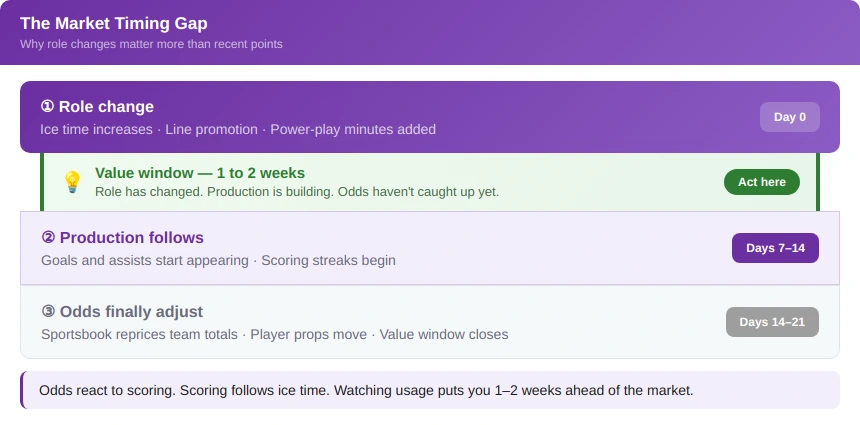
That delay creates a window. A player’s progression can outpace the market by one to two weeks when the odds haven’t caught up, but the ice time already has. Knowing what to look for — ice time changes, line promotions, special teams deployment — puts you ahead of that adjustment rather than behind it.
Types of Young Players That Move the Odds
Not every young player changes a game in the same way. Some bring instant offence. Others influence structure, pace, or overall consistency. If you look closer, most impact comes from three distinct groups, and each affects outcomes differently.
Elite Rookies Entering the League
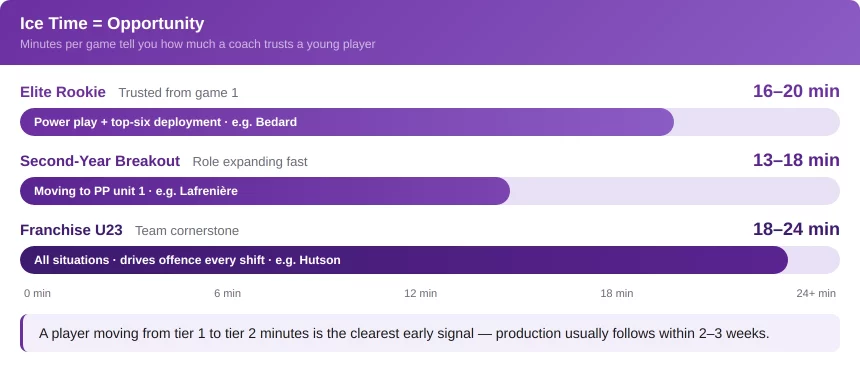
A small group of top young NHL players enters the league and immediately plays real minutes. These are not slow-development prospects. Coaches trust them early because they already handle pace, pressure, and decision-making.
You can usually spot them by usage:
- 16–20 minutes per game
- regular power-play involvement
- top-six deployment
For example, Connor Bedard averaged heavy offensive minutes and finished his first full season (2023-24) with 22 goals and 61 points in just 68 games. Before his injury, he was trending closer to a 30-goal pace. Players with that combination of usage and production in year one have the highest ceiling in the league.
Second-Year Breakout Candidates
This is usually the most important group. Second-year players already understand NHL speed, but their responsibilities tend to expand significantly in year two. That’s why many of the hottest NHL players under 25 emerge from this category.
The changes may appear small on paper:
- from roughly 13 minutes to 17–18 minutes per game
- from the second power-play unit to the first
- from a middle-six role to a top-line assignment
But those adjustments dramatically increase opportunity.
Take Alexis Lafrenière. In 2021-22, he finished his second season with 31 points from 79 games compared to 21 points from 56 in his first year and showed stronger production once his role stabilised. The skill was always there, but consistent usage made the difference.
Under-23 Stars Becoming Franchise Players
At this stage, players stop being “promising” and become essential. These are the NHL’s best young players — the ones teams rely on every night.
You’ll notice clear signs:
- 18–22 minutes per game
- consistent role in all situations
- involvement in key offensive plays
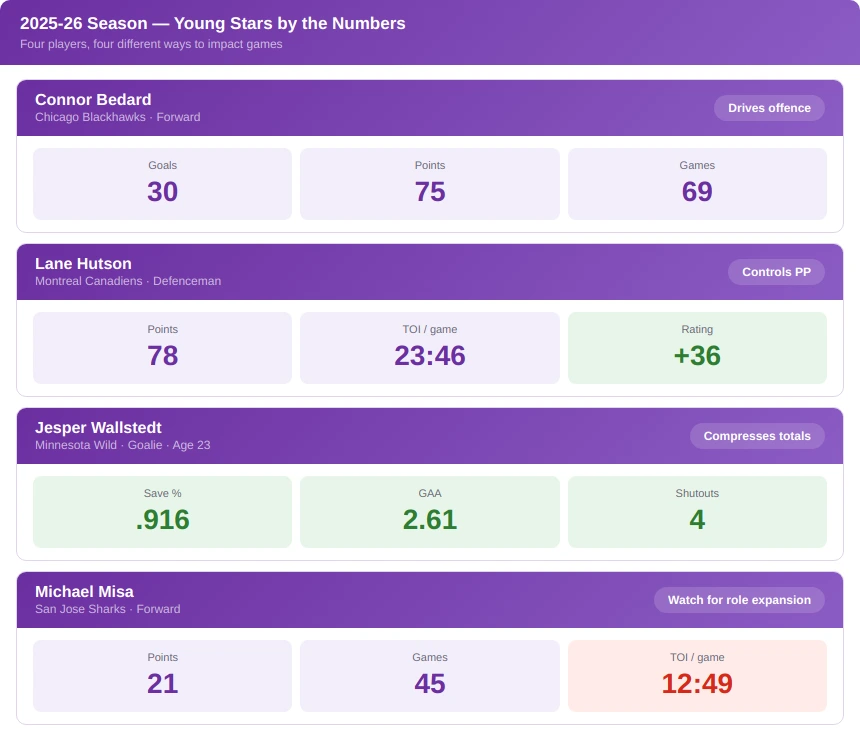
Take Michael Misa. Even in limited NHL minutes (12:49 average ice time) this season, he produced 21 points in 45 games. That level of efficiency shows what happens if his role expands — more time likely means more production.
These players do more than produce highlights because they consistently drive offence, steady team performance, and make outcomes feel more predictable, which is why rookies create flashes while franchise players create lasting patterns.
Key Traits That Affect Betting Impact
Offensive Production and Scoring Ability
Points matter, but you need to look deeper. Compare real output with NHL player rankings: rankings show potential, while production shows current impact.
Check goals and assists per game, shot volume, and creativity in the offensive zone. Players who generate chances through movement and passing rather than just positioning tend to sustain production better. For example, Connor Bedard is not just scoring goals; he is consistently driving offence whenever he is on the ice, and that’s what makes him influential.
Ice Time and Role in the Lineup
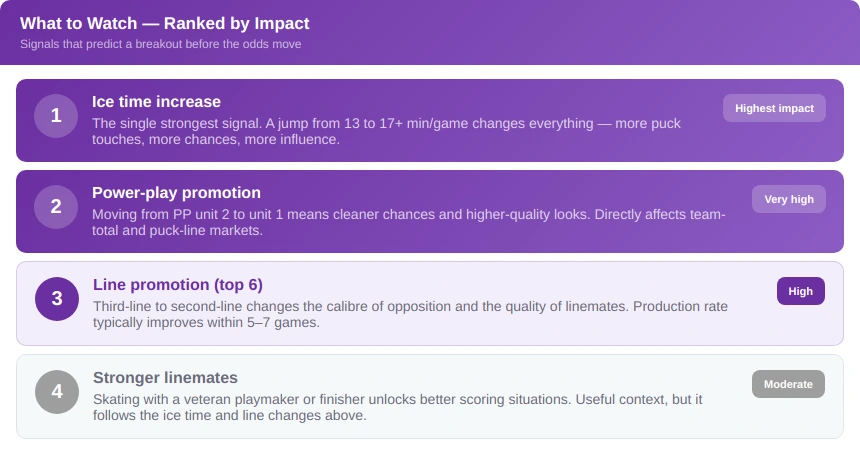
Opportunity changes everything for young players. Ice time, line placement, and offensive usage usually tell you more about future production than raw point totals alone. A player getting trusted in stronger situations naturally becomes more involved in the game.
For example, Michael Misa produced 21 points in 45 games despite limited minutes. If his role expands, the production will likely grow with it. Even a small increase in ice time leads to more puck touches, more scoring chances, and more influence over the flow of play.
Special Teams Contribution
Special teams often reveal how much trust a coach places in a player. Power-play usage creates cleaner shooting opportunities and more chances to contribute offensively, while penalty-kill minutes usually reflect defensive reliability and consistency.
Players like Lane Hutson stand out because they can control play on the power play rather than only at even strength. With 20 power-play points and a permanent role quarterbacking Montreal’s top unit, he’s an example of a young defenceman whose deployment directly influences team-total and puck-line markets. Once a player becomes part of special teams, he is usually involved in some of the most important moments of the game.
Consistency vs Volatility
Some players contribute steadily every night, while others alternate between quiet performances and explosive games. Durability matters too. A player who misses 15 games a season through minor injuries never builds the run of form that moves markets.
Volatile players can still be highly talented, but their impact tends to fluctuate more dramatically. Trevor Connelly, for example, shows high-end skill but uneven results at times, while Nate Danielson is often viewed as a steadier and more reliable presence. Over the long run, consistency usually creates a stronger overall impact, while volatility leads to shorter bursts of influence.
Recent Examples of Young NHL Stars Influencing Outcomes
Defencemen
The new generation of top NHL defenceman prospects doesn’t just defend — they drive play. Take Lane Hutson. Now in his second NHL season, he logs 23:46 a night, controls the puck from the blue line, and finished 2025-26 with 78 points (12 goals, 66 assists) and a +36 rating across all 82 games. His edge work and confidence allow him to keep plays alive, run the power play, and stay involved in most offensive sequences — exactly why his minutes have become a key input for handicappers betting Canadiens games.
Then there is reigning NHL Rookie of the Year Matthew Schaefer, who represents a more complete style of defenceman. His game relies on skating, awareness, and defensive control rather than pure offence alone. Players with that profile influence games differently because they limit scoring chances against, manage transitions more effectively, and help stabilise the structure of the entire team. Offensive defencemen can speed games up, while complete defenders often control how games are played altogether.
Forwards
Most impact still comes from forwards, especially among the best prospects NHL systems are developing right now. Start with Connor Bedard. His production (30 goals, 75 points in 69 games in the 2025-26 season) tells part of the story, but his real value comes from constant involvement. He shoots often, carries the puck, and drives offence every shift.
Another strong case is Utah Mammoth prospect Tij Iginla. His 1.88 points per game in the WHL show elite scoring ability, but what stands out more is his all-around game — puck battles, positioning, and consistency. That’s what allows a player to transition and stay effective.
You also see different styles:
- Players like Bradly Nadeau rely on finishing ability (high goal rate)
- Players like Jake O’Brien drive play through passing and vision
Some forwards finish plays. Others create them. Both can shift results, just in different ways.
Goalie
Goaltending can change a team faster than any other position on the ice. Jesper Wallstedt is a strong example of that. Posting a .916 save percentage with a 2.61 GAA and four shutouts in 35 games as a 23-year-old rookie isn’t simply impressive statistically — it shows consistency against NHL competition. His November 2025 run, when he went 6-0-0 with a 1.14 GAA and .967 save percentage to win Rookie of the Month, was the kind of stretch that visibly compresses team totals and shifts division-winner odds.
What separates goalies from other young players is the scale of their influence. They affect every shot, shape the rhythm of the game, and often hide or expose weaknesses throughout the lineup. A strong goalie can keep a team stable even during difficult stretches, while inconsistent goaltending can quickly create problems no matter how talented the roster looks on paper.
How Sportsbooks React to Rising Talent
Sportsbooks don’t change odds because a player is “promising.” They react when a player starts affecting real outcomes — goals, chances and overall team performance. The issue is timing. Young players often change their roles faster than the odds adjust. If you understand what sportsbooks look at, you can spot that gap.
Pre-Season Projections vs Reality
Before the season starts, every NHL prospect is given an expected role based on draft position, junior production, and development projections. But once games begin, those expectations often change quickly.
A player expected to stay in a limited role can suddenly move into the top six because of injuries, chemistry, or strong early performances. At the same time, highly ranked prospects sometimes lose minutes if they struggle with the pace of the league.
That’s why early-season usage matters more than preseason predictions. Ice time, line combinations, and offensive opportunities usually reveal more than reputation alone. Projections show what teams expect. Actual usage shows what coaches trust in real games.
Odds Adjustments After Breakout Games
Sportsbooks react fast once production becomes visible. A short scoring streak or several strong games can quickly shift player and team odds. But those results usually start with a role change. Increased ice time, power-play usage, or stronger linemates often come before the goals arrive.
If you focus only on recent scoring, you usually notice the trend late. Watching how a player is being used often explains the breakout before the numbers fully catch up. Odds tend to move after the production appears. The real impact usually begins earlier.
Media Hype and Public Betting Influence
When a young player starts producing, media attention grows immediately. Highlights spread online, interviews appear everywhere, and the player becomes much more visible to casual fans.
That attention can influence betting markets as well. More people begin backing the player or his team, and sportsbooks adjust to balance the action. The issue is that popularity does not always reflect long-term consistency.
Sometimes a player becomes a major talking point after only a few strong games, even if his role has not changed much underneath. Public attention can move faster than actual development. Hype shows what people are reacting to in the moment, while usage usually gives a clearer picture of real impact.
Identifying Future Odds Movers
If you want to identify which young players will influence games, you need to look at what changes before production. Goals come later. Role, usage, and involvement come first.
Top Prospects and Draft Classes
Start with NHL teams’ top prospects, but focus on who is closest to NHL minutes, not just who is ranked highest. Scouting reports and draft rankings map the pipeline, but proximity to NHL minutes matters more than where a player was selected. Teams with strong drafting records tend to graduate prospects faster, which means their depth charts are worth monitoring from September onwards.
For example, players like Michael Misa and Tij Iginla stand out because of elite junior production. Misa scored over 130 points last season, and Iginla produced nearly two points per game. That level of output shows they can generate offence on their own.
Monitoring Advanced Stats and Underlying Metrics
Points can be misleading, especially early. You need to check what a player does every shift. Research shows that stats like assists depend on ice time and teammates, while deeper play-driving metrics better predict future production.
Focus on:
- shot attempts
- puck involvement
- pace contribution
Higher pace leads to more scoring chances but also more turnovers — that’s why some young players create chaotic, high-event games.
Spotting Increased Usage and Line Promotions
One of the clearest breakout signs is increased opportunity. When a player moves higher in the lineup or joins the power play, production often follows quickly. More minutes usually mean more puck touches and better offensive situations.
Team Context and Opportunity
Team structure affects development heavily. Rebuilding teams tend to give young players larger roles and more freedom, while deeper playoff teams limit opportunities. A prospect on the San Jose Sharks may earn key minutes faster simply because there is more room in the lineup.
Risks of Overvaluing Young Players
Young players often get overrated after short scoring streaks or viral highlights. A prospect may score in several games, but if his ice time, line placement, and power-play role stay the same, that production may not last.
Public hype also grows faster for high draft picks and offensive players, even though consistency usually matters more long term. Defencemen and goalies often develop more slowly, but their impact can become more stable over time.
Responsible Gambling
Betting should be entertainment, not a way to make money. Gambling can be addictive—only bet what you can afford to lose, and never chase your losses. Set deposit, loss, and time limits before you play, and take regular breaks.
If gambling stops being fun or starts affecting your finances, relationships, or wellbeing, seek help immediately.
Support available across Canada:
- Responsible Gambling Council: responsiblegambling.org (national resource centre)
- British Columbia: Call 1-888-795-6111 (24/7)
- Alberta: Call 1-866-332-2322 (24/7)
- Quebec: Call 1-800-461-0140 (24/7, bilingual)
- Saskatchewan: Call 1-800-306-6789 (24/7)
- Manitoba: Call 1-800-463-1554 (24/7)
- Atlantic provinces: Call 1-800-461-1234 (NB), 1-888-429-8167 (NS), 1-855-255-4255 (PE), 1-888-899-4357 (NL)
- Additional support: Gambling Therapy (gamblingtherapy.org), Gamblers Anonymous (gamblersanonymous.org)
- 988 Suicide Crisis Helpline: Call or text 988
TonyBet provides responsible gambling tools in your account settings, including deposit limits, loss limits, time limits, cool-off periods, and self-exclusion. Use them.
Age restrictions: You must be 19 or older to gamble in British Columbia, Saskatchewan, and Atlantic provinces. You must be 18 or older in Alberta, Manitoba, and Quebec. Underage gambling is illegal.
For more information about responsible gambling practices and support resources, visit the Responsible Gambling section on TonyBet.

FAQ
Do rookies significantly impact NHL game outcomes?
Which young players are most likely to influence results?
How quickly do markets react to breakout performances?
Are young players overvalued by the public?


