






Major League Soccer has built a reputation for chaos in the final minutes. A calm match at the 75th minute can suddenly turn into an end-to-end battle with attacking substitutions, defensive errors, and long stoppage periods.
The 2026 MLS season has continued that pattern. High-tempo matches, aggressive transition play, and inconsistent defending have produced a league where late goals remain common. Unlike slower tactical leagues, many MLS teams continue pushing numbers forward deep into stoppage time.
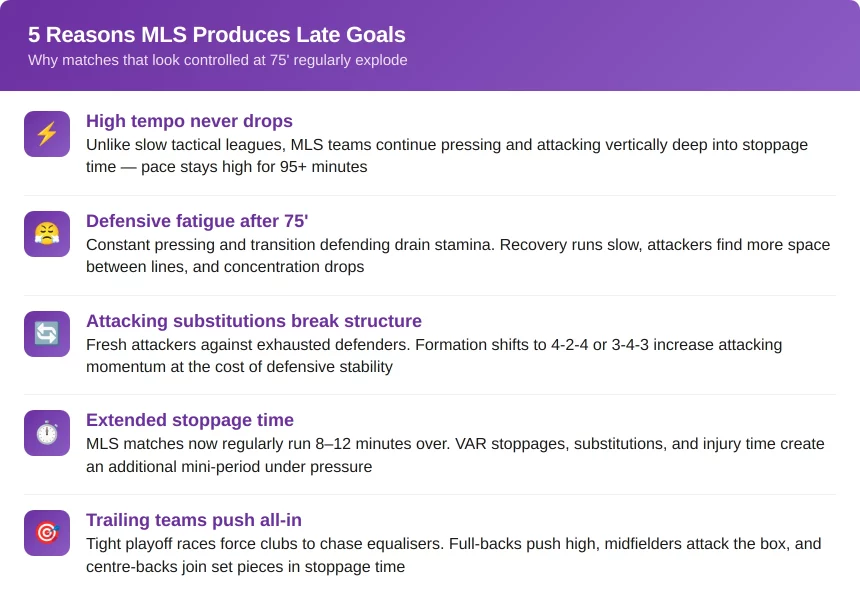
Late Goals in MLS: What the Data Shows
Frequency of Goals After the 75th Minute
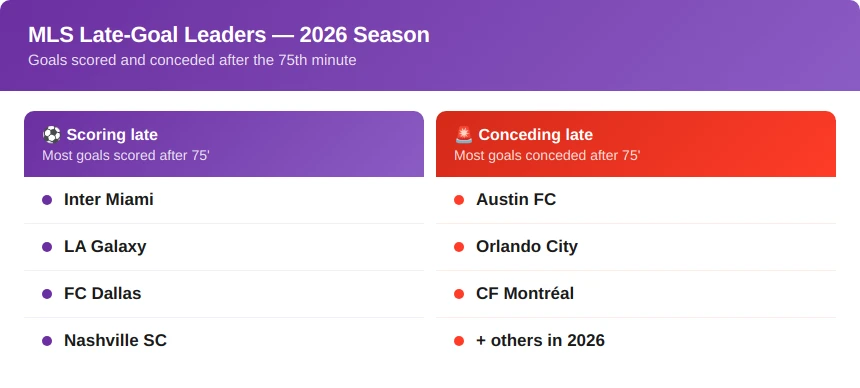
MLS consistently ranks among the more active leagues for goals in the final 15 minutes. Major League Soccer stats from SoccerStats show that many teams score or concede heavily between the 76th and 90th minutes, including stoppage time. During the opening months of the 2026 season, Inter Miami, LA Galaxy, Dallas, and Nashville sat among the league leaders in goals scored after the 75th minute.
The pattern becomes even more pronounced when game state enters the equation. Teams trailing by one goal increase attacking intensity after the 75th minute, while leading teams frequently lose compactness. That combination creates more shots, more transition opportunities, and higher late xG totals than earlier periods of the match.
How MLS Compares to Other Leagues
MLS consistently ranks among the best leagues for late goals alongside other high-tempo competitions. Still, it differs from leagues like Serie A or Ligue 1 because matches rarely slow down after one side takes the lead. The pace remains high, pressing continues, and defensive structure breaks more frequently.
Older Opta comparisons already showed MLS producing similar shot totals to Europe’s top leagues despite lower passing accuracy and less defensive control. That remains evident in 2026. Teams attack quickly, transitions happen constantly, and matches become stretched late.
The Premier League has also seen a rise in stoppage-time goals following changes to added-time guidelines. However, MLS still produces more chaotic late-game sequences because of defensive inconsistency and aggressive tactical risk-taking.
Match Examples
Several MLS matches in 2026 have reinforced the trend. On March 15, the Houston Dynamo beat the Portland Timbers with a stoppage-time winner from Mateusz Bogusz, while D.C. United completed a comeback against the Chicago Fire through a late penalty following VAR intervention the previous day. That evening, Toronto FC also conceded in the 98th minute against the New York Red Bulls.
Physical Fatigue and Game Intensity
High Tempo and End-to-End Play Style
MLS matches rarely become slow tactical battles. Many teams rely on vertical attacking, quick counters, and direct progression instead of long possession phases. That raises overall tempo and forces players into repeated high-intensity sprints.
The league’s physical profile contributes heavily to late goals. Constant pressing, transition defending, and wide-open spacing reduce stamina late in matches. Once endurance drops, defensive recovery runs become slower, and attackers find more space between lines.
This is especially noticeable in summer fixtures played under heat and humidity. Matches in Texas, Florida, and other warm-weather markets regularly show declining defensive intensity after halftime.
Defensive Errors Late in Matches
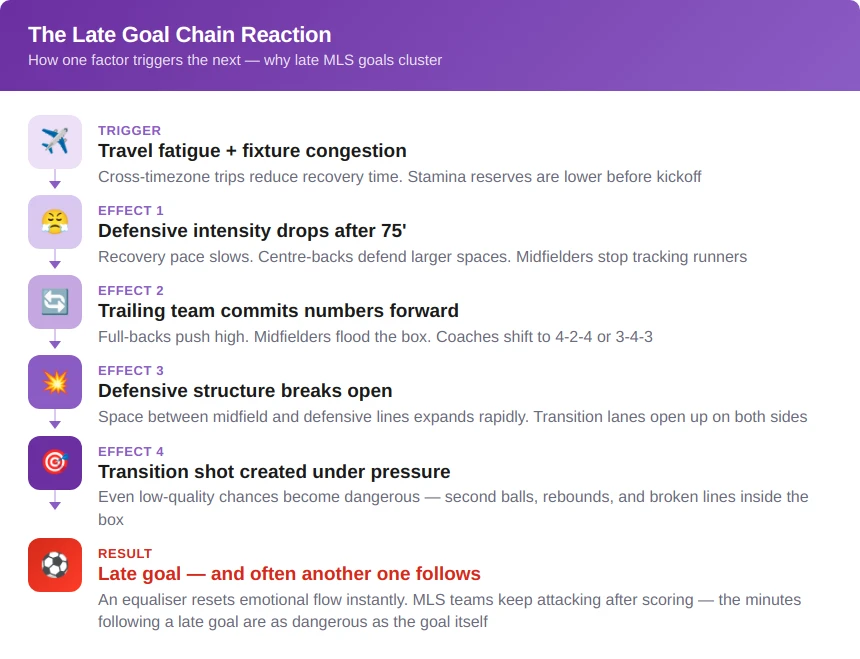
Late MLS goals are not only created by attacking quality. Many come from concentration drops and poor defending. Teams lose compactness, centre-backs defend larger spaces, and midfielders stop tracking runners consistently.
The effect becomes stronger once substitutions alter defensive structure. MLS clubs also rotate heavily because of fixture congestion, which reduces defensive chemistry.
In 2026, several teams have already shown clear late-game defensive issues. Austin FC, Orlando City, and CF Montréal ranked among the weaker MLS defences in goals conceded after the 75th minute during the opening months of the 2026 season.
Impact of Travel and Scheduling in MLS
The MLS schedule creates physical demands few European leagues can match. Teams travel across multiple time zones throughout the regular season, often flying thousands of miles between matches.
That travel impacts recovery, stamina, and defensive organisation. Trips between the West Coast and East Coast reduce preparation time and contribute to fatigue accumulation over the course of the season. Even with improved recovery science and charter flights, MLS still faces unique logistical challenges.
Fatigue affects pressing intensity late in matches. Once teams stop pressing collectively, the space between the midfield and defensive lines expands rapidly.
Tactical Shifts in the Final Minutes
Teams Chasing the Game
MLS coaches rarely settle for narrow defeats. Teams trailing late commit numbers forward aggressively, especially in regular-season matches where playoff races remain tight.
Full-backs push higher, midfielders attack the penalty area, and centre-backs sometimes join set pieces during stoppage time. The result is a league where one late goal frequently produces another chance minutes later.
Attacking Substitutions and Formation Changes
Substitutions change the tactical flow of MLS matches dramatically. Fresh attackers enter against exhausted defenders, while coaches shift formations toward more aggressive shapes like 4-2-4 or 3-4-3 systems.
These adjustments may reduce defensive stability but increase attacking momentum. The fresh legs of late substitutes often become decisive against tired defenders struggling with recovery pace and transition coverage.
Increased Risk-Taking and Open Play
During the final 10 minutes, MLS matches frequently resemble transition battles rather than structured tactical contests. Teams abandon conservative build-up play and attack directly through wide spaces or early crosses.
Direct attacking and stretched spacing create repeated transition shots during the closing stages. Even low-quality chances become dangerous because second balls, rebounds, and broken defensive lines produce chaotic sequences inside the box.
The Role of Stoppage Time
Longer Added Time and More Opportunities
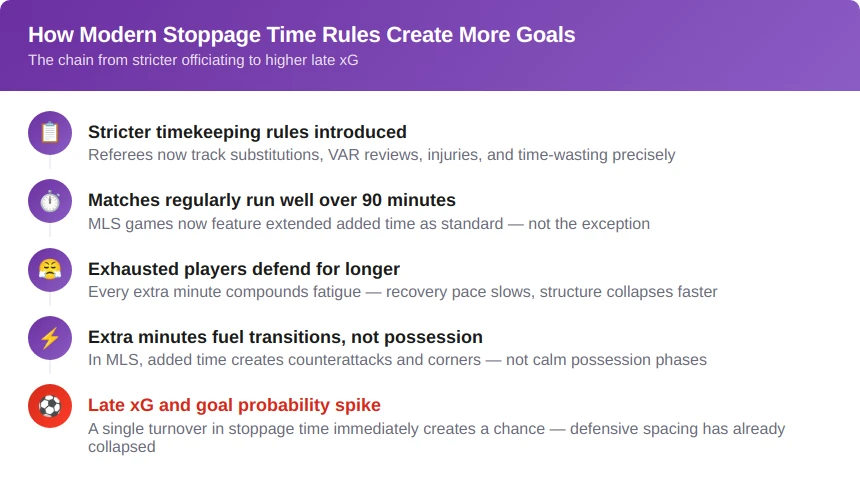
Modern stoppage-time rules have increased scoring opportunities globally. MLS matches now regularly feature extended stoppage periods because referees apply stricter timekeeping standards for injuries, substitutions, and VAR interruptions.
Longer matches naturally increase the likelihood of late goals. A game with 10 minutes of stoppage time effectively creates an additional mini-period in which exhausted teams continue defending under pressure.
Rule Changes Affecting Time-Wasting
Referees now punish time-wasting more aggressively. Goalkeepers receive quicker warnings, substitutions are tracked carefully, and VAR delays add substantial stoppage periods.
These changes are particularly important in MLS, where matches already feature heavy transition play. Extra minutes tend to create more counterattacks, corners, and attacking sequences rather than slow possession phases. That benefits attacking teams late in games.
How Extra Minutes Increase Goal Probability
Goal probability rises late because attacking urgency grows while defensive quality declines. Once matches extend beyond the 90th minute, tactical discipline becomes harder to maintain.
A single turnover during stoppage time can immediately create a chance because defensive spacing collapses under pressure.
Statistical Patterns Behind Late Goals
Higher Goal Probability in Final Minutes
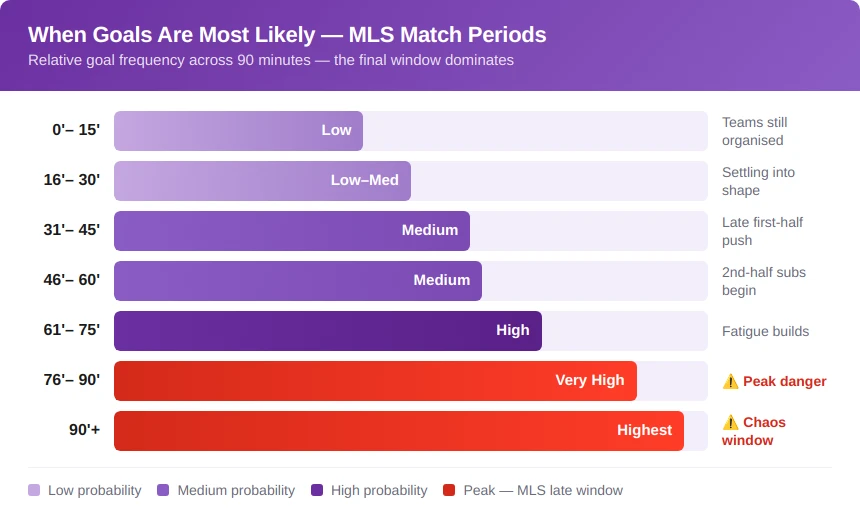
Soccer-wide late-goal statistics already show elevated scoring after the 75th minute, but MLS amplifies the trend through pace and tactical openness. Matches with high shot volume and rapid transitions naturally create stronger late xG profiles.
Live match data from the 2026 season continued to show elevated shot volume and attacking pressure during the closing stages of matches.
Game State Influence
Trailing teams attack more directly and commit additional players forward. Leading teams respond by dropping deeper and protecting space near the box.
That tactical imbalance increases sustained pressure late in matches. Defending sides face repeated crosses, set pieces, and transition attacks.
The psychology of protecting a lead also plays a role. Teams defending narrow advantages frequently stop progressing the ball effectively, which invites more pressure and raises xG conceded.
Clustering of Goals Toward Full Time
MLS matches regularly produce clusters of late goals rather than isolated moments. One equaliser changes the emotional flow instantly and creates another wave of attacking play. This pattern explains why many MLS matches explode after appearing controlled for long periods. Once the structure disappears, transitions multiply rapidly.
Psychological and Situational Factors
Pressure on Defending Teams
One-goal leads rarely feel secure in MLS, especially once matches enter extended stoppage time. MLS playoff races frequently remain tight across both conferences, which increases pressure on defending teams late in matches. Clubs chasing playoff qualification often push aggressively for points instead of protecting narrow defeats, especially during crowded summer stretches in the MLS schedule.
Momentum Swings Late in Matches
MLS matches regularly become transition-heavy after late equalisers because teams continue attacking instead of slowing possession. That aggressive flow creates rapid momentum swings and additional scoring opportunities during stoppage time. A single transition chance or dangerous set piece can completely change the match flow.
Unlike in slower leagues where teams manage possession calmly after scoring, MLS teams frequently continue attacking immediately after equalising, which is why the minutes following a late goal are often as dangerous as the goal itself.
Importance of Late Goals in Standings
The MLS playoff structure increases urgency across the regular season. Teams place a high value on single points because conference standings remain compressed for much of the year.
That pushes clubs to chase equalisers aggressively instead of accepting defeats. Coaches also prioritise attacking substitutions because late points can decide playoff qualification, which is why late-goal frequency has become one of the more discussed MLS betting trends.
League-Specific Reasons for MLS Trends
Parity and Competitive Balance
Salary restrictions and roster parity prevent major gaps between MLS clubs, which keeps more matches competitive deep into the second half. Tighter matches naturally produce more late drama because games remain undecided longer.
Defensive Inconsistency Across Teams
Many MLS clubs remain stronger in attack than defence. Technical attacking talent has improved rapidly, but defensive organisation still varies heavily across the league. This imbalance contributes directly to late goals. Teams continue generating attacking xG while struggling to maintain defensive compactness for 90 minutes.
Developmental Nature of the League
MLS remains a developmental league in several areas, including tactical structure and defensive consistency. Younger players, rotating squads, and evolving coaching systems create unpredictable match flow. That unpredictability benefits entertainment value but also contributes to late-game volatility.
Insights from Fans and Observers
Perception of “Late Goal Chaos” in MLS
MLS fans regularly describe the league as unpredictable late in matches. Long stoppage periods, aggressive substitutions, and stretched defensive spacing regularly create chaotic final minutes in MLS matches.
Teams Prone to Late Goals
Certain teams repeatedly appear in late-goal matches because of tactical identity. Clubs that press aggressively or attack vertically tend to create more open endings. In 2026, teams like Inter Miami, Austin FC, Orlando City, and Dallas have already shown strong involvement in late scoring sequences.
Variability Across Seasons and Teams
Coaching changes, officiating trends, and roster turnover influence how late-game patterns develop across different MLS seasons. Still, the core factors remain consistent. Despite those seasonal changes, high pace, travel fatigue, aggressive attacking, and long stoppage periods continue driving late goals across Major League Soccer – a consistency that keeps late-game scoring at the centre of MLS soccer betting trends year after year.
Responsible Gambling
Betting should be entertainment, not a way to make money. Gambling can be addictive—only bet what you can afford to lose, and never chase your losses. Set deposit, loss, and time limits before you play, and take regular breaks.
If gambling stops being fun or starts affecting your finances, relationships, or wellbeing, seek help immediately.
Support available across Canada:
- Responsible Gambling Council: responsiblegambling.org (national resource centre)
- British Columbia: Call 1-888-795-6111 (24/7)
- Alberta: Call 1-866-332-2322 (24/7)
- Quebec: Call 1-800-461-0140 (24/7, bilingual)
- Saskatchewan: Call 1-800-306-6789 (24/7)
- Manitoba: Call 1-800-463-1554 (24/7)
- Atlantic provinces: Call 1-800-461-1234 (NB), 1-888-429-8167 (NS), 1-855-255-4255 (PE), 1-888-899-4357 (NL)
- Additional support: Gambling Therapy (gamblingtherapy.org), Gamblers Anonymous (gamblersanonymous.org)
- 988 Suicide Crisis Helpline: Call or text 988
TonyBet provides responsible gambling tools in your account settings, including deposit limits, loss limits, time limits, cool-off periods, and self-exclusion. Use them.
Age restrictions: You must be 19 or older to gamble in British Columbia, Saskatchewan, and Atlantic provinces. You must be 18 or older in Alberta, Manitoba, and Quebec. Underage gambling is illegal.
For more information about responsible gambling practices and support resources, visit the Responsible Gambling section on TonyBet.

FAQ
Why are there so many late goals in MLS matches?
Are MLS games more prone to late goals than other leagues?
Does stoppage time significantly affect scoring rates?
Can late goals in MLS be predicted?


