


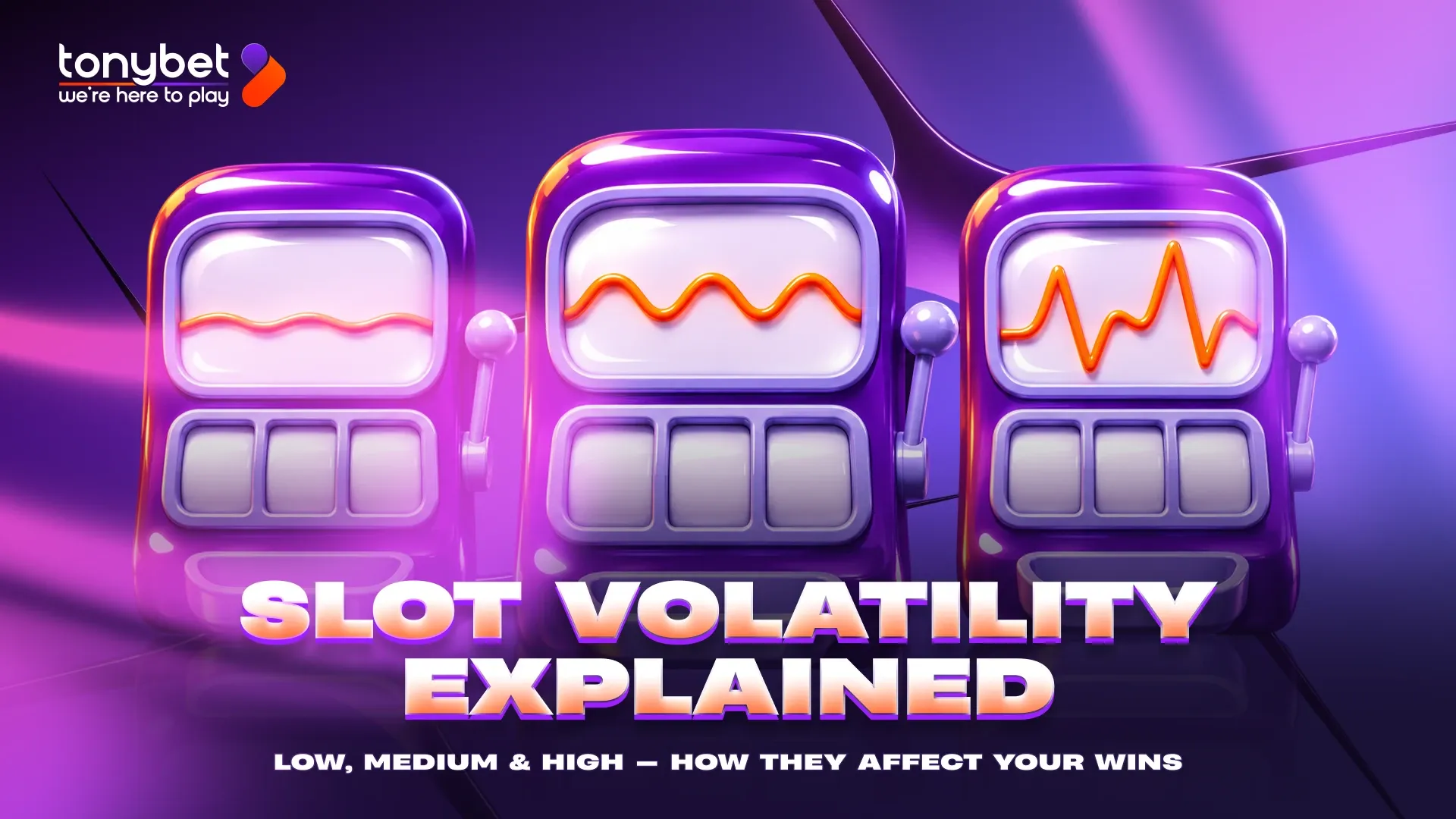



Why can two slots pay back the same share of every dollar wagered and still feel nothing alike? The answer is volatility. This guide explains what volatility means, how each level changes a slot session for Canadian casino players, and how to check a game’s rating in the Tonybet lobby.
What Is Slot Volatility?
So, what does volatility mean? It describes a slot’s payout pattern, meaning how often the game pays and the typical payout size. A low-volatility slot spreads its returns across many small wins. A high-volatility slot holds more of its returns for fewer, larger wins.
The slot provider sets volatility when designing the game. It does not change while you play. It also says nothing about a single spin. Every result is random and independent of the one before.
Volatility vs Variance
Both words are used for the same idea. In statistics, variance measures how widely results spread around the average, and volatility is usually expressed as its square root, the standard deviation. For players, the distinction makes no practical difference.
Low, Medium and High Volatility Compared
The table shows the general pattern. Exact figures differ from game to game, and some providers go beyond three levels to rate games on a 1–5 or 1–10 scale.
| Volatility Level | Win Frequency | Typical Win Size | Session Style |
| Low | Frequent | Small, often a few times the bet or less | Steady, slow-moving balance |
| Medium | Moderate | Mostly small, with occasional larger wins | Ups and downs within a range |
| High | Infrequent | Mostly small, with rare large wins | Long dry spells and sharp swings |
As reference points, NetEnt’s Starburst is widely listed as a low-volatility slot with a relatively low maximum win (most sources list 500x the bet), while Play’n GO’s Book of Dead is usually rated high, with a maximum win of 5,000x.
Read any slot machine volatility list with care, though. Published ratings for the same game can differ by a level, so the game’s own information is the final word.
Low-Volatility Slots
Frequent Smaller Wins
Low-volatility slots pay often, but most wins are small. Their hit frequency, the share of spins that return something, is usually higher than on high-volatility games. Some of those wins still pay back less than the stake (a quarter in the low-volatility model below), so a win on the screen can still be a loss on the spin.
Hit frequency alone does not define volatility, though. NetEnt’s Starburst wins on about 23% of spins, while its sibling Starburst XXXtreme, rated very high volatility with a maximum win of 200,000x, wins on about 20%. The real difference lies in the size of the wins.
How They Affect Session Length
Because the balance moves in small steps, a fixed bankroll usually lasts longer. That does not make low volatility cheaper. The RTP sets the expected loss per spin, not the volatility.
Medium-Volatility Slots
Balanced Win Frequency and Payout Size
Medium-volatility slots sit between the two. Wins come often enough to keep the balance moving, with a bonus feature or a larger line win now and then. Ratings in this band are often split further into medium-low and medium-high.
In the simulation below, the medium model produced the widest spread of results, because its larger wins landed often enough to lift many sessions while others fell well short.
High-Volatility Slots
Longer Dry Spells
In high-volatility slots, most wins are smaller than the stake, so long runs without a meaningful win are common.
In the simulation below, the high-volatility model’s longest run without a win at least equal to the stake averaged 43 spins, against 20 for the low-volatility model.
A long dry spell is normal play, not a sign that a win is due. Each spin is independent, and a losing run does not change the odds of the next one.
Larger Potential Payouts
In practice, the meaning of high volatility comes down to concentration. A large share of the game’s return sits in rare outcomes, often inside a bonus feature, which is where the maximum win is usually reached. Those outcomes are rare by design, and most sessions end without reaching them.
Slot Volatility vs RTP
RTP (return to player) is the share of all money wagered that a slot is designed to pay back over a very large number of spins.
A 96% RTP means a theoretical CAD 96 returned for every CAD 100 wagered across all players, representing a house edge of 4%. It does not mean that an individual player who wagers CAD 100 will receive CAD 96 back.
Volatility describes how that return is distributed. The two are independent, so a high-volatility slot can have the same RTP as a low-volatility one.
Providers also often release several RTP versions of the same game, so check the figure in the game info rather than assuming it.
How Volatility Changes Your Gaming Experience
To show the difference, we simulated three hypothetical slots, all set to a 96% RTP, and each played for 200 spins at CAD 1, 20,000 times over. The figures illustrate payout patterns; they are not data from real games.
| Measure | Low volatility | Medium volatility | High volatility |
| Hit frequency | 24% of spins | 20% of spins | 19% of spins |
| Wins that pay less than the stake | 25% of wins | 39% of wins | 62% of wins |
| Average longest run without a win at least equal to the stake | 20 spins | 28 spins | 43 spins |
| Median result after 200 spins | −CAD 10 | −CAD 19 | −CAD 58 |
| Middle 80% of results | −CAD 57 to +CAD 45 | −CAD 103 to +CAD 118 | −CAD 123 to +CAD 85 |
| Sessions finishing ahead | 40% | 43% | 25% |
| Sessions losing CAD 100 or more | Under 1% | 12% | 28% |
All three models lose about CAD 8 per 200 spins on average, because they share the same RTP. Their hit frequencies differ by only a few points, as with real games.
What changes is the short-term variance, driven by win size. The median sits below the average in every column, because a few large wins pull the average up while most sessions finish under it.
The high-volatility model finishes ahead least often, since its return depends on rare large wins that most sessions never reach.
The medium model shows the widest middle range and finishes ahead slightly more often than the low one, because its larger wins land often enough to turn many sessions around, while the high model’s biggest outcomes appear in fewer than one session in 20.
Which Volatility Level Fits Different Players?
| Player Preference | Volatility Type | Why |
| Longer sessions on a fixed budget | Low | Small, frequent wins move the balance slowly |
| Steady play with occasional features | Medium | Regular wins with some larger results |
| Accepting long losing runs for rare large wins | High | Returns are concentrated in rare outcomes |
None of these choices changes the house edge. They change how the session feels.
Common Slot Volatility Mistakes
- Treating a dry spell as a sign that a win is due. Every spin is independent.
- Confusing volatility with RTP. A low-volatility game is not a better-paying game.
- Raising the bet size to recover losses. A bigger bet raises the expected loss per spin on any slot, and on a high-volatility game it also deepens the swings.
- Trusting one outside rating. Published ratings for the same game can differ, so check the game info or paytable.
- Judging a slot on a handful of spins. Twenty spins say almost nothing about a game’s pattern.
Managing Your Session by Volatility Level
Set the budget for the slot session first, then choose a bet size that fits the volatility. On high-volatility slots, a smaller bet relative to your bankroll leaves more room for dry spells; on low-volatility games, the balance moves more gradually either way.
Decide on a time limit and a loss limit before you start, and stop when you reach either one. Responsible gambling tools such as deposit limits and time reminders make those limits easier to keep.
Responsible Gambling
Betting should be entertainment, not a way to make money. Gambling can be addictive—only bet what you can afford to lose, and never chase your losses. Set deposit, loss, and time limits before you play, and take regular breaks.
If gambling stops being fun or starts affecting your finances, relationships, or wellbeing, seek help immediately.
Support available across Canada:
- Responsible Gambling Council: responsiblegambling.org (national resource centre)
- British Columbia: Call 1-888-795-6111 (24/7)
- Alberta: Call 1-866-332-2322 (24/7)
- Quebec: Call 1-800-461-0140 (24/7, bilingual)
- Saskatchewan: Call 1-800-306-6789 (24/7)
- Manitoba: Call 1-800-463-1554 (24/7)
- Atlantic provinces: Call 1-800-461-1234 (NB), 1-888-429-8167 (NS), 1-855-255-4255 (PE), 1-888-899-4357 (NL)
- Additional support: Gambling Therapy (gamblingtherapy.org), Gamblers Anonymous (gamblersanonymous.org)
- 988 Suicide Crisis Helpline: Call or text 988
TonyBet provides responsible gambling tools in your account settings, including deposit limits, loss limits, time limits, cool-off periods, and self-exclusion. Use them.
Age restrictions: You must be 19 or older to gamble in British Columbia, Saskatchewan, and Atlantic provinces. You must be 18 or older in Alberta, Manitoba, and Quebec. Underage gambling is illegal.
For more information about responsible gambling practices and support resources, visit the Responsible Gambling section on TonyBet.

FAQ
What does volatility mean in slots?
Is high or low volatility better?
Is volatility the same as RTP?
Can two slots have the same RTP but different volatility?
How can I find a slot's volatility?


