






A game can look decided until the final minute ruins the spread. One missed free throw, a quick foul sequence, or a garbage-time basket can completely flip the betting result.
Many NBA bettors trust teams that stay calm late in games, especially when star players take control during close finishes. At the same time, clutch numbers can become misleading very quickly. A short hot streak or a few dramatic endings may completely change how a team looks in close-game situations.
In this article, we examine how clutch performance connects to ATS betting, why some late-game teams still struggle to cover, and how sportsbooks react once certain players or teams build a strong clutch reputation.
Clutch Time in Basketball
The NBA officially defines clutch time as the final five minutes of a game when the score difference is five points or fewer. These moments receive enormous attention because every possession carries a greater win probability. A missed free throw with 20 seconds left can affect the outcome far more than several mistakes earlier in the game.
Clutch moments also shape legacies. Players like Michael Jordan, Kobe Bryant, and Damian Lillard built reputations around late-game shot-making and playoff performances. Debates surrounding the top 10 most clutch NBA players of all time remain popular because dramatic endings influence public memory more than ordinary regular-season performances.
Typical Time and Score Conditions
Most clutch situations happen during close fourth quarters or overtime periods when one or two possessions separate both teams. Coaches shorten rotations, defences tighten, and star players handle the ball more frequently. Analysts often use advanced metrics like Win Probability Added (WPA) as a benchmark for measuring the impact of late-game plays instead of relying only on points scored.
Why Clutch Time Gets So Much Attention
Clutch basketball attracts bettors because late possessions often decide whether teams cover the spread. A favourite leading by four points may fail to cover after missed free throws, while an underdog can cash tickets with a meaningless last-second basket.
Those endings create emotional reactions, but emotions alone do not always provide reliable betting insight. Sportsbooks understand how strongly the public values clutch reputations, which is why star players and famous late-game teams often influence betting lines before the game even begins.
How Clutch Performance Is Measured
For years, clutch basketball was judged mostly through reputation. Fans remembered game-winning shots, commentators praised “killer instinct”, and certain players developed larger-than-life identities based on a handful of late possessions. Modern analytics approaches the subject differently. Instead of relying on narratives, analysts now use detailed metrics designed to measure how much a player truly impacts winning during high-pressure moments.
Traditional Stats vs Clutch-Specific Metrics
Traditional basketball statistics focus on totals like points, assists, rebounds, and field-goal percentage. While useful, these numbers do not fully capture late-game importance because they treat every possession equally. A layup in the first quarter counts the same as a three-pointer with 10 seconds left, even though the second play carries much greater win probability.
Clutch-specific analysis attempts to solve this issue using contextual weighting and situational estimation. Instead of counting only production, advanced systems measure how strongly a play changes a team’s chances of winning. Analysts also use data aggregation across hundreds of close-game possessions to identify whether certain players consistently perform above expected levels.
This approach becomes especially important when discussing famous clutch debates or comparing all-time NBA playoff clutch stats.
Win Probability Added (WPA) and Impact Plays
One of the most useful clutch analytics tools is Win Probability Added, commonly called WPA. This metric tracks how much each play changes a team’s likelihood of winning. The higher the leverage of the moment, the greater the impact.
A famous example came during the 2013 NBA Finals when Ray Allen hit a game-tying three-pointer against the Spurs. The shot reportedly increased Miami’s win probability by roughly 40%, far above the normal expected value of an average made three-pointer. Analysts describe this difference as “clutch WPA” because the timing dramatically increased the play’s importance.
The opposite can happen, too. Earlier in that same game, LeBron James committed a late turnover that sharply reduced Miami’s chances of winning. Under WPA analysis, negative plays in high-pressure situations carry greater penalties because of their leverage.
Analysts also separate “expected WPA” from “clutch WPA.” Expected values act as a baseline index, while clutch contributions measure performance above or below that expectation. Garbage-time possessions receive lower calibration because they have little influence on the outcome.
Shooting Efficiency in High-Pressure Moments
Late-game shooting efficiency often shapes public perception more than any other clutch statistic. Fans naturally focus on buzzer-beaters, difficult jumpers, and final-minute scoring runs. Searches related to the most clutch-time points in NBA history usually reflect that fascination with dramatic offence.
Still, efficiency matters more than volume. A player taking difficult shots late in games may create memorable highlights while posting average percentages overall. Analysts, therefore, examine true shooting percentage, turnover rate, and free-throw accuracy specifically during clutch possessions.
Those details become highly relevant for betting markets because late-game free throws, intentional fouls, and rushed possessions often determine whether teams cover the spread. In many close games, a single missed free throw changes both the final margin and the betting result.
Does Clutch Performance Really Exist?
The idea of “clutch” performance has divided basketball analysts for years. Some believe elite players consistently perform better under pressure, while others argue most late-game success comes from randomness and selective memory. Modern analytics suggests that clutch moments are real, but repeatable clutch dominance is much harder to prove.
Research on Clutch vs Regular Performance
Research comparing regular and late-game performance usually shows only small differences for most players. Many stars maintain similar shooting percentages in both situations, while others experience short-term spikes that disappear over time.
Analysts often find a weak correlation between previous clutch success and future late-game efficiency, which makes long-term inference difficult. This is why debates about the greatest clutch player of all time rarely produce universal agreement. Reputation and statistical evidence do not always match.
Variance and Small Sample Size Issues
Small sample sizes create major problems in clutch analysis. Even superstar players only take a limited number of truly high-pressure shots each season, so normal statistical variance can heavily influence results.
A player hitting several game winners in one playoff run may look historically clutch, but those makes could simply be an outlier within a larger shooting distribution. Analysts, therefore, look for year-to-year stability and reliability before treating clutch numbers as predictive signals.
Psychological Factors and Perception Bias
Psychology strongly shapes how fans interpret clutch basketball. People remember dramatic game winners far more than routine possessions, creating emotional bias. Media coverage increases this effect by replaying successful late-game shots repeatedly while ignoring failed attempts.
That often leads fans to confuse memorable moments with repeatable skill. Confidence and composure clearly matter under pressure, but proving direct causation between clutch reputation and future results remains difficult due to ongoing statistical uncertainty.
Clutch Time vs Covering the Spread
Why Winning Doesn’t Equal Covering
Many newer bettors ask, “What does cover the spread mean in betting?” after watching a team win the game but still lose the bet. In spread betting, sportsbooks set a margin that the favourite must win by, not just the game result itself.
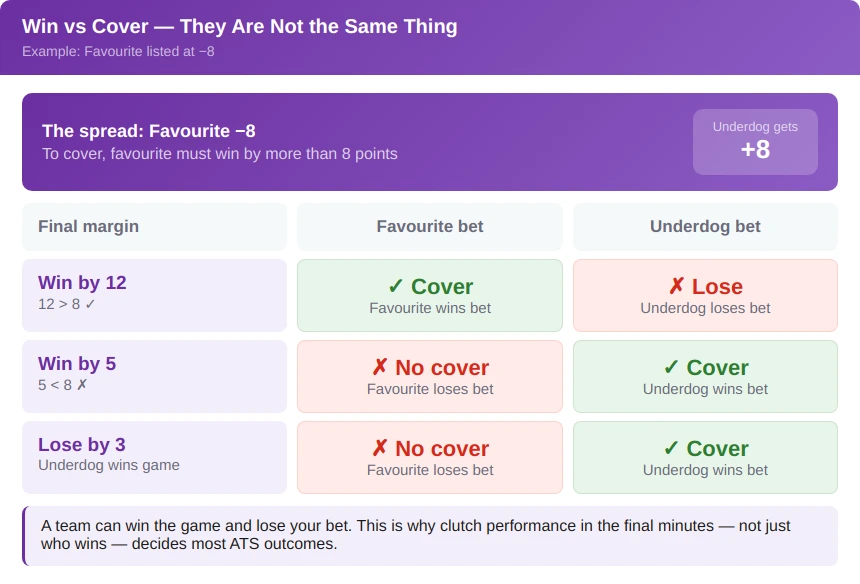
For example, if a team is listed at -8, it must win by more than eight points to cover the spread. Winning by only five still counts as a failed ATS result. On the other side, the underdog can lose the game but still cover if the final margin stays inside the spread.
Thus, successful NBA teams are not always successful betting teams. Popular contenders often receive inflated spreads because public bettors continue backing them, especially when star players are involved. As a result, favourites may win regularly while still struggling to cover consistently over a long season.
Impact of Late-Game Scoring Margins
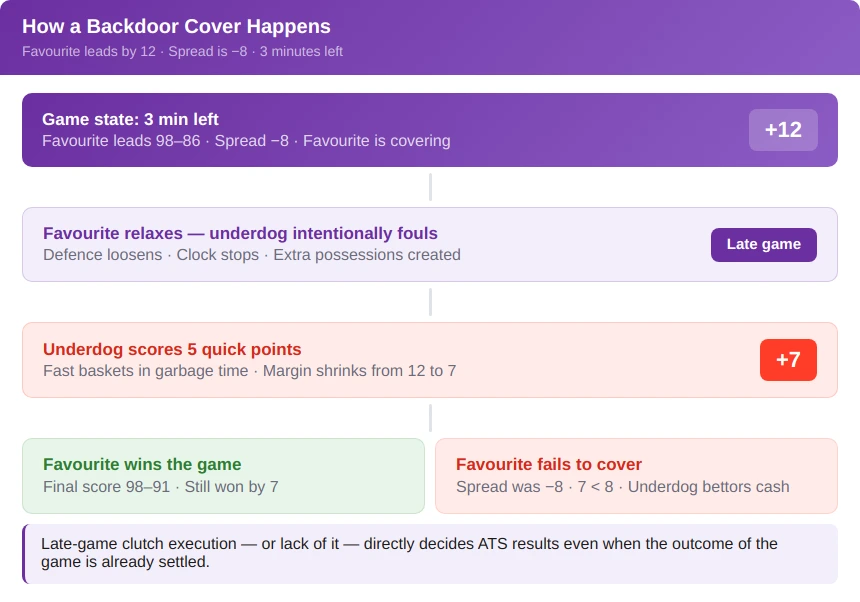
Late-game scoring margins are important because many ATS results are decided during the final possessions. A game that looks finished can still swing against the spread.
These situations are often called backdoor covers. For example, a favourite may lead by 12 points late, relax defensively, and allow quick points that cut the final margin to seven. The favourite still wins the game, but underdog bettors win against the spread.
This also helps explain how often favourites cover the spread. Even strong teams fail to cover regularly because NBA spreads are tight and late-game variance is common.
Free Throws, Fouling and Spread Outcomes
Late fouling has a huge effect on NBA spread results because it creates extra possessions and constant free-throw situations in the final minutes.
Teams trailing late intentionally stop the clock, which can quickly change the final scoring margin even when the winner is already clear. This is often how an underdog covers the spread in a close game.
Bettors studying NBA teams that cover the spread pay close attention to late-game free-throw shooting, coaching decisions, and execution under pressure. Teams that stay organised in clutch situations usually perform more consistently against the spread over time.
Predictive Value of Clutch Metrics
Every NBA season creates a few new “clutch legends.” A player hits a game-winner on national TV, a team survives several close finishes in a row, and suddenly bettors start treating those moments like reliable indicators for future games.
That’s where betting markets become tricky. Emotional moments attract attention, but sportsbooks care much more about long-term patterns and repeatable results.
Year-to-Year Consistency of Clutch Performance
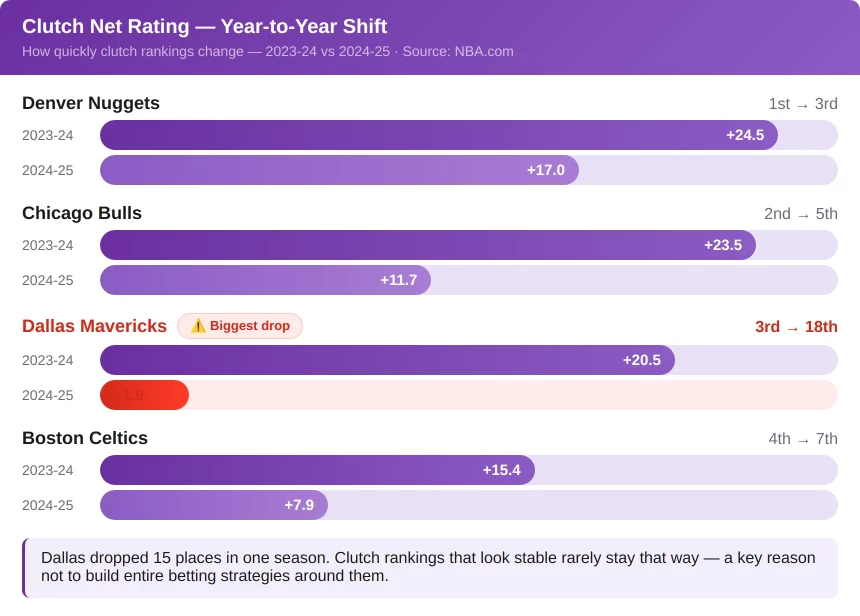
Clutch numbers rarely stay stable for long. A player who looks unstoppable in late-game situations one season can easily regress to average levels the next year. Analysts have tracked this pattern for years, especially with shooting percentages in close fourth-quarter possessions.
Part of the problem comes from the sample itself. Truly high-pressure possessions make up only a small fraction of an NBA season, so a few extra made shots can completely change the picture. That naturally creates statistical variance.
Correlation Between Clutch Stats and ATS Results
Late-game execution absolutely affects ATS outcomes. The problem for bettors is that sportsbooks already know this. Once a team develops a strong clutch reputation, public money quickly follows. That often pushes the line slightly higher than it would be otherwise.
A good example appears every season with popular contenders. Teams led by stars like Stephen Curry or LeBron James attract betting support simply because people trust them late in games. As a result, those teams sometimes win consistently while becoming less profitable for betting to cover the spread.
Analysts have also noticed that teams with unusually strong records in close games often slide backward the following year. That does not erase the value of clutch execution, but it does suggest that some apparent trends contain more statistical noise than bettors first assume.
Limits of Using Clutch Data for Prediction
Clutch metrics can help explain what happened in a game, but they do not always predict what happens next. Injuries, scheduling, pace, fatigue, and matchup quality usually influence NBA results more consistently than one player’s reputation in late possessions.
Experienced bettors rarely build an entire “clutch bet” strategy around highlights alone. Used correctly, clutch data works better as a supporting context rather than as a standalone prediction model.
How Sportsbooks Factor in Clutch Ability
Star Players and Public Perception
Certain players naturally create confidence among bettors. When games stay close late, many people would rather trust proven stars than role players or younger teams.
That confidence influences betting markets constantly. Teams with famous closers usually receive more public action in tight games because fans expect those players to take control under pressure.
Line Adjustments Based on Reputation
Sportsbooks do not need huge line changes to remove betting value. Even a one-point adjustment can completely change long-term profitability. Once the public begins backing a team heavily because of its clutch reputation, bookmakers shade the spread accordingly. Over time, that adjustment makes it much harder to find value simply by betting well-known late-game teams.
Efficiency of Modern Betting Markets
NBA betting markets react faster now than they did a decade ago. Injury reports, advanced stats, public betting trends, and player narratives all move odds within minutes. As a result, true market inefficiencies rarely stay open for long. By the time most bettors notice a clutch trend, sportsbooks have usually already accounted for it.
When Clutch Performance Actually Matters
Clutch stats still have value. The key is knowing where they matter and where people tend to exaggerate them.
Close Games and Tight Spreads
Late-game execution becomes much more important when spreads are small. In those situations, one turnover or missed free throw can decide both the game and whether a team manages to cover the spread. This is also where bettors pay close attention to foul shooting, coaching decisions, and late-game shot selection.
Late-Game Decision Making and Coaching
Players receive most of the attention, but coaching often shapes clutch outcomes just as much. Timeout usage, defensive matchups, substitution timing, and foul strategy all become more important in the final minutes.
Strong teams usually show better late-game consistency because they stay organised when games become chaotic.
Live Betting vs Pre-Game Markets
Clutch analysis often becomes more useful during live betting. Watching a game unfold gives bettors a chance to evaluate confidence, fatigue, rotations, and momentum in real time. Those details are much harder to measure before tip-off.
Common Mistakes When Using Clutch Data
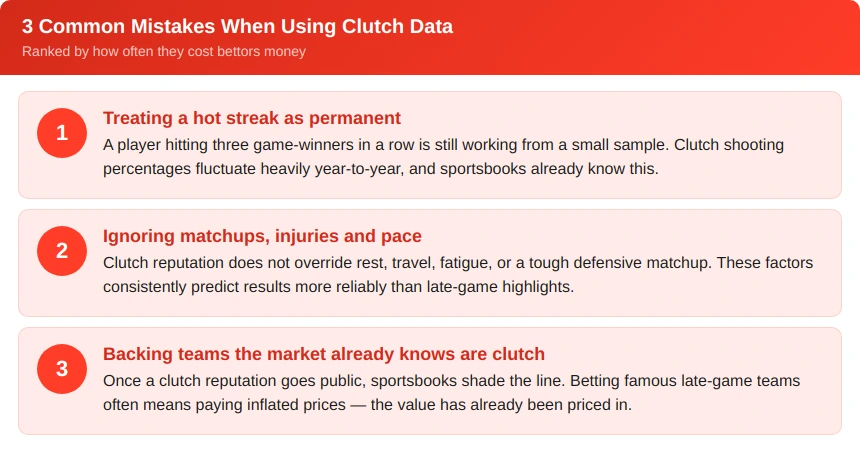
One of the easiest mistakes in NBA betting is treating a few memorable moments like permanent proof of clutch greatness. Basketball seasons are long, and small samples can create misleading conclusions very quickly.
Another common mistake is ignoring the bigger picture. Matchups, injuries, pace, travel schedules, and overall efficiency usually matter more than one or two famous late-game shots.
Smart bettors use clutch metrics carefully. They help explain certain situations, but they rarely work as a shortcut to guaranteed ATS success.
Responsible Gambling
Betting should be entertainment, not a way to make money. Gambling can be addictive—only bet what you can afford to lose, and never chase your losses. Set deposit, loss, and time limits before you play, and take regular breaks.
If gambling stops being fun or starts affecting your finances, relationships, or wellbeing, seek help immediately.
Support available across Canada:
- Responsible Gambling Council: responsiblegambling.org (national resource centre)
- British Columbia: Call 1-888-795-6111 (24/7)
- Alberta: Call 1-866-332-2322 (24/7)
- Quebec: Call 1-800-461-0140 (24/7, bilingual)
- Saskatchewan: Call 1-800-306-6789 (24/7)
- Manitoba: Call 1-800-463-1554 (24/7)
- Atlantic provinces: Call 1-800-461-1234 (NB), 1-888-429-8167 (NS), 1-855-255-4255 (PE), 1-888-899-4357 (NL)
- Additional support: Gambling Therapy (gamblingtherapy.org), Gamblers Anonymous (gamblersanonymous.org)
- 988 Suicide Crisis Helpline: Call or text 988
TonyBet provides responsible gambling tools in your account settings, including deposit limits, loss limits, time limits, cool-off periods, and self-exclusion. Use them.
Age restrictions: You must be 19 or older to gamble in British Columbia, Saskatchewan, and Atlantic provinces. You must be 18 or older in Alberta, Manitoba, and Quebec. Underage gambling is illegal.
For more information about responsible gambling practices and support resources, visit the Responsible Gambling section on TonyBet.

FAQ
Does clutch performance help predict covering the spread?
Why do some teams win but fail to cover?
Are clutch players overrated in betting markets?
What metrics are most useful for analysing clutch situations?


