





If you bet in Canada for any length of time, you end up switching between two odds formats whether you want to or not. Most Canadian sportsbooks default to decimal odds. A lot of betting content, U.S. broadcasts, and line comparison tools still lean on American odds. So even if you prefer one format, you usually have to read both. That’s why understanding sports betting odds matters so much once you start comparing prices across different books and sports lines.
What Are Betting Odds?
Odds are the price attached to a market. In practical terms, they show the possible return on a wager while reflecting the sportsbook’s built-in margin, also called the vig, juice, or hold.
Why Odds Matter
Odds affect every part of a betting decision. They shape how much you risk, how much your stake can win, and whether a line deserves a place in your bankroll plan. A bettor looking at a favourite at 1.50 and an underdog at 2.80 is not only choosing a team – they are choosing between a lower multiplier and a higher one, with different levels of variance.
How Odds Are Used
Sportsbooks use odds to price outcomes like a moneyline winner, a spread, a total, or a prop. Bettors use the same numbers to compare prices across books, estimate implied probability, and decide whether a posted line is better or worse than their own projection. That is what betting odds, explained simply, come down to: a payout tool and a probability signal.
American Odds Explained
American odds use a plus or minus number built around a 100-unit reference point. That format is especially familiar to bettors who follow U.S.-style markets – betting odds in American football, basketball, and hockey all default to it.
How Positive Odds Work
With positive American odds, the number shows the profit on a 100-unit bet. If a team is +150, a CA$100 wager returns CA$150 in profit and CA$250 total. You’ll usually see this kind of price on an underdog or on a longer-shot prop market.
How Negative Odds Work
Negative American odds flip the logic. Instead of showing what a CA$100 bet wins, they show how much must be risked to make CA$100 in profit. If a team is -150, you must risk CA$150 to win CA$100, for a total return of CA$250. These prices are common on the favourite.
Examples of American Odds
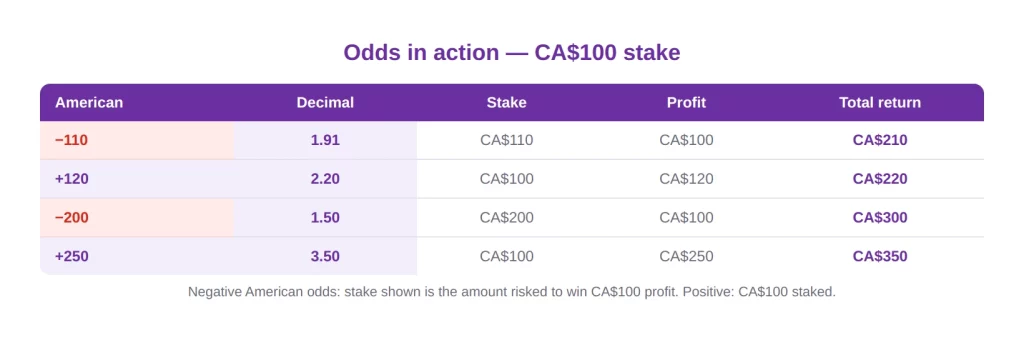
A quick set of examples makes how sports betting odds work easier to see in real numbers:
- -110: risk CA$110 to win CA$100
- +120: risk CA$100 to win CA$120
- -200: risk CA$200 to win CA$100
- +250: risk CA$100 to win CA$250
These examples show the pattern clearly: bigger plus prices increase profit, while stronger favourites pay less.
For American odds, the implied probability formula works like this:
- For negative odds, probability = odds / (odds + 100)
- For positive odds, probability = 100 / (odds + 100)
That gives you the market estimate before adjusting for the sportsbook’s overround.
Decimal Odds Explained
Decimal odds are the standard format across most of Canada and much of Europe. They display the full return rather than just the profit, which makes them faster to scan for many bettors.
How Decimal Odds Work
In decimal format, the number already includes your original stake. If a line is 2.50, every CA$1 wager returns CA$2.50 total. That means CA$1.50 in profit plus the CA$1 stake back.
This speed is part of why, when weighing European odds vs American odds, most Canadian bettors find decimal pricing easier to work with day to day. A decimal price reads like a direct multiplier, which also makes parlays easier to follow. For anyone learning how to read sports betting odds, decimal pricing is usually the quicker format to understand at a glance.
Calculating Payouts
The payout formula is direct:
- Stake × decimal odds = total return
If you bet CA$40 at 1.80, the return is CA$72 and profit is CA$32. If you bet CA$25 at 3.20, the return is CA$80 and profit is CA$55. Because the stake is already included in the number, the math stays clean from one market to the next.
Examples of Decimal Odds
Here are three simple decimal examples:
- 1.50: CA$20 returns CA$30
- 2.00: CA$20 returns CA$40
- 3.75: CA$20 returns CA$75
In decimal format, the whole number already includes the returned stake, which is why the odds payout math looks more straightforward.
Comparing Decimal and American Odds
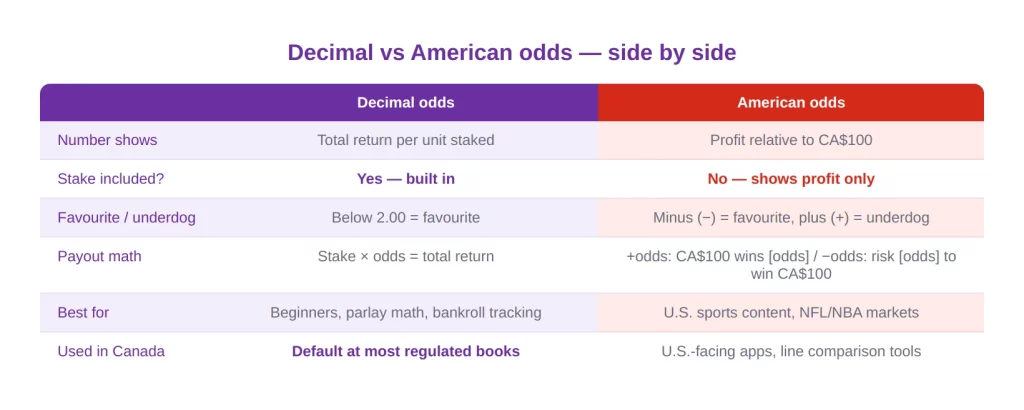
Both formats show the same market price. They just present it differently. The real difference is how quickly each format lets a bettor read payout, risk, and implied chance at a glance.
Key Differences
American odds focus on profit relative to 100. Decimal odds show total return per unit wagered. American pricing feels natural to bettors who follow U.S. point spreads and NFL moneylines, while decimal pricing is easier for anyone who wants fast payout math and simpler parlay calculations.
Pros and Cons of Each Format
Decimal odds are easier for beginners, easier for bankroll tracking, and easier for comparing multi-leg bets. American odds are familiar to bettors who grew up with U.S. books, and they make favourite-versus-underdog pricing feel natural once learned.
When Each Format Is Used
In Canada, decimal odds are the default at many regulated books. American odds still appear in betting content, U.S.-facing apps, and line comparison tools. A bettor switching between Canadian and American content may move back and forth between the two formats several times in one session.
Converting Between Odds Formats
A good calculator helps, but the basic formulas are worth knowing. Once you understand the core math, it becomes much easier to compare prices across books without slowing down your decision.
American to Decimal Conversion
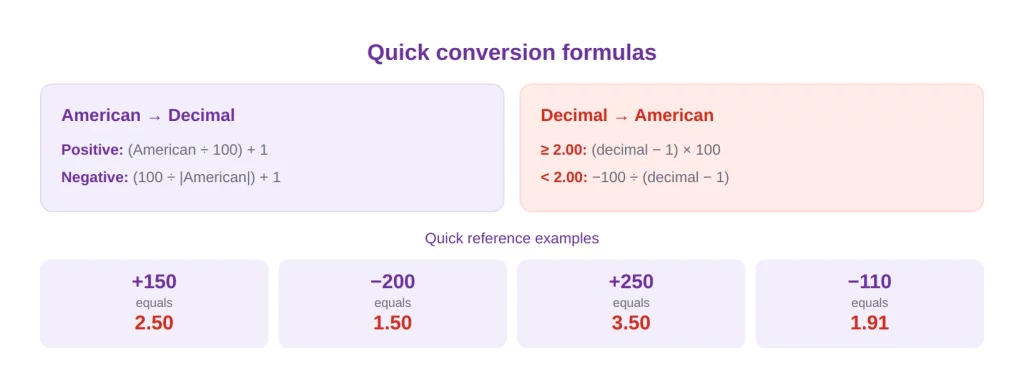
The American to decimal odds formula is straightforward once you separate positive and negative prices:
- For positive odds: decimal = (American / 100) + 1
- For negative odds: decimal = (100 / American absolute value) + 1
So +150 becomes 2.50. A price of -200 becomes 1.50.
Decimal to American Conversion
The decimal to American odds formula works differently depending on whether the decimal price sits above or below even money:
- If decimal odds are 2.00 or higher: American = (decimal – 1) × 100
- If decimal odds are below 2.00: American = -100 / (decimal – 1)
So 2.50 becomes +150. A price of 1.50 becomes -200.
Tools and Tips for Conversion
A basic conversion chart works well for daily use. A sportsbook interface or odds calculator is faster when you are comparing several markets. A good habit is to convert first, then check the probability. For example, if one book lists +130 and another shows 2.35, conversion tells you immediately which price is stronger.
Common Misunderstandings About Odds
Most mistakes happen when bettors treat odds as a prediction instead of a price. The number on the screen is a betting price shaped by the market and the sportsbook’s margin, not a guaranteed forecast of what will happen. If you need to explain betting odds in one clean sentence, they are prices that show both payout and implied chance.
Odds vs. Probability
Odds don’t state the true chance of an event. They show the sportsbook’s priced estimate with its built-in edge. If a book deals both sides of a market at -110, the combined implied percentage goes above 100%. That excess is the bookmaker’s hold.
Misreading Expected Value
A favourite is not always the better bet. A line only has value when the price is better than the bettor’s own estimate. If your projection says a team wins 55% of the time and the market implies 60%, the ticket may still be poor even if the team wins more than it loses. That’s where discussions of arbitrage, edge, and expected value begin.
How Lines Move
Lines move because of new information, sharp action, public action, and changes in handle. Injury news, weather, and roster changes all matter. So does market pressure when one side attracts more money. A spread can move from -3.5 to -4.5, and a moneyline can shift from +130 to +115, which changes both payout and implied chance.
Responsible Gambling
Betting should be entertainment, not a way to make money. Gambling can be addictive—only bet what you can afford to lose, and never chase your losses. Set deposit, loss, and time limits before you play, and take regular breaks.
If gambling stops being fun or starts affecting your finances, relationships, or wellbeing, seek help immediately.
Support available across Canada:
- Responsible Gambling Council: responsiblegambling.org (national resource centre)
- British Columbia: Call 1-888-795-6111 (24/7)
- Alberta: Call 1-866-332-2322 (24/7)
- Quebec: Call 1-800-461-0140 (24/7, bilingual)
- Saskatchewan: Call 1-800-306-6789 (24/7)
- Manitoba: Call 1-800-463-1554 (24/7)
- Atlantic provinces: Call 1-800-461-1234 (NB), 1-888-429-8167 (NS), 1-855-255-4255 (PE), 1-888-899-4357 (NL)
- Additional support: Gambling Therapy (gamblingtherapy.org), Gamblers Anonymous (gamblersanonymous.org)
- 988 Suicide Crisis Helpline: Call or text 988
TonyBet provides responsible gambling tools in your account settings, including deposit limits, loss limits, time limits, cool-off periods, and self-exclusion. Use them.
Age restrictions: You must be 19 or older to gamble in British Columbia, Saskatchewan, and Atlantic provinces. You must be 18 or older in Alberta, Manitoba, and Quebec. Underage gambling is illegal.
For more information about responsible gambling practices and support resources, visit the Responsible Gambling section on TonyBet.