


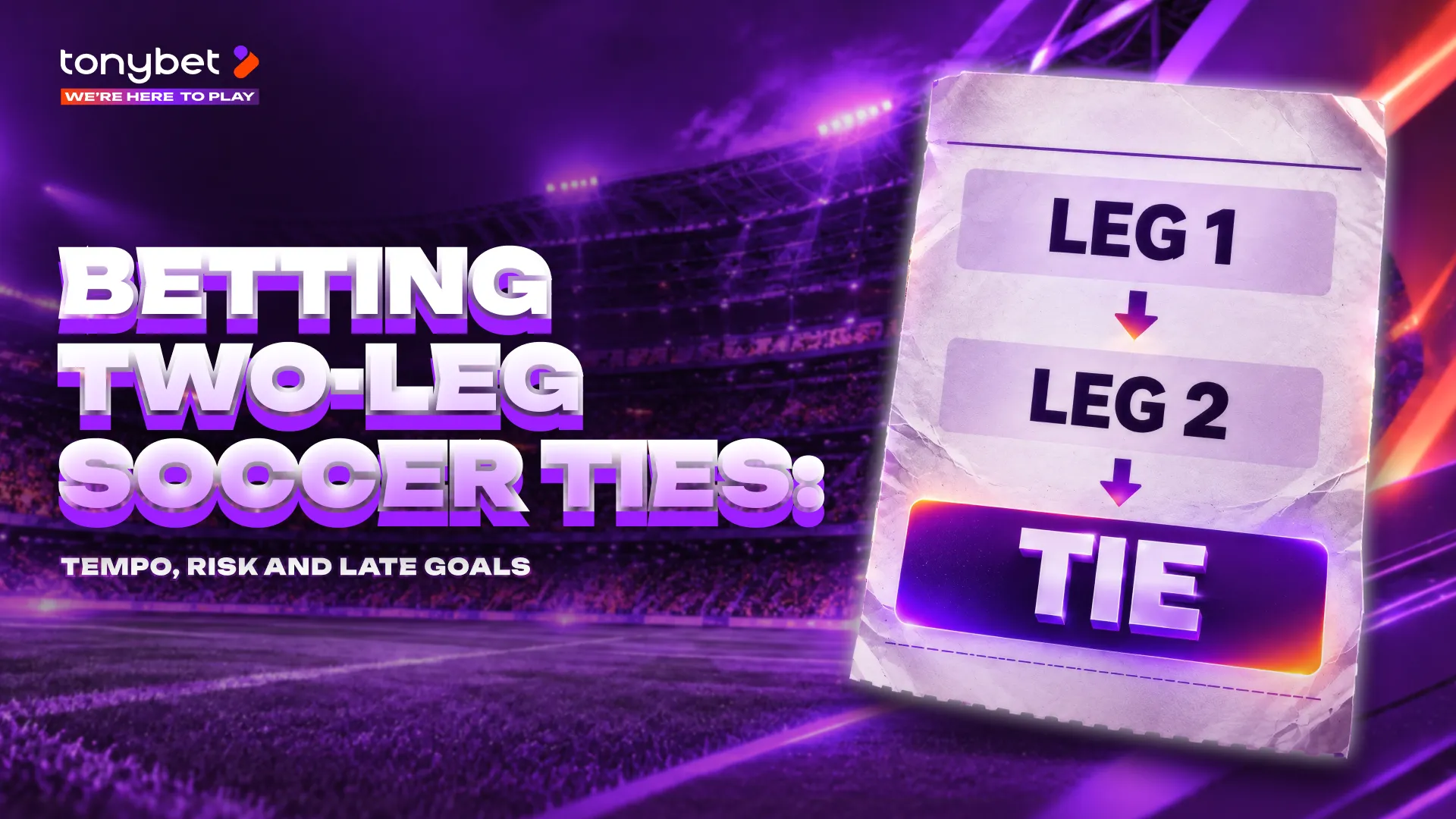


A tie in soccer can mean a level score, but in knockout soccer it can also mean two teams meeting across two matches, with the first and second legs connected by the aggregate score. In a two-leg tie, each team usually plays one match at home, and the goals from both matches are added together to determine which team advances.
This changes how bettors read soccer betting lines, since the live match score alone doesn’t tell the full story: the result of the first leg shapes how the second leg is likely to be played. This guide explains how aggregate scoring, first-leg caution, second-leg risk, momentum, fatigue, and late goals can affect betting in soccer.
How Two-Leg Ties Work in Modern Soccer
A two-leg tie means two teams play each other twice, with each team usually hosting one match in its own stadium. The goals from both matches are added together, and the team with the higher aggregate score earns qualification to the next round.
For example, if a team wins the first leg 3-1 and loses the second leg 1-0, it still wins the tie 3-2 on aggregate. So, for anyone asking what 2 legs mean in soccer betting, it means the bettor must consider both matches together, not treat the second leg as a fresh game with no history.
This format is common in major knockout competitions, but the exact stage can differ. In UEFA club competitions such as the Champions League, Europa League, and Conference League, knockout-phase matches are played home and away except for the final, which is a single match. England’s EFL Cup also uses two-legged semi-finals before a one-match final. That is why bettors should check the competition rules first instead of assuming every knockout match follows the same format.
If the aggregate score is level after the second leg, the tie goes to two 15-minute periods of extra time. If the teams are still level after extra time, a penalty shootout decides who qualifies. UEFA removed the away goals rule from its club competitions starting with the 2021/22 season, but bettors should still check the rules of the specific competition. The betting site does not decide the away goals rule; the tournament rulebook does.
Why First and Second Legs Require Different Betting Approaches
The first leg and second leg are part of the same fixture, but they do not always carry the same risk.
The first leg often starts with more caution because both teams know there is still another match to play. The second leg is clearer because the aggregate score tells each team what it needs. A team leading the tie may lower the tempo, protect space, and look for a counterattack. A team behind may push higher, increase pressing, and take more risks in transition.
For example, in the 2023/24 Champions League quarter-final, Barcelona won the first leg 3-2, but PSG attacked the second leg with more urgency and won 4-1. PSG went through 6-4 on aggregate, showing why the second leg can look very different from the first.
How Aggregate Score Shapes Team Tactics
The first-leg score can change the second-leg plan. A team leading on aggregate may accept less possession, defend deeper, and wait for counterattacks. The team behind may press earlier, move the ball faster, and leave more space behind its defence.
Before placing a bet, read the aggregate score alongside team news, suspension risk, home advantage, and likely game state. A 1-0 lead can produce a very different match from a 3-0 lead, even when the same team is ahead.
First-Leg Betting: Patience Over Aggression
First-leg betting often rewards patience because neither team wants the tie to collapse early. The home team may attack, but it may also avoid leaving too much space behind. The away team may be comfortable with a narrow loss or draw if the second leg is at home.
That does not mean every first leg will be low-scoring, but it explains why draw, under, first-half under, and cautious handicap markets often get attention. Bettors comparing soccer betting lines should check team news, home advantage, and how much risk each coach is likely to accept.
Second-Leg Betting: Chasing Goals and Managing the Lead
The second leg usually carries more intensity because the qualification picture is clearer. A team behind on aggregate may need a comeback, while the team ahead may manage the lead, slow the tempo, or wait for a counterattack.
Team rotation should be read carefully. A coach may rest players because of fatigue, a tight fixture list, suspension risk, injury management, or tactical changes. Rotation does not always mean the tie is already safe.
Why Late Goals Are More Common in Decisive Matches
In knockout soccer, one goal can change the match result, the aggregate score, and the qualification picture at once.
In a second leg, the team behind may send more players forward, while the team ahead may defend deeper and protect space. That pressure can grow in the final minutes because of fatigue, substitutions, added time from the referee, and the fear of going out.
Late-goal statistics from UEFA’s 2021/22 Champions League technical report show that 23% of goals came from the 76th minute to the end of the second half, including stoppage time. UEFA also noted that 10 of the 21 knockout-stage wins that season were secured with a goal from the 70th minute onward.
For example, in the 2023/24 Champions League round of 16, Inter were ahead on aggregate until Memphis Depay scored for Atlético in the 87th minute. That late goal levelled the tie at 2-2 on aggregate, forced extra time, and Atlético later won on penalties.
Best Betting Markets for Two-Leg Knockout Ties
Before choosing a market, it helps to distinguish a two-leg soccer tie from legs in betting. A two-leg tie is a soccer format with two matches. So, what are legs in sports betting then? A betting leg is one pick within a bet slip, particularly in a parlay.
A 1-leg parlay is just a single pick, while a 2-leg parlay combines two picks that must both win. Some bettors bet legs from different matches, but two picks from the same tie can be correlated, so the sportsbook rules matter.
| Market | What You Are Betting On | Why It Matters in Two-Leg Ties |
| To qualify | The team that advances after both legs | Focuses on the tie winner, not just one match |
| Aggregate handicap | The final goal difference across both legs | Useful when one team is clearly stronger |
| Aggregate total | Total goals scored across both matches | Connects first-leg tempo with second-leg risk |
| Match total | Goals in one leg only | Better when the second-leg game state is clear |
| Both teams to score | Both teams scoring in one match | Can suit open second legs |
| First-leg under | Lower goal total in the opening match | Can fit cautious first-leg setups |
| Trailing team to score first | The team behind on aggregate scores first | Ties directly to comeback pressure |
| Team to qualify and win match | Team wins the match and advances | Useful when match result and qualification angle align |
The qualification market is often useful because teams are playing to advance, not necessarily to win the second leg by itself. A team can draw the match and still qualify if the aggregate score is enough.
Reading Momentum Beyond the First-Leg Scoreline
The first-leg score does not always tell the full story of a tie. A 1-0 result may hide missed chances, strong pressing, weak finishing, injuries, or a team that controlled possession without turning it into goals.
Check injuries, yellow-card risk, suspension rules, travel, fatigue, and how both teams finished the first leg. A team that ended strongly may carry more confidence into the second leg, while a team that lost control late may need tactical changes.
A team showing resilience in the first leg can still make the second leg competitive, but bettors should connect that view to price, team news, and the aggregate score before placing a bet.
Common Betting Mistakes in Aggregate-Score Matches
One common mistake is treating both matches in the same tie as separate events with no connection. A two-leg parlay that uses picks from the same tie can carry extra risk because the first result can strongly shape the second-leg tactics — and some sportsbooks block same-tie combinations altogether.
League form is still important, but it should not be considered in isolation. In aggregate-score matches, the first-leg score, injuries, suspension risk, likely rotation, and competition rules can matter more than a normal league table position.
Live Betting Opportunities During Second Legs
Live betting during a second leg should start with the aggregate score. A team drawing 1-1 on the night may still be losing the tie, while another team may be comfortable with the same match score because it leads on aggregate.
The stadium atmosphere can also affect the second-leg tempo. A home crowd may lift the team chasing the tie, but the bettor should still watch possession, pressing, substitutions, referee decisions, and late fatigue before reacting to live betting odds.
Rules to Remember: Betting Two-Leg Soccer Ties
- Check the aggregate score, not only the score in the current match.
- Confirm whether the away goals rule still applies to the competition before placing a bet.
- Expect the first leg to be more cautious in some ties, but do not assume every first leg will be low-scoring. The second leg often changes once one team has to chase qualification.
- Check team rotation before betting. Rotation can point to fatigue, injuries, fixture pressure, suspension risk, or tactical changes, not just confidence.
- Review the seeding and competition format where relevant. UEFA uses club coefficient rankings in draw procedures, but once a tie is set, betting should focus more on team news, aggregate score, venue, and match context.
Responsible Gambling
Betting should be entertainment, not a way to make money. Gambling can be addictive—only bet what you can afford to lose, and never chase your losses. Set deposit, loss, and time limits before you play, and take regular breaks.
If gambling stops being fun or starts affecting your finances, relationships, or wellbeing, seek help immediately.
Support available across Canada:
- Responsible Gambling Council: responsiblegambling.org (national resource centre)
- British Columbia: Call 1-888-795-6111 (24/7)
- Alberta: Call 1-866-332-2322 (24/7)
- Quebec: Call 1-800-461-0140 (24/7, bilingual)
- Saskatchewan: Call 1-800-306-6789 (24/7)
- Manitoba: Call 1-800-463-1554 (24/7)
- Atlantic provinces: Call 1-800-461-1234 (NB), 1-888-429-8167 (NS), 1-855-255-4255 (PE), 1-888-899-4357 (NL)
- Additional support: Gambling Therapy (gamblingtherapy.org), Gamblers Anonymous (gamblersanonymous.org)
- 988 Suicide Crisis Helpline: Call or text 988
TonyBet provides responsible gambling tools in your account settings, including deposit limits, loss limits, time limits, cool-off periods, and self-exclusion. Use them.
Age restrictions: You must be 19 or older to gamble in British Columbia, Saskatchewan, and Atlantic provinces. You must be 18 or older in Alberta, Manitoba, and Quebec. Underage gambling is illegal.
For more information about responsible gambling practices and support resources, visit the Responsible Gambling section on TonyBet.
FAQ
How does aggregate scoring affect betting decisions?
Are second-leg matches usually higher scoring than first legs?
Which betting markets work best for two-leg ties?
Why are late goals so important in knockout soccer?


