






Asian handicap betting is a popular sports wagering format designed to eliminate the possibility of a draw and create more balanced odds between teams. It gives one team a virtual advantage or disadvantage before the match starts. Bettors can choose handicaps such as -1, +0.5, or -1.5, depending on the expected strength difference between teams.
Asian Handicap in Basketball Betting
Asian handicap betting removes the idea of a simple win/loss and replaces it with a margin-based outcome. Instead of asking “who wins,” the bet focuses on by how many points a team wins or loses. In NBA betting, where scoring regularly crosses 200 total points and possessions are fast-paced, this approach creates more precise markets.
In practical terms, the Asian handicap adjusts the final score using a line. A favourite might start at -6.5, while an underdog gets +6.5. That adjustment turns a lopsided matchup into something closer to a 50/50 proposition – the exact balance bookmakers aim for.
This is why terms like margin, spread, scoring, possessions, and efficiency matter. NBA games are driven by pace and offensive output, and handicap betting reflects that reality more directly than basic win markets.
How It Differs From Standard Point Spread
At first glance, an Asian handicap looks identical to a traditional spread. Both adjust the score using a line and require a team to win by a certain margin. The difference lies in how outcomes are handled.
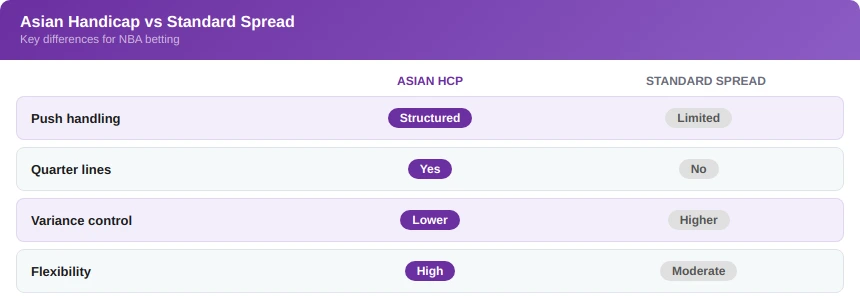
Standard spreads usually include a win, a loss, and sometimes a push (stake returned). Asian handicap, on the other hand, goes further by introducing split bets (quarter-point lines), reduced variance outcomes, and more control over risk.
For example, a -6.0 spread behaves like a standard line. But a -6.25 Asian handicap splits your stake across two outcomes, changing how probability and payouts are calculated. This flexibility helps bettors manage variance more effectively in games where final margins regularly land between five and 10 points.
Why Are Draws Eliminated in Asian Handicap?
Basketball rarely ends in a draw due to overtime, but the Asian handicap still removes “dead” outcomes by design. Even when the adjusted score lands exactly on the line, the bet resolves cleanly.
- Whole numbers – possible push
- Half points – no push
- Quarter lines – split result
This structure ensures that every handicap bet resolves clearly through a push, full win, or split outcome.
How Asian Handicap Works in NBA Games?
To bet on NBA handicap markets effectively, start with the relationship between the favourite’s line and the expected scoring margin.
Favourite (-) vs Underdog (+) Explained
The core idea is simple. The favourite (-) must win by more than the handicap. The underdog (+) can lose within the margin or win outright.
A typical NBA handicap market between Boston and Miami might place the Celtics at -7.5 due to their stronger offensive efficiency, deeper rotation, and higher scoring consistency.
- Boston Celtics -7.5
- Miami Heat +7.5
If Boston win by 10, the favourite covers the spread. If they win by six, the underdog covers instead. This structure reflects real NBA dynamics:
- Favourites with elite offensive efficiency tend to cover spreads by converting possessions cleanly and protecting the ball through lower turnover rates.
- Underdogs usually stay within the handicap by slowing tempo, limiting transition scoring, and protecting possession through lower turnover rates.
Point-Based Handicaps in High-Scoring Sports
NBA games typically involve 95-105 possessions per team. That volume creates larger scoring margins compared to football or soccer. As a result, NBA handicap lines typically range from -3.5 to -12.5, depending on team strength, injuries, and recent form, and small changes (±1 point) significantly impact probability.
A shift from -5.5 to -6.5 might seem minor, but it changes the likelihood of covering by several percentage points, especially in games with strong rebounding and transition scoring edges.
How Bookmakers Balance Odds Around 50/50
Understanding NBA handicap betting odds starts with how bookmakers set the line – both the margin (e.g., from -6.5 to -7.5) and the price (e.g., from 1.90 to 1.80) shift until money flows evenly on both sides.
Those adjustments are based on several factors, including team analytics (offence/defence efficiency), recent rotation changes, injury reports, and matchup-specific factors.
If too much money comes in on one side, the line moves. That’s how betting markets stay efficient.
Types of Asian Handicap Lines in Basketball
Below are the main handicap lines in basketball betting.
Whole Number Lines
Whole number handicaps allow for a push, where the adjusted score lands exactly on the line. It removes risk but also removes profit.
| Handicap | Result Condition | Outcome |
| -6.0 | Win by exactly 6 | Stake returned |
| -6.0 | Win by 7+ | Win |
| -6.0 | Win by 5 or less | Loss |
A push in basketball betting, explained simply: the adjusted margin lands exactly on the line, the bet neither wins nor loses, and the stake is returned in full.
Half-Point Lines
Half-point lines are sometimes called no-push lines in basketball betting, because every bet resolves as a win or a loss. Here’s a table with the result condition and the outcome.
| Handicap | Result Condition | Outcome |
| -6.5 | Win by 7+ | Win |
| -6.5 | Win by 6 or less | Loss |
Quarter Lines and Split Bets
Quarter handicaps split your stake across two lines.
| Handicap | Split | Outcome Example |
| -6.25 | Half on -6, half on -6.5 | Win + Half Loss |
| +0.25 | Half on 0, half on +0.5 | Push + Win |
Split bets in Asian handicap betting, explained: a quarter-line handicap like -6.25 divides your stake equally between -6.0 and -6.5, so one half of the bet can push or win while the other loses. It reduces variance and smooths results over time.
Second-Half and Live Asian Handicap Markets
NBA handicap betting markets extend beyond pre-game lines into live and second-half options that update with every possession. For example:
- A team leads by 12 at halftime.
- Second-half handicap: -4.5.
NBA second-half handicap betting works differently from pre-game lines because live betting handicap adjustments reflect what’s already happened – score, foul trouble, rotation depth, and pace. A team that dominated the first half may open the second at -6.5 despite a -3.5 pre-game line.
Live Asian handicap basketball markets reprice on every stoppage, so the window to act is short. An effective in-play handicap NBA strategy focuses on one trigger: when the live line overreacts to a single run, and the underlying pace and efficiency haven’t changed.
Real NBA Match Scenarios Explained
We have picked real NBA scenarios to make Asian handicap betting easier to understand.
Example 1: Favourite Covers a Standard Line
On March 11, 2026, a meeting between Denver and Houston finished 129-93, producing a 36-point margin.
- Handicap: Nuggets -8.5
- Result: Win (cover)
Denver’s offensive efficiency (high field goal percentage and low turnovers) created a comfortable margin. The favourite covered comfortably due to strong half-court execution and rebounding advantage.
Example 2: Underdog Covers Despite Losing
The second example is a game between the Los Angeles Lakers and the Golden State Warriors on February 7, 2026, which ended 105-99, resulting in a six-point margin.
- Handicap: Warriors +6.5
- Result: Win (cover)
Golden State lost the game but controlled the tempo and limited possessions. Their three-point scoring efficiency kept the margin tight, allowing the underdog to cover.
Example 3: Push Scenario on Whole Line
On April 9, 2026, the New York Knicks beat the Boston Celtics 112-106, producing a six-point margin that resulted in a push on a -6.0 handicap. The game landed exactly on the line. Bettors got their stake back, which is a classic example of what a push is in NBA betting.
Example 4: Quarter Handicap Split Outcome
Another example is the clash between the Phoenix Suns and the Sacramento Kings on October 22, 2025. The final score was 120-116, resulting in a four-point margin.
- Handicap: Suns -4.25
- Result: Half Push/Half Loss
In this case, half the stake on -4.0 pushes, while the half on -4.5 loses. This illustrates how quarter-line Asian handicap mechanics work in the NBA.
Comparing Asian Handicap to NBA Spread Betting
Asian handicap and spread betting might be similar. However, there are some differences that you should take into account:
Key Similarities & Key Differences
Both systems rely on margin-based results, line adjustments, and probability balancing. Here is a structured table that will help you to understand both:
When Asian Handicap Offers More Value
Asian handicap becomes valuable when the line sits on a key margin (e.g., 6 or 7 points). Another important factor is identifying teams with inconsistent defence or unreliable bench production.
Asian handicap also provides value when bettors want to reduce risk in volatile matchups. It’s particularly useful in games with strong pace differences or late-game fouling scenarios that inflate scoring. Intentional fouling and late free throws frequently turn four-point games into seven-point margins, which directly affects handicap outcomes.
Advantages of Using Asian Handicap in NBA Betting
Reduced Variance and Better Risk Control
Asian handicap smooths outcomes by allowing pushes and splitting bets. This reduces the impact of unpredictable events like late-game fouling, garbage-time scoring, free throws, and comebacks in the final minutes.
More Precise Lines Than Standard Spreads
Quarter lines allow bettors to fine-tune their exposure. Instead of committing fully to -6.5, you can split between -6 and -6.5. This is valuable when modelling games using analytics, probability, and player efficiency ratings.
Opportunities in Mismatched Games
In games with clear talent gaps, favourites may be overpriced on the moneyline. Handicap lines offer better value. For example, a strong team with elite starters and bench rotation, such as the Oklahoma City Thunder, might dominate weaker opponents but still present value on adjusted lines.
Common Mistakes With Asian Handicap in Basketball
Many bettors misunderstand how the Asian handicap works. Common errors include:
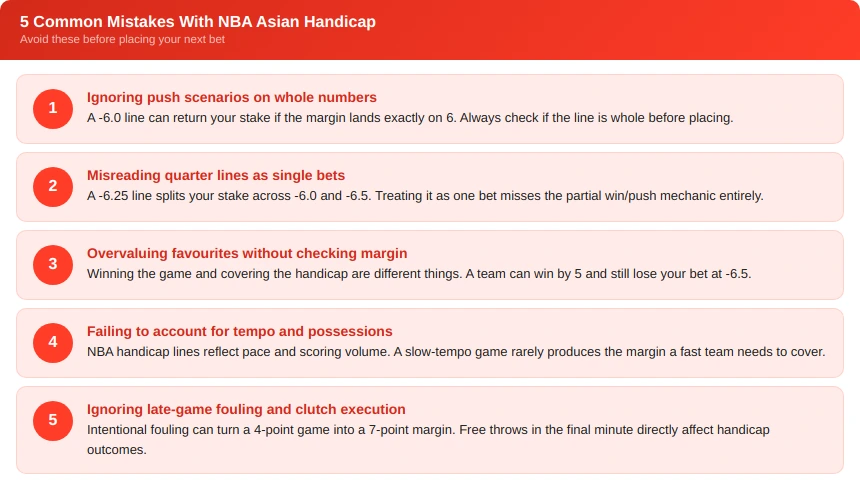
Another frequent mistake is ignoring clutch performance. Late-game execution often determines whether a team covers the spread.
Responsible Gambling
Betting should be entertainment, not a way to make money. Gambling can be addictive—only bet what you can afford to lose, and never chase your losses. Set deposit, loss, and time limits before you play, and take regular breaks.
If gambling stops being fun or starts affecting your finances, relationships, or wellbeing, seek help immediately.
Support available across Canada:
- Responsible Gambling Council: responsiblegambling.org (national resource centre)
- British Columbia: Call 1-888-795-6111 (24/7)
- Alberta: Call 1-866-332-2322 (24/7)
- Quebec: Call 1-800-461-0140 (24/7, bilingual)
- Saskatchewan: Call 1-800-306-6789 (24/7)
- Manitoba: Call 1-800-463-1554 (24/7)
- Atlantic provinces: Call 1-800-461-1234 (NB), 1-888-429-8167 (NS), 1-855-255-4255 (PE), 1-888-899-4357 (NL)
- Additional support: Gambling Therapy (gamblingtherapy.org), Gamblers Anonymous (gamblersanonymous.org)
- 988 Suicide Crisis Helpline: Call or text 988
TonyBet provides responsible gambling tools in your account settings, including deposit limits, loss limits, time limits, cool-off periods, and self-exclusion. Use them.
Age restrictions: You must be 19 or older to gamble in British Columbia, Saskatchewan, and Atlantic provinces. You must be 18 or older in Alberta, Manitoba, and Quebec. Underage gambling is illegal.
For more information about responsible gambling practices and support resources, visit the Responsible Gambling section on TonyBet.

FAQ
Is Asian handicap the same as the NBA point spread?
What happens if the handicap result is exactly equal?
Are Asian handicap bets common in basketball?
How do quarter-line handicaps work in NBA games?


