






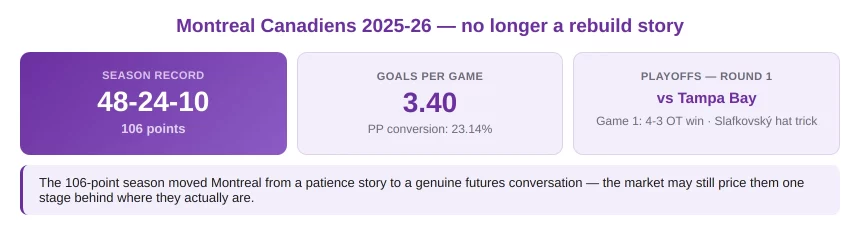
The Montreal Canadiens rebuild looks a lot different in April 2026 than it did two years ago. Montreal are no longer selling only patience. The club finished the regular season 48-24-10 with 106 points, drew the Tampa Bay Lightning in the first round, and opened that series with a 4-3 overtime win behind Juraj Slafkovský’s hat trick. For anyone assessing Montreal Canadiens’ playoff upside in futures markets, that gives the conversation a more serious base than a pure long-shot story.
Montreal Canadiens Rebuild Overview
The big change is that Montreal Canadiens hockey now sits in the middle ground between a rebuild and full arrival. The Montreal Canadiens’ stats show a team that scored 3.40 goals per game, converted 23.14% of their power plays, and got elite production from their top line, so this is no longer a roster starting from zero.
How the Canadiens Entered a Full Rebuild
Jeff Gorton and Kent Hughes were hired to reset the roster and build for the long run, and the organisation has said that openly for years. The Canadiens’ site described the 2022 draft as the first one under the Hughes-Gorton administration, while later retrospectives again framed their mandate as rebuilding the roster and laying a durable foundation.
Timeline of Montreal’s Long-Term Strategy
By April 2026, the team looked different on the ice. Montreal reached the playoffs in 2025, added Noah Dobson in June 2025, locked in core pieces on long contracts, and then turned the 2025-26 season into a 106-point campaign. That is a different phase from the years when veterans like David Savard, Joel Armia, Cayden Primeau, and Samuel Montembeault were carrying more of the short-term load while the club waited for their younger wave.
Core Players Leading the Canadiens’ Future
The futures case starts with the players already driving Montreal Canadiens games at the NHL level. This is not a projection built only on draft pedigree. Montreal have front-line production in place.
Nick Suzuki, Cole Caufield, and the Current Leadership Core
Nick Suzuki and Cole Caufield have become the clearest signs that Montreal’s rebuild is moving in the right direction. Suzuki finished the 2025-26 regular season with 101 points, while Caufield added 51 goals, giving the Canadiens a top line that can generate offence at a high level.
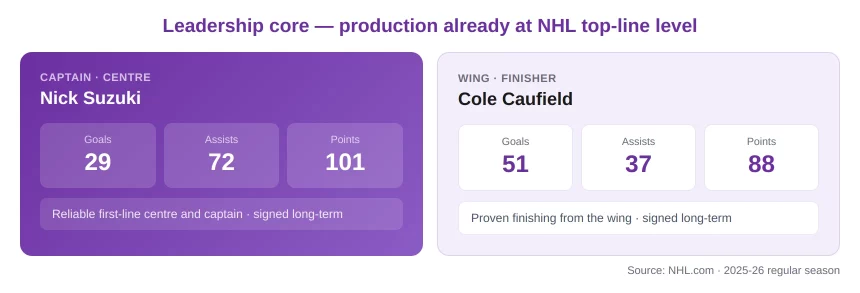
| Player | Goals | Assists | Points |
| Nick Suzuki stats | 29 | 72 | 101 |
| Cole Caufield stats | 51 | 37 | 88 |
Their production also helps explain why Montreal look further along than they did earlier in the rebuild. Suzuki provides the team with a reliable first-line centre and captain, while Caufield brings proven finishing from the wing. With both players signed to multi-year deals, the Canadiens have a leadership core that matches the club’s next competitive window.
Juraj Slafkovský and the Next Generation of Talent
Juraj Slafkovský has moved from an intriguing prospect to a real top-line driver. After developing chemistry with Ivan Demidov mid-season, Slafkovský returned to the first line for the stretch run, and in Game 1 against Tampa Bay, he delivered a playoff hat trick, with Suzuki and Caufield each adding two assists.
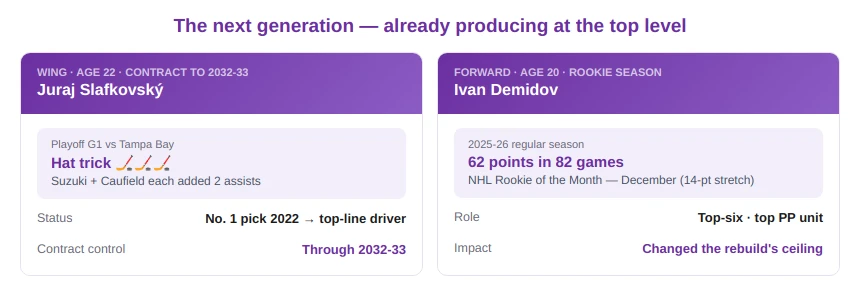
That spike fits the broader story around Juraj Slafkovský’s stats: he is no longer just the No. 1 pick from 2022, but a player producing winning moments on a playoff stage.
Impact of New Offensive Additions in the Top Six
Montreal’s top six has gained another layer with Ivan Demidov, and the rest of the forward group is deeper than it was at the start of the rebuild. Recent projected lineups have placed Demidov with Alex Newhook, while Kirby Dach also re-entered the mix lower in the top nine during the opening playoff round.
That gives coach Martin St. Louis more lineup flexibility than earlier versions of this roster, when players like Gallagher and Anderson were asked to carry too much of the load behind the first unit.
The Canadiens’ Prospect Pipeline and Development Strategy
Montreal’s pipeline is one reason the market leaves room for long-range upside. The Canadiens are not trying to patch every hole externally. They have used Laval and the Rocket as a real development bridge, and AHL coverage in 2026 highlighted that Owen Beck, Adam Engström, Jacob Fowler, Joshua Roy, and Florian Xhekaj all played NHL games this season.
Ivan Demidov and High-End Offensive Potential
Ivan Demidov’s Canadiens story accelerated quickly. NHL.com’s playoff roster breakdown credited him with 62 points in 82 games and described him as a top-six forward working beside Suzuki and Caufield on the top power-play unit, while the NHL had named him Rookie of the Month for December after a 14-point stretch. Those Ivan Demidov stats are the kind that change a rebuild’s ceiling.
Key Prospects Expected to Join the NHL Roster
The next wave is close enough to have an immediate impact. The AHL coverage has tied Beck, Roy, Engström, Fowler, and Florian Xhekaj directly to NHL call-ups this season. Jacob Fowler also appeared in the Canadiens’ projected lineups late in the year, which says plenty about the organisation’s willingness to fast-track players who are ready.
Strength of Montreal’s Overall Prospect Pool
Montreal’s prospect picture looks strong even beyond the biggest names at the top of the system. The organisation has already reached the point where the conversation is not limited to one elite talent, because Montreal Canadiens players such as Owen Beck, Joshua Roy, David Reinbacher, Filip Mešár, and Jacob Fowler offer the club depth across forward, defence, and in goal. That broader base adds context to current Montreal Canadiens stats, since the NHL roster is producing now while the system still holds more pieces for the next stage of the build.
Defensive and Goaltending Foundations for the Future
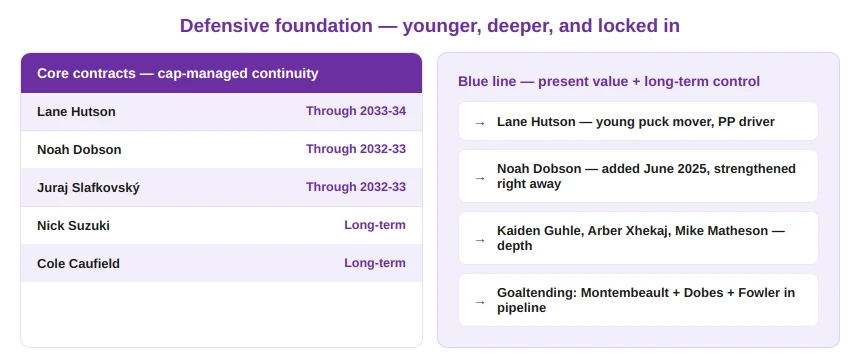
Montreal look more balanced now because the blue line is younger, deeper, and better supported than it was earlier in the rebuild. Lane Hutson, Kaiden Guhle, Arber Xhekaj, Mike Matheson, and Noah Dobson have given the club a stronger base behind their top forwards.
Emerging Defensive Core and Blue Line Investments
Lane Hutson, Kaiden Guhle, Arber Xhekaj, Mike Matheson, and Noah Dobson provide Montreal with a blue line with both present value and long-lasting control. NHL.com’s season preview and its March reporting both highlighted how Dobson strengthened the defence and how the club’s core deals were built to keep key pieces in place for the next several years. That multi-year setup gives extra weight to current Montreal Canadiens player stats, because the back end is no longer built around short-term patchwork.
Goaltending Plans in the Post-Carey Price Era
The crease has also shifted from uncertainty to layered depth. Samuel Montembeault remained part of the NHL picture, Jakub Dobes handled starts late in the year, and Fowler pushed into the conversation. Instead of leaning on one temporary solution, Montreal now have competition and succession built into the position.
Long-Term Stability in the Defensive System
There is more stability in the team structure too. Savard’s retirement removed a veteran safety valve, but Montreal replaced experience with higher-end talent and contract control. Hutson signed through 2033-34, Dobson through 2032-33, Slafkovský through 2032-33, and Suzuki and Caufield are already on long deals. That kind of cap-managed continuity offers the staff a chance to build identity instead of resetting every summer.
Front Office Strategy and Asset Management
The front office has been deliberate rather than reactive. The Canadiens added Noah Dobson, locked in key contracts for Suzuki, Caufield, Slafkovský, and Hutson, and kept room for future moves.
Draft Capital and Trade Flexibility
The Montreal Canadiens have the kind of flexibility that keeps them involved in NHL trade rumours. Hughes and Gorton have shown they can add experience without rushing the process, and NHL.com noted in January that the team had brought in Phillip Danault while leaving room for more moves.
Salary Cap Planning During the Rebuild
The cap picture is one of the most convincing parts of the case. NHL.com’s reporting on Hutson’s extension stressed that Montreal’s core contracts were built around keeping the team in a position to win, not chasing record-setting individual deals. In a division with expensive rivals and pressure markets, that discipline gives Montreal more room to add when the real contender window opens.
Why the Canadiens Could Be a Futures Betting Opportunity
A 106-point season changed the way Montreal should be viewed in long-range futures markets. The club have moved beyond moral victories, but the market may still price them as if the rebuild is one stage earlier.
Young Core Peaking in the Next Few Seasons
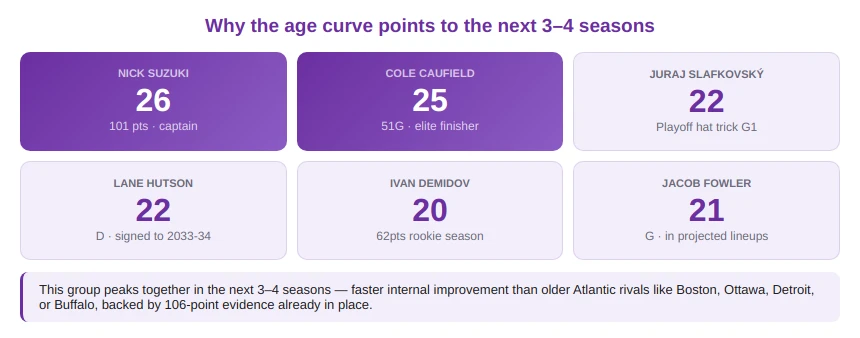
Suzuki is 26, Caufield 25, Slafkovský 22, Hutson 22, Demidov 20, and Fowler 21. That age curve lines up with the next few seasons much better than with a win-now-only push in 2026. A team with that profile can improve internally faster than older Atlantic rivals such as Boston, Ottawa, Detroit, or Buffalo, especially when they have 106-point evidence.
Long-Term Value in Stanley Cup Futures Markets
There is a reasonable case for Montreal Canadiens playoffs and Cup futures because the offensive ceiling is real, the defence is younger and stronger, and the contract structure is manageable. The regular season showed what the top end looks like: 51 goals from Caufield, 101 points from Suzuki, and a 62-point rookie season from Demidov. Those are numbers that belong to a rising team, not a distant project.
Comparing Montreal’s Rebuild With Other NHL Teams
Compared with many NHL rebuilds, Montreal’s has played out under heavier attention in Quebec and at the Bell Centre. The difference in 2026 is that the Canadiens have a playoff berth, a 106-point season, and a young core that looks closer to contention than a typical rebuilding team.
Risks That Could Delay the Canadiens’ Contender Window
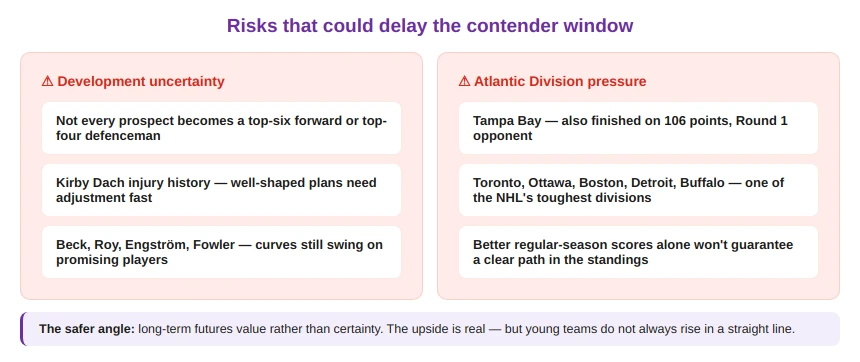
There is risk in treating Montreal as a near-lock future contender. Young teams do not always rise in a straight line.
Development Uncertainty With Young Prospects
Prospect depth is useful, but not every player becomes a top-six forward or top-four defenceman. Beck, Roy, Engström, and Fowler are promising, yet prospect curves swing. Dach’s injury history and the shifting roles around Newhook also show how quickly a well-shaped plan can need adjustment.
Competitive Pressure in the Atlantic Division
The Atlantic remains difficult. Tampa finished level with Montreal on 106 points, and divisional races also run through Toronto, Ottawa, Boston, Detroit, and Buffalo. That leaves little margin for error, because the Montreal Canadiens’ better scores alone do not guarantee an easier path in the standings, and stronger play from the Montreal Canadiens goalies has to hold up against one of the NHL’s toughest divisions.
Responsible Gambling
Betting should be entertainment, not a way to make money. Gambling can be addictive—only bet what you can afford to lose, and never chase your losses. Set deposit, loss, and time limits before you play, and take regular breaks.
If gambling stops being fun or starts affecting your finances, relationships, or wellbeing, seek help immediately.
Support available across Canada:
- Responsible Gambling Council: responsiblegambling.org (national resource centre)
- British Columbia: Call 1-888-795-6111 (24/7)
- Alberta: Call 1-866-332-2322 (24/7)
- Quebec: Call 1-800-461-0140 (24/7, bilingual)
- Saskatchewan: Call 1-800-306-6789 (24/7)
- Manitoba: Call 1-800-463-1554 (24/7)
- Atlantic provinces: Call 1-800-461-1234 (NB), 1-888-429-8167 (NS), 1-855-255-4255 (PE), 1-888-899-4357 (NL)
- Additional support: Gambling Therapy (gamblingtherapy.org), Gamblers Anonymous (gamblersanonymous.org)
- 988 Suicide Crisis Helpline: Call or text 988
TonyBet provides responsible gambling tools in your account settings, including deposit limits, loss limits, time limits, cool-off periods, and self-exclusion. Use them.
Age restrictions: You must be 19 or older to gamble in British Columbia, Saskatchewan, and Atlantic provinces. You must be 18 or older in Alberta, Manitoba, and Quebec. Underage gambling is illegal.
For more information about responsible gambling practices and support resources, visit the Responsible Gambling section on TonyBet.

FAQ
How long is the Montreal Canadiens rebuild expected to take?
Who are the key young players in the Canadiens rebuild?
Are the Canadiens a good long-term bet to win the Stanley Cup?
What factors could accelerate Montreal’s return to contention?


