






The Toronto Raptors entered the season with low expectations. Many analysts expected them to finish around ninth or 10th in the Eastern Conference and fight for a play-in place at best.
Instead, Toronto reached the playoffs with 46 wins, becoming one of the more interesting underdog teams in the NBA. They were regularly priced like a rebuilding side long after they had stopped playing like one.
For bettors, the real question now is: do bookmakers still underrate Toronto, or has the value finally disappeared?
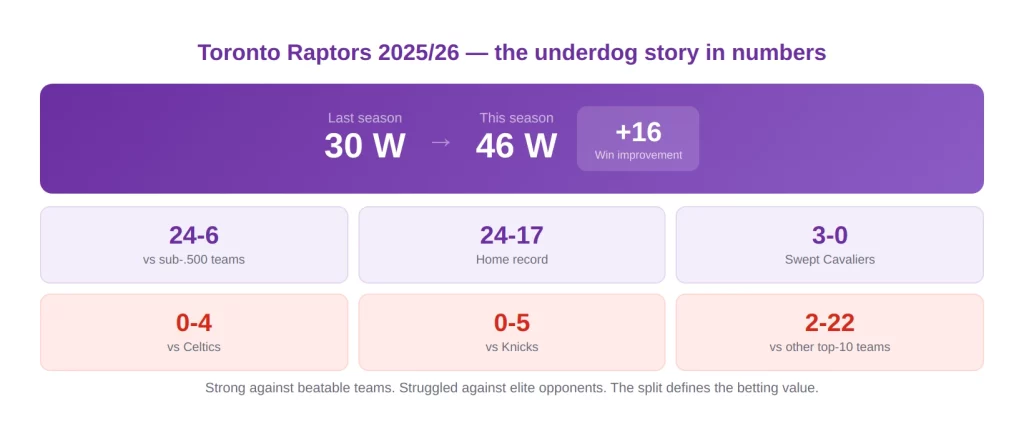
Raptors Preseason Expectations vs Reality
Before the season, the Raptors looked like a team in transition. They had won only 30 games the year before. Scottie Barnes was still developing. Brandon Ingram had not yet fully settled into the team. Immanuel Quickley and RJ Barrett had shown promise, but there were still questions over the core’s ability to work across a full season, as well as the roster’s shooting, scoring, and overall star power.
Season projections had Toronto finishing outside the top six in the East. Instead, the Raptors improved by 16 wins and secured a playoff place.
Toronto also took care of the teams they were supposed to beat. The Raptors went 24-6 against teams at .500 or below, which helped turn a fringe play-in projection into a playoff season.
Barnes became the team’s leader. Quickley took a bigger role in the backcourt. Barrett gave the Raptors another reliable scorer, while Jakob Poeltl and Brandon Ingram added depth.
The betting market did not fully react for much of the season. Toronto kept entering games as underdogs even when they were clearly competitive, which left the odds slightly in their favour.
Why the Raptors Were a Valuable Underdog in the Regular Season
The Toronto Raptors were a strong underdog team because they had more players who could make a difference than most people thought. Bettors tend to prefer bigger names, which regularly pushed Toronto into the underdog role against stronger opponents.
Toronto still reached the playoffs and swept the Cleveland Cavaliers 3-0 in the regular-season series. The Raptors also proved tougher to beat than many expected and consistently outperformed teams that entered the season with similar expectations.
Toronto had several players who could swing a game:
- Scottie Barnes could score, rebound, defend, and create for others.
- Immanuel Quickley gave the team pace and outside shooting.
- RJ Barrett attacked the basket and got to the free-throw line.
- Brandon Ingram created shots late in games.
- Jakob Poeltl gave Toronto a physical presence inside.
The team did not rely on one player carrying the offence every night. If one player struggled, somebody else stepped up.
Toronto also worked better as a spread bet than a moneyline bet because they regularly stayed close enough to cover the spread, even when they did not win outright.
Why Were Bettors Cautious When Betting on the Raptors?
The Raptors looked far less attractive when the schedule, injuries, or matchups worked against them, so bettors had good reasons to be cautious.
Inconsistent Results
The biggest issue was consistency. The Toronto Raptors could beat a strong team one night and struggle against a weaker one a few days later.
Toronto swept the Cleveland Cavaliers during the regular season, yet also lost twice to the Charlotte Hornets and dropped a game to the Washington Wizards. That made the Raptors difficult to trust from one game to the next.
Toronto also looked less convincing away from home. The Raptors finished 24-17 at home and 22-19 on the road, with the gap widening when they played on short rest or the second night of a back-to-back.
Injuries mattered as well. Toronto looked far more dangerous when Scottie Barnes, Immanuel Quickley, RJ Barrett, and Brandon Ingram were all available. If one of them missed the game, the Raptors became a much riskier underdog bet.
Lack of Elite Star Power
Toronto improved because several players took a step forward, but the team still lacked a genuine top-five NBA player.
Scottie Barnes became an All-Star and the leader of the team, yet he was not on the same level as Nikola Jokic, Luka Doncic, Shai Gilgeous-Alexander, or Jayson Tatum. In tight games, the difference was very clear.
The Raptors went 0-4 against the Boston Celtics and 0-5 against the New York Knicks. In several of those games, Toronto stayed close for long stretches before the other side pulled away late.
This was the risk with betting the Raptors against elite teams. Even if Toronto could cover the spread, winning outright became much harder when the opponent had the best player on the floor.
The Raptors were therefore harder to trust against teams such as the Los Angeles Lakers (0-2), Denver Nuggets (0-2), and Oklahoma City Thunder (1-1), where one superstar could decide the game in the final few minutes.
Best Situations to Bet the Raptors as Underdogs in the Playoff Series against the Cavaliers
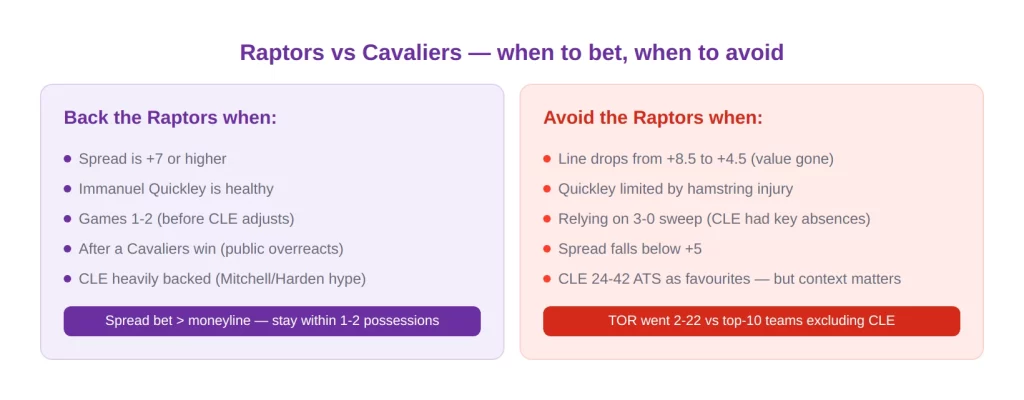
The best time to back the Toronto Raptors will be when the line climbs too high because of the excitement around the Cleveland Cavaliers.
Cleveland have opened Game 1 as an 8.5-point favourite despite losing all three regular-season meetings. The Cavaliers also had one of the worst records against the spread in the NBA when listed as favourites, going 24-42.
Toronto covered in all three games against Cleveland this season, including a 126-113 win as a 7.5-point underdog and a 112-101 win as a 4.5-point underdog in Cleveland.
The strongest spots to back Toronto will be:
- If the spread is +7 or higher
- If Immanuel Quickley is healthy and available
- In the first two games of the series, before Cleveland have fully adjusted to Toronto’s defence
- After a Cleveland win, the public may push the line too far towards the Cavaliers
- In any game where the Cavaliers are heavily backed because of Donovan Mitchell and James Harden
Toronto will likely be a better spread bet than a moneyline play. The Raptors will not need to win outright. They will only need to stay within one or two possessions.
Situations to Avoid
Avoid betting on the Toronto Raptors if the line has already moved sharply in their favour.
If Toronto open at +8.5 and drop to +4.5 before tip-off, much of the value will already be gone.
The Raptors will also become far less attractive if Immanuel Quickley is limited by his hamstring injury. Toronto need Quickley’s shooting and pace to punish Cleveland’s weak perimeter defence.
It will also be dangerous to rely too heavily on the 3-0 regular-season sweep. Cleveland did not have James Harden for any of those games, while Donovan Mitchell, Jarrett Allen, and Darius Garland all missed time.
Toronto also struggled against the league’s best teams. Excluding those three wins over Cleveland, the Raptors went just 2-22 against the NBA’s other top-10 teams. That’s why Toronto become a much riskier bet if the spread falls below +5.
Responsible Gambling
Betting should be entertainment, not a way to make money. Gambling can be addictive—only bet what you can afford to lose, and never chase your losses. Set deposit, loss, and time limits before you play, and take regular breaks.
If gambling stops being fun or starts affecting your finances, relationships, or wellbeing, seek help immediately.
Support available across Canada:
- Responsible Gambling Council: responsiblegambling.org (national resource centre)
- British Columbia: Call 1-888-795-6111 (24/7)
- Alberta: Call 1-866-332-2322 (24/7)
- Quebec: Call 1-800-461-0140 (24/7, bilingual)
- Saskatchewan: Call 1-800-306-6789 (24/7)
- Manitoba: Call 1-800-463-1554 (24/7)
- Atlantic provinces: Call 1-800-461-1234 (NB), 1-888-429-8167 (NS), 1-855-255-4255 (PE), 1-888-899-4357 (NL)
- Additional support: Gambling Therapy (gamblingtherapy.org), Gamblers Anonymous (gamblersanonymous.org)
- 988 Suicide Crisis Helpline: Call or text 988
TonyBet provides responsible gambling tools in your account settings, including deposit limits, loss limits, time limits, cool-off periods, and self-exclusion. Use them.
Age restrictions: You must be 19 or older to gamble in British Columbia, Saskatchewan, and Atlantic provinces. You must be 18 or older in Alberta, Manitoba, and Quebec. Underage gambling is illegal.
For more information about responsible gambling practices and support resources, visit the Responsible Gambling section on TonyBet.

FAQs
When are the Raptors the best underdog bet?
Do the Raptors perform better at home or on the road for betting?
Which Raptors players influence betting outcomes the most?
What betting markets work best for Raptors games?


